IELTS Speaking Part 1: Holidays Questions & Band 9 Answers (2026)
Use our AI tools to get personalized Band 9 answers and vocabulary lists to talk about holidays, festivals, and celebrations.
Start Practicing →Holidays are a favorite topic for examiners. They might ask about your country's national days, religious festivals, or what you do on your days off. To score Band 9, avoid saying "I eat good food." Instead, use words like commemorate, festive spirit, family reunion, or traditional delicacy to describe your celebrations.
How to Use These Sample Answers
Below are the latest 2026 questions for "Holidays."
Important: These answers are for a person from Bangladesh. They talk about Eid, visiting their village home, and eating delicious spicy food and sweets. But if you are from Vietnam, China, or South Korea and celebrate the Lunar New Year, these answers are probably not for you.
So, here is the plan:
Read these samples to understand the Band 9 structure.
Use the IELTS Speaking Lab App to get personalized answers. It gives you perfect vocabulary that fits your real life—whether you celebrate Christmas, Diwali, or Tet.
Part 1: Questions & Model Answers about Holidays
1. What is the most important holiday in your country?
Without a doubt, it is Eid-ul-Fitr. It marks the end of Ramadan, the holy month of fasting. It is a massive nationwide celebration where everyone goes back to their hometowns to be with their families. The festive spirit is truly contagious.
2. How do you usually celebrate this holiday?
The day starts with a special morning prayer. After that, we embrace each other and say "Eid Mubarak." The rest of the day is spent hopping from house to house, visiting relatives and gorging on traditional delicacies. It is all about communal harmony and joy.
3. Do you like public holidays?
Yes, absolutely. They are a much-needed respite from the daily grind. In my country, we work very long hours, so having a day off to recharge and spend quality time with friends is essential for my mental well-being.
4. What do you usually do on your days off?
I usually take it easy. I might pursue one of my hobbies like reading or gardening. If the weather is nice, I might go for a short trip to the countryside to enjoy nature and get some fresh air.
5. Do you prefer active holidays or relaxing holidays?
I definitely prefer relaxing ones. My life is quite hectic, so when I have time off, I want to do absolutely nothing. I prefer a staycation where I can sleep in, watch movies, and just unwind without any schedule or pressure.
6. Is there a holiday you dislike?
Not really, but sometimes the commercialization of certain days like Valentine's Day bothers me. It feels like companies just want you to spend money rather than genuinely celebrate love. It can feel a bit artificial and forced.
7. Do you eat special food during holidays?
Oh, yes. Food is the centerpiece of any Bangladeshi celebration. On Eid, we eat a rich meat dish called "Biryani" and lots of milky desserts like "Semai." The aroma of spices fills every house. It is a time of pure culinary indulgence.
8. Do people in your country wear special clothes on holidays?
Yes, we do. It is customary to buy new clothes for Eid. Men usually wear a "Panjabi," which is a long traditional tunic, and women wear colorful "Sarees" or "Salwar Kameez." dressing up in vibrant attire adds to the celebratory mood.
9. Did you enjoy holidays more when you were a child?
Definitely. As a child, holidays meant no school and getting "Salami"—gift money from elders. I had zero responsibilities and could just play all day. Now, as an adult, holidays often involve a lot of social obligations and hosting duties.
10. What is the longest holiday in your country?
The Eid holidays are usually the longest, lasting about three to four days. However, if they fall near a weekend, people often take extra leave to create a long weekend and go on an extended travel trip to the beach or mountains.
11. Do you think holidays are important for families?
Crucially important. In our modern busy lives, families often drift apart. Holidays serve as a catalyst for bringing everyone together. It is a time for family reunions, resolving old conflicts, and strengthening bonds over shared meals.
12. Are there any festivals in your country that celebrate a season?
Yes, we celebrate "Pohela Boishakh," which is the Bengali New Year and marks the start of summer. It is a secular festival celebrated by people of all religions. We have colorful parades called "Mongol Shobhajatra" and listen to traditional folk music.
13. Do you exchange gifts during holidays?
It depends on the occasion. On Eid, we usually give money to children rather than wrapped gifts. However, on birthdays or weddings, giving physical gifts is customary. It is a gesture of love and goodwill.
14. Do you decorate your house for holidays?
Yes, for big festivals we do. We might hang string lights on the balcony or clean the house from top to bottom. A clean and decorated home is believed to welcome prosperity and good luck for the coming year.
15. How do you feel when a holiday is over?
I usually feel a mix of satisfaction and the "post-holiday blues." It is hard to go back to the routine after days of fun and freedom. I often feel a bit lethargic on the first day back at work.
16. Is it important to preserve traditional festivals?
Absolutely. Festivals are the custodians of our culture and history. If we stop celebrating them, we lose a part of our identity. They teach the younger generation about our heritage and values, keeping our traditions alive.
17. Do you like to travel during public holidays?
I try to avoid it if possible. The roads and transport systems get overcrowded with people rushing home. It can be a logistical nightmare. I prefer to travel during the off-peak season when it is quieter and cheaper.
18. What is a national day in your country?
Our Independence Day is on March 26th. It is a very solemn and patriotic day. We remember the martyrs who sacrificed their lives for our country. There are parades, and national flags are hoisted everywhere to show our patriotism.
19. Do schools have long holidays in your country?
Yes, students usually get a long summer break and another break at the end of the year. It allows them to decompress after exams. Many families use this time to visit their ancestral homes in the villages.
20. If you could create a new holiday, what would it be?
I would create a "Digital Detox Day." A day where the internet is turned off, and everyone has to put down their phones. It would force people to interact face-to-face and reconnect with the real world without digital distractions.
Key Vocabulary for IELTS Topic: Holidays
Here is the complete glossary of every bolded word and phrase used in the answers above.
Ancestral homes: The family home in a village where your parents or grandparents came from.
Artificial: Not real or sincere; fake.
Catalyst: Something that causes a change or event to happen.
Commercialization: The process of managing something principally for financial gain (making it all about money).
Commemorate: To show respect for someone or something in a ceremony.
Communal harmony: Different groups of people living together in peace.
Culinary indulgence: Eating a lot of delicious, rich food.
Customary: According to the customs or usual practices associated with a particular society.
Custodians: People who take care of or protect something (like culture).
Decompress: To relax and reduce stress.
Distractions: Things that prevent you from giving full attention to something else.
Eid-ul-Fitr: An important Islamic festival marking the end of Ramadan.
Family reunions: Occasions when many members of an extended family get together.
Festive spirit: The happy, excited feeling people have during a holiday.
Goodwill: Friendly, helpful, or cooperative feelings or attitude.
Heritage: Valued objects and qualities such as cultural traditions that have been passed down from previous generations.
Lethargic: Feeling a lack of energy and enthusiasm.
Long weekend: A weekend that is at least three days long due to a public holiday.
Nationwide celebration: A party or festival observed by the whole country.
Off-peak season: The time of year when travel is less popular and cheaper.
Patriotism: Devotion to and vigorous support for one's country.
Post-holiday blues: A feeling of sadness when you have to return to work/school after a holiday.
Prosperity: The state of being successful and having a lot of money.
Respite: A short period of rest or relief from something difficult or unpleasant.
Secular festival: A celebration that is not connected to religion.
Social obligations: Things you feel you must do for other people (like visiting relatives).
Solemn: Formal and dignified; serious.
Staycation: A holiday spent in one's home country or at home rather than abroad.
Traditional delicacies: Special, high-quality foods that have been eaten for a long time in a culture.
Unwind: To relax after a period of work or tension.
Vibrant attire: Bright, colorful, and lively clothing.
Create Your Own Band 9 Answers
The answers above are perfect—if you are from Bangladesh. But what if you are from Vietnam, China, or Brazil?
Your answers need to be true so that you can easily recall them during a stressful exam.
IELTS Speaking Lab helps you turn your real ideas into Band 9 answers.
Select your topic - Holidays.
Input your rough idea (e.g., "I celebrate the Lunar New Year with red envelopes and dragon dances").
Get personalized Band 9 answers instantly, with the perfect vocabulary for your story.
Not happy with these answers?
Change the core idea, band level difficulty, length and get a full glossary in our free app!
Start Practicing →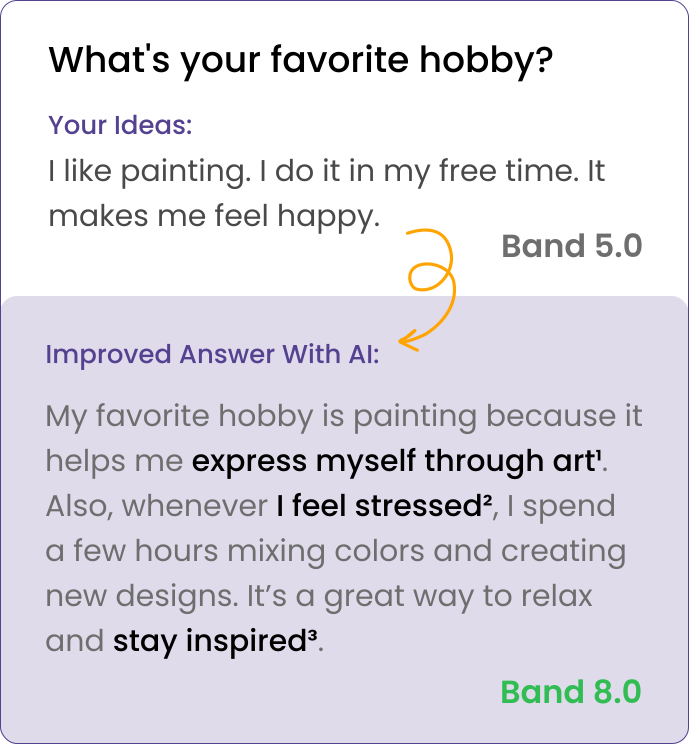
Practice IELTS Speaking answers in our free app
- Build personalized answers that match your target band.
- Turn short replies into fluent answers
- Let examiners fall in love with your answers!
Related Articles
Sample Answers
IELTS Speaking Part 1: Concentration Questions & Answers (Sep-Dec 2026)
Latest Sep-Dec 2026 IELTS Speaking Part 1 questions for Concentration. Read Band 9 sample answers, or use our AI app to turn your own ideas into perfect answers.
Sample Answers
IELTS Speaking Part 1: Jewelry Questions & Band 9 Answers (2026)
Latest Sep-Dec 2026 IELTS Speaking Part 1 questions for Jewelry. Read Band 9 sample answers or generate personal answers using our AI.
Sample Answers
IELTS Speaking Part 1: Colors Questions & Answers (Sep-Dec 2026)
Latest Sep-Dec 2026 IELTS Speaking Part 1 questions for Colors. Read Band 9 sample answers, or use our AI app to turn your own ideas into perfect answers.