IELTS Speaking Part 1: Music Questions & Band 9 Answers (2026)
Latest Sep-Dec 2026 IELTS Speaking Part 1 questions for Music. Read Band 9 sample answers or generate personal answers using our AI.
Start Practicing →Music just hit the official IELTS question list for Sep-Dec 2026. Examiners want to hear about your personal taste, instruments you play, or how music affects your mood. Use words like eclectic taste, soothing, or nostalgic to show depth.
Latest Sep-Dec 2026: Music Questions & Sample Answers
1. Do you like music?
Yes, I have a very eclectic taste. I grew up listening to Western classical masterpieces, which I still love, but recently I’ve really gotten into American Indie folk. I listen to music almost every day to help me manage my mood.
2. What is your favorite type of music?
It depends on what I am doing. If I am focusing on my studies, I prefer instrumental classical music because it helps me concentrate. But if I want to relax at home, I listen to acoustic Indie tracks because the lyrics are usually very meaningful and the melody is soothing.
3. Can you play any musical instruments?
Yes, I play the piano. In my culture, and specifically in my family, it is very common for parents to force their children to learn an instrument. I used to hate the strict piano lessons, but now I am grateful because it gave me a great appreciation for music.
4. Do you prefer listening to live music or recorded music?
I definitely prefer recorded music. I find large concerts too loud and chaotic. I prefer to put on my high-quality headphones and enjoy the crisp sound of a studio recording. It feels more intimate and private.
5. Have you ever been to a concert?
I have been to a few, but usually small recitals or jazz clubs rather than big stadiums. Last year, I went to a small venue in my hometown to see a local orchestra. It was a mesmerizing experience to see the musicians' skill up close.
6. Do you listen to music while you work?
Always. It helps me block out distracting noises at work. However, I cannot listen to songs with words while I am working because I find the lyrics distracting. I usually choose a symphony or some ambient electronic music.
7. How do you listen to music?
I rely entirely on modern technology. I use streaming apps on my phone. I have curated several playlists for different moods—one for focus, one for sleep, and one for commuting.
8. Is music a popular hobby in your country?
Yes, very much so. Many people view singing or playing instruments as one of their main hobbies. In my country, traditional music is still very popular at weddings, but the younger generation prefers mainstream Western pop or Hip Hop.
9. Can you sing?
Absolutely not! I am completely tone-deaf. I only sing in the shower where no one can hear me. If I tried to sing in public, it would be quite embarrassing for everyone involved.
10. Do you think music is good for your health?
Definitely. I think it is essential for mental health. Listening to a calm piece of music lowers my stress levels instantly. It is a form of therapy for me when I am feeling anxious or overwhelmed.
11. What kind of music do you dislike?
I really cannot stand loud Electronic Dance Music (EDM) or Heavy Metal. To me, it just sounds like noise. It gives me a headache and makes me feel agitated rather than relaxed. I prefer music that has a clear melody.
12. Do your friends like the same music as you?
Not really. Most of my friends prefer upbeat pop music or whatever is currently on the charts. When we drive together, we usually compromise and listen to the radio, but I often find their taste a bit too commercial for me.
13. Do you think children should learn an instrument?
Yes, I think it is a valuable skill. Even though I found it difficult as a child, learning to read sheet music taught me discipline and patience. It is a form of cognitive training that helps with other subjects like math.
14. Do you listen to music when you eat?
Yes, especially if I am having a nice meal. I think soft jazz or classical music enhances the dining experience and makes the food taste better. It creates a sophisticated atmosphere.
15. Has your taste in music changed over the years?
Drastically. As a teenager, I only wanted to listen to what was "cool." Now, I don't care about trends. I look for music that has artistic value or emotional depth. I have become a bit of a music snob in my old age!
Key Vocabulary for IELTS Topic: Music
Acoustic: Music played without electric instruments (e.g., just a guitar and voice).
Agitated: Feeling troubled, nervous, or unable to relax.
Ambient electronic music: Quiet, relaxing electronic music with no strong beat or lyrics.
Appreciation: Recognition and enjoyment of the good qualities of someone or something.
Artistic value: The importance of something as a piece of art, rather than just a product.
Block out distracting noises: To use sound (like music) to stop you from hearing other annoying sounds.
Chaotic: In a state of complete confusion and disorder (too messy/loud).
Classical masterpieces: Famous and excellent pieces of classical music (e.g., by Mozart or Beethoven).
Cognitive training: Exercises that help improve brain function and learning.
Commercial: Produced mainly to make money; often implying it lacks quality or soul.
Compromise: An agreement reached by each side giving up some of what they wanted.
Concentrate: To focus all one's attention on a particular activity.
Crisp sound: Audio that is very clear and high quality.
Curated: Carefully chosen and organized.
Discipline and patience: The ability to work hard and wait for results without getting angry.
Eclectic taste: Liking many different styles or types of things.
Electronic Dance Music (EDM): A broad range of percussive electronic music genres made largely for nightclubs.
Emotional depth: The quality of having strong, complex, and meaningful feelings.
Enhances the dining experience: Makes eating a meal feel more special or enjoyable.
Force their children: To make children do something they might not want to do.
Form of therapy: A way to help heal or relax the mind (used metaphorically here).
Heavy Metal: A genre of rock music characterized by loud, aggressive sounds.
High-quality headphones: Expensive listening devices that produce great sound.
Indie folk: A genre of music that is independent (not major label) and uses acoustic instruments.
Instrumental: Music performed with instruments only; no singing.
Intimate: Private and personal; a close atmosphere.
Jazz clubs: Small venues specifically for playing jazz music.
Live music: Music performed in front of an audience, not recorded.
Lowers my stress levels: Makes you feel calmer and less worried.
Mainstream: The ideas, attitudes, or activities that are regarded as normal or conventional (popular).
Manage my mood: To use something (like music) to control how you feel.
Meaningful: Having a serious, important, or useful quality or purpose.
Melody: A sequence of single notes that is musically satisfying (the tune).
Mental health: A person’s condition with regard to their psychological and emotional well-being.
Mesmerizing experience: Something so impressive that it holds your attention completely.
Music snob: Someone who believes their taste in music is superior to others.
Noise: Sound, especially one that is loud or unpleasant or that causes disturbance.
On the charts: Currently very popular and selling well (top 40).
Piano lessons: Classes where a teacher instructs a student how to play the piano.
Playlists: Lists of digital audio files to be played on a computer or mobile device.
Recitals: Small performances of music, often given by a soloist or small group.
Recorded music: Music that has been stored on a medium (like a CD or file) to be listened to later.
Sheet music: Musical notes written or printed on paper.
Skill: The ability to do something well.
Sophisticated atmosphere: A feeling of class, culture, and high quality in a room.
Soothing: Having a gently calming effect.
Streaming apps: Applications like Spotify or Apple Music used to listen to music online.
Strict: Demanding that rules concerning behavior are obeyed and observed.
Studio recording: Music recorded in a professional soundproof room (very clean sound).
Symphony: An elaborate musical composition for a full orchestra.
Tone-deaf: Unable to perceive differences of musical pitch (cannot sing in tune).
Traditional music: Folk music that has been played in a culture for a long time.
Trends: A general direction in which something is developing or changing (fashions).
Upbeat: Cheerful and optimistic (fast tempo).
Valuable skill: An ability that is useful and important to have.
Venue: The place where something happens, especially an organized event like a concert.
Western classical: Art music produced or rooted in the traditions of Western culture (Europe).
Create Your Own Band 9 Answers
IELTS Speaking Lab helps you turn your real ideas into Band 9 answers.
Select your topic/question - Music/What is your favorite type of music?
Input your rough idea - "I love K-pop."
Get a personalized Band 9 answer instantly, with the perfect vocabulary for your story.
Not happy with these answers?
Change the core idea, band level difficulty, length and get a full glossary in our free app!
Start Practicing →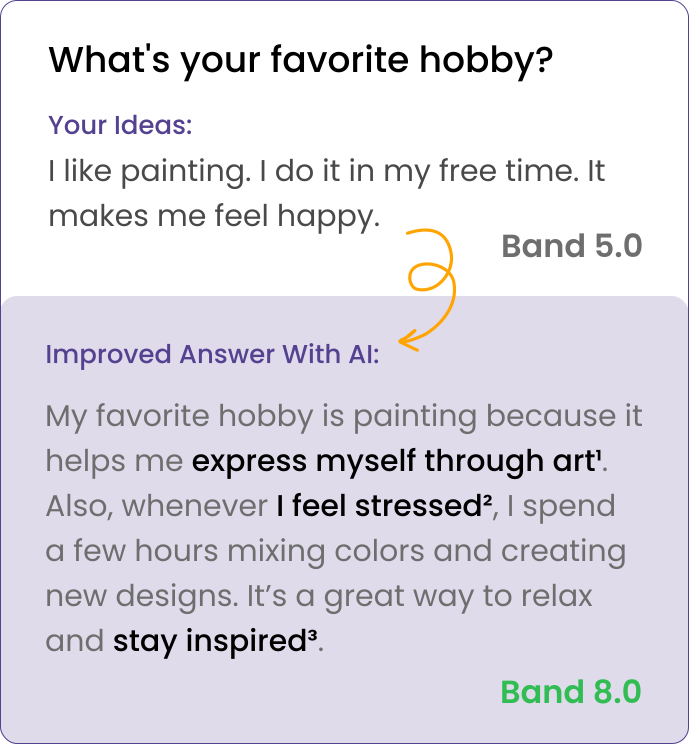
Practice IELTS Speaking answers in our free app
- Build personalized answers that match your target band.
- Turn short replies into fluent answers
- Let examiners fall in love with your answers!
Related Articles
Sample Answers
IELTS Speaking Part 1: Concentration Questions & Answers (Sep-Dec 2026)
Latest Sep-Dec 2026 IELTS Speaking Part 1 questions for Concentration. Read Band 9 sample answers, or use our AI app to turn your own ideas into perfect answers.
Sample Answers
IELTS Speaking Part 1: Jewelry Questions & Band 9 Answers (2026)
Latest Sep-Dec 2026 IELTS Speaking Part 1 questions for Jewelry. Read Band 9 sample answers or generate personal answers using our AI.
Sample Answers
IELTS Speaking Part 1: Colors Questions & Answers (Sep-Dec 2026)
Latest Sep-Dec 2026 IELTS Speaking Part 1 questions for Colors. Read Band 9 sample answers, or use our AI app to turn your own ideas into perfect answers.