Describe a Difficult Decision: Part 2 Cue Card (2026)
Use our AI to get a personalized Band 9 answer and vocabulary for the IELTS Speaking Part 2 Cue Card "Describe a difficult decision you made".
Start Practicing →The "Describe a difficult decision you made" is one of the most popular 2026 Cue Cards in the Past Events category. To achieve Band 7+, you must avoid simply stating what you did. Instead, you should focus on the internal conflict, the options you weighed, and the consequences associated with this choice using vocabulary like dilemma, crossroads, and life-altering.
How to Use This Sample Answer
Below is a sample answer for an ambitious professional who decided to quit a secure job to study abroad. If this matches your experience, great. But what if your difficult decision was about changing your university major? Or moving to a different city away from your parents?
So here is the plan:
Read this sample answer to understand the structure of a Band 7+ answer.
Use the IELTS Speaking Lab App to instantly generate your own personal answer to this Cue Card with perfect vocabulary that describes your specific difficult decision.
Part 2 Cue Card and Sample Answer
Describe a difficult decision you made. You should say:
What the decision was
When you made it
How long it took you to make it
And explain why it was difficult to make.
Band 9 Sample Answer
Answer: I want to talk about a time I reached a major crossroads in my life: deciding whether to stay in a secure, well-paying position in my hometown or move abroad to pursue a master's degree. This happened about two years ago, right when I was actually up for a promotion at my company.
Add detail: I had been employed at a local tech firm, and my career was on a steady, comfortable trajectory. However, I had always dreamed of experiencing life internationally. The dilemma was agonizing. On one hand, I had a guaranteed salary and the comfort of my family nearby to support me. On the other hand, leaving meant stepping into the unknown, facing intense financial pressure, and abandoning my work security for a highly demanding academic venture in a foreign country.
Anecdote: I spent weeks agonizing over the options. I vividly remember sitting at my kitchen table one evening, staring blankly at a detailed pro-and-con list I had written out. I was so stressed by the indecision that I couldn't even sleep properly. I finally called my university mentor for advice, and she simply told me that "comfort is the enemy of growth." That single sentence was the exact wake-up call I needed.
Explain: Ultimately, I decided to take the leap and submit my study application. It was an incredibly daunting choice to make, and saying goodbye to everything familiar was heartbreaking. Nevertheless, I felt a massive sense of relief once the decision was finalized. Looking back, it was a completely life-altering move that pushed me out of my comfort zone, forcing me to become more independent, resourceful, and resilient.
This answer uses the AAAE Strategy (Answer, Add detail, Anecdote, Explain).
Part 3 Questions and Sample Answers
After you finish your Cue Card, the examiner will ask you deeper questions related to choices and decision-making.
1. What everyday decisions do people generally make? Most daily choices are quite trivial and habitual. People decide what to eat, what clothes to wear, and which route to take to the office. While these seem minor, the sheer volume of them can lead to decision fatigue by the end of the day, which is why many successful people prefer to establish strict morning routines to save mental energy.
2. Why do some people find it so hard to make decisions? I believe the primary reason is the fear of failure or regret. People often over-analyze the potential negative outcomes, leading to analysis paralysis. Furthermore, we live in an age of information overload. Having endless options for everything makes it incredibly difficult to commit to just one path, as people constantly fear missing out on something better.
3. How can people improve their decision-making skills? One effective method is to consult with impartial individuals who can offer an objective perspective, rather than relying solely on emotions. Additionally, creating structured frameworks, such as cost-benefit analyses, can help break down an overwhelming choice into logical steps. Ultimately, it also requires accepting that no decision is flawless and that making a wrong choice is often better than making no choice at all.
4. Do you think adults always make better decisions than children? Generally, yes, because adults possess more life experience and better cognitive development, allowing them to foresee long-term consequences. However, adults can sometimes be overly cautious or blinded by their past traumas. Children, on the other hand, often make decisions based on pure intuition and curiosity, which can occasionally lead to more creative and unconventional outcomes.
Key Vocabulary for IELTS Cue Card: Difficult Decision
Here is the complete glossary of the vocabulary used in the answers above, plus extra high-level words relevant to this topic.
Abandoning: (Verb) Ceasing to support or look after something; giving up completely.
Agonizing over: (Phrasal Verb) To spend a long time worrying and thinking about a difficult situation or choice.
Analysis paralysis: (Noun Phrase) A situation where overthinking a problem causes an individual or group to be unable to make a decision.
Cognitive development: (Noun Phrase) The construction of thought processes, including remembering, problem-solving, and decision-making.
Crossroads: (Noun) A point at which a crucial decision must be made that will have far-reaching consequences.
Daunting: (Adjective) Seeming difficult to deal with in anticipation; intimidating.
Decision fatigue: (Noun Phrase) The deteriorating quality of decisions made by an individual after a long session of decision-making.
Dilemma: (Noun) A situation in which a difficult choice has to be made between two or more alternatives, especially equally undesirable ones.
Guaranteed salary: (Noun Phrase) A fixed, regular payment that is certain and not dependent on performance or external factors.
Impartial: (Adjective) Treating all rivals or disputants equally; fair and just.
Life-altering: (Adjective) Having a significant and permanent effect on someone's life.
Overwhelming: (Adjective) Very great in amount; a feeling of being defeated by something too strong to handle.
Pro-and-con list: (Noun Phrase) A list of arguments for and against a particular decision.
Pursue a master's degree: (Phrase) To follow or seek to achieve advanced academic study at a postgraduate level.
Trajectory: (Noun) The path followed by a process, development, or person's career over time.
Trivial: (Adjective) Of little value or importance.
Unconventional: (Adjective) Not based on or conforming to what is generally done or believed.
Wake-up call: (Noun Phrase) Something that happens and serves as a warning that action must be taken.
Well-paying position: (Noun Phrase) A job or role that provides a high or satisfactory monetary compensation.
Create Your Own Band 9 Answers
The answer above is perfect—if you actually quit a job to study abroad. But what if your difficult decision was about ending a long-term relationship? Or starting your own business?
Your answers need to be true so that you can easily recall them during a stressful exam.
IELTS Speaking Lab helps you turn your real ideas into Band 9 answers.
Select your cue card - Describe a difficult decision you made.
Input your rough idea (e.g., "I had to choose between two different universities").
Get personalized Band 9 answer instantly, with the perfect vocabulary for your story.
Not happy with these answers?
Change the core idea, band level difficulty, length and get a full glossary in our free app!
Start Practicing →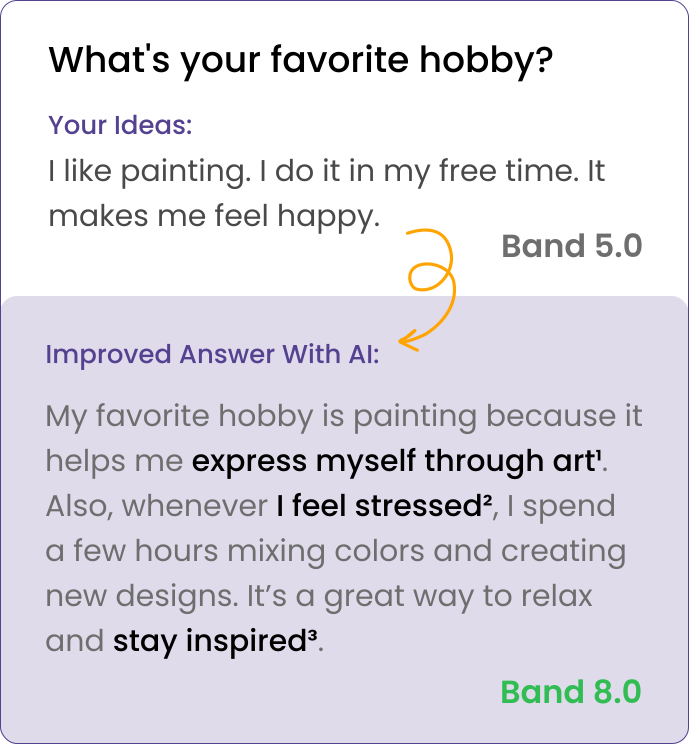
Practice IELTS Speaking answers in our free app
- Build personalized answers that match your target band.
- Turn short replies into fluent answers
- Let examiners fall in love with your answers!
Related Articles
Sample Answers
IELTS Speaking Part 1: Concentration Questions & Answers (Sep-Dec 2026)
Latest Sep-Dec 2026 IELTS Speaking Part 1 questions for Concentration. Read Band 9 sample answers, or use our AI app to turn your own ideas into perfect answers.
Sample Answers
IELTS Speaking Part 1: Jewelry Questions & Band 9 Answers (2026)
Latest Sep-Dec 2026 IELTS Speaking Part 1 questions for Jewelry. Read Band 9 sample answers or generate personal answers using our AI.
Sample Answers
IELTS Speaking Part 1: Colors Questions & Answers (Sep-Dec 2026)
Latest Sep-Dec 2026 IELTS Speaking Part 1 questions for Colors. Read Band 9 sample answers, or use our AI app to turn your own ideas into perfect answers.