IELTS Speaking Part 1: Keys Questions & Band 9 Answers (2026)
Use our AI tools to get personalized Band 9 answers and vocabulary to talk about security, losing things, and digital locks.
Start Practicing →Keys is a surprising but common topic. The examiner might ask if you lose them often, or if you think electronic locks are better. To score Band 9, avoid saying "I have a key for my house." Instead, use words like misplace, duplicate, cumbersome, or biometric to describe your habits.
How to Use These Sample Answers
Below are the latest 2026 questions for "Keys."
Important: These answers are for a person who is very organized and careful. They always put their keys in the same place when they get home. They hate carrying heavy things in their pockets, so they only carry the keys they really need.
But if you are a person who loses things every week, or if you use a fingerprint or code to open your door instead of a metal key, these answers are probably not for you.
So, here is the plan:
Read these samples to understand the Band 9 structure.
Use the IELTS Speaking Lab App to get personalized answers. It gives you perfect vocabulary that fits your real life.
IELTS Speaking Part 1 Questions & Model Answers about Keys (2026)
1. Do you always bring keys with you?
Yes, absolutely. It is an essential part of my daily routine. Before I leave the house, I always do a "pocket check" to ensure I have my wallet, phone, and keys. I would never leave without them because I am terrified of being locked out.
2. Have you ever lost your keys?
Thankfully, no. I am extremely conscientious about where I put them. I know that losing a key is a major security risk and replacing the locks can be very expensive. So, I treat them with great care.
3. Do you often forget the keys and lock yourself out?
Never. As I mentioned, I am very organized. I have a designated spot by the door where I place my keys the moment I walk inside. This habit ensures that I always know exactly where they are.
4. Do you think it's a good idea to leave your keys with a neighbor?
It depends on the relationship. If you trust your neighbors implicitly, then yes, it is a sensible precaution. It can save you the cost of calling a locksmith in an emergency. However, I personally prefer to give a spare key to a family member instead.
5. How many keys do you have on your keyring?
I try to keep it minimalist. I only carry the essentials: my front door key, my car key, and my office key. I find large bunches of keys to be cumbersome and noisy, and they ruin the shape of my pockets.
6. Do you keep a spare key?
Yes, definitely. I keep a duplicate set at my parents' house just in case of an emergency. I think it is irresponsible not to have a backup plan. Relying on just one set is a recipe for disaster.
7. What would you do if you lost your keys?
I would probably panic initially! But practically speaking, I would retrace my steps to try and find them. If they were truly gone, I would immediately call my landlord to change the locks to prevent any potential break-in.
8. Do you carry a lot of keys?
No, I dislike the clutter. Some people carry keys for houses they lived in ten years ago, which I find baffling. I regularly declutter my keychain to ensure I am only carrying what is strictly necessary for my current life.
9. Have you ever found someone else's keys?
Yes, once I found a set on a park bench. I handed them into the local police station. I know how stressful it is to misplace something important, so I wanted to make sure they had the best chance of being reunited with their owner.
10. Do you think electronic locks will replace traditional keys?
Eventually, yes. Digital locks and biometric systems, like fingerprint scanners, are becoming much more common. They offer more convenience because you don't have to carry a physical object. However, I still trust the reliability of a traditional metal key over technology that might run out of battery.
11. Where do you keep your keys at home?
I have a small decorative bowl on the hallway table. It is the first thing I see when I enter the house. placing them there has become a muscle memory for me. If I didn't have a specific place for them, I would spend hours looking for them every morning.
12. Do you have a keychain?
Yes, I have a simple leather fob. It was a gift from a friend. I think a keychain is important because it adds a bit of weight and bulk, making the keys harder to lose and easier to fish out of a bag. It also adds a touch of personalization.
13. Is it safe to hide a key outside your house?
I don't think so. Hiding a key under the doormat or a flower pot is a cliché. Burglars know all the common hiding spots. It effectively invites intruders into your home. It is much safer to leave a key with a trusted person.
Key Vocabulary for IELTS Topic: Keys
Here is the complete glossary of every bolded word and phrase used in the answers above.
Biometric: Using unique physical characteristics (like fingerprints) for identification.
Break-in: An illegal entry into a building to commit a crime.
Cliché: A phrase or opinion that is overused and betrays a lack of original thought.
Clutter: A collection of things lying about in an untidy state.
Conscientious: Wishing to do one's work or duty well and thoroughly.
Cumbersome: Large or heavy and therefore difficult to carry or use.
Declutter: To remove unnecessary items from an untidy or overcrowded place.
Designated spot: A specific place chosen for a particular purpose.
Duplicate: A copy of something (like a second key).
Locked out: To be unable to enter a building because you do not have the key.
Locksmith: A person who makes and repairs locks.
Minimalist: A style or approach that uses the fewest possible elements.
Misplace: To put something in the wrong place and lose it temporarily.
Muscle memory: Doing something automatically without thinking because you have done it so many times.
Neighbors: People living near or next door to the speaker.
Personalization: The action of designing or producing something to meet someone's individual requirements.
Precaution: A measure taken in advance to prevent something dangerous or unpleasant.
Security risk: Something that could cause a loss of safety or protection.
Spare key: An extra key kept in case the main one is lost.
Create Your Own Band 9 Answers
The answers above are perfect—if you are an organized person who never loses things. But what if you lose your keys every week? Or what if you use a smart lock with a code?
Your answers need to be true so that you can easily recall them during a stressful exam.
IELTS Speaking Lab helps you turn your real ideas into Band 9 answers.
Select your topic - Keys.
Input your rough idea (e.g., "I use my fingerprint to open my door because I always lose metal keys").
Get personalized Band 9 answers instantly, with the perfect vocabulary for your story.
Not happy with these answers?
Change the core idea, band level difficulty, length and get a full glossary in our free app!
Start Practicing →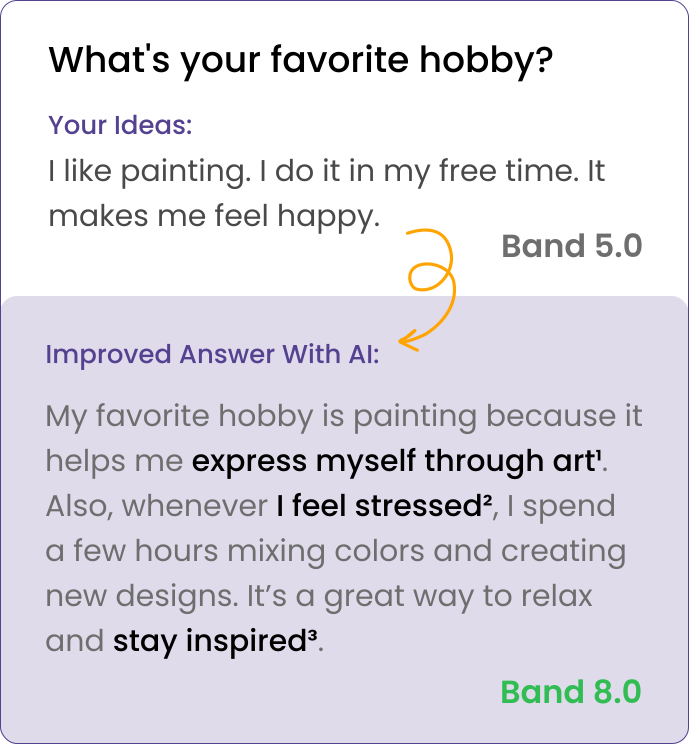
Practice IELTS Speaking answers in our free app
- Build personalized answers that match your target band.
- Turn short replies into fluent answers
- Let examiners fall in love with your answers!
Related Articles
Sample Answers
IELTS Speaking Part 1: Concentration Questions & Answers (Sep-Dec 2026)
Latest Sep-Dec 2026 IELTS Speaking Part 1 questions for Concentration. Read Band 9 sample answers, or use our AI app to turn your own ideas into perfect answers.
Sample Answers
IELTS Speaking Part 1: Jewelry Questions & Band 9 Answers (2026)
Latest Sep-Dec 2026 IELTS Speaking Part 1 questions for Jewelry. Read Band 9 sample answers or generate personal answers using our AI.
Sample Answers
IELTS Speaking Part 1: Colors Questions & Answers (Sep-Dec 2026)
Latest Sep-Dec 2026 IELTS Speaking Part 1 questions for Colors. Read Band 9 sample answers, or use our AI app to turn your own ideas into perfect answers.