IELTS Speaking Part 1: Daily Routine Questions & Band 9 Answers (2026)
Use our AI tools to get personalized Band 9 answers and vocabulary lists to talk about your morning and evening habits.
Start Practicing →Daily Routine is one of the most common topics in IELTS. The examiner will ask when you wake up, what you do in the mornings, or how you organize your day. To score Band 9, avoid saying "I wake up and brush my teeth." Instead, use words like early bird, kick-start my day, hectic, or unwind to describe your schedule.
How to Use These Sample Answers
Below are the latest 2026 questions for "Daily Routine."
Important: These answers are for a person who wakes up early and works in an office. They are very organized and like having a strict plan. But if you are a night owl who stays up late, or a freelancer who works from home in your pajamas, these answers are probably not for you.
So, here is the plan:
Read these samples to understand the Band 9 structure.
Use the IELTS Speaking Lab App to get personalized answers. It gives you perfect vocabulary that fits your real life—whether you love 5 AM runs or sleeping until noon.
Part 1: Questions & Model Answers about Daily Routine
1. What time do you usually wake up?
I am definitely an early bird. I usually wake up at the crack of dawn, around 5:30 AM. I love the peace and quiet of the morning before the rest of the world wakes up. It helps me prepare mentally for the day ahead.
2. Is your routine the same every day?
Yes, I am a creature of habit. I like to follow a structured schedule because it makes me feel productive and in control. Doing the same things at the same time minimizes stress and helps me stay organized.
3. What is the first thing you do in the morning?
The first thing I do is drink a large glass of water to hydrate. Then, I do some light stretching to kick-start my day. I try to avoid looking at my phone immediately because I don't want to get distracted by technology right away.
4. Do you have breakfast every day?
Absolutely. I believe it is the most important meal of the day. I usually have a hearty food like oatmeal or eggs to fuel my body. If I skip breakfast, I feel sluggish and can't focus on my tasks later on.
5. Do you prefer mornings or evenings?
I prefer mornings. My energy levels are at their peak before noon. By the time the evening comes, I am usually drained and just want to lie on the sofa. The morning feels full of possibility and potential.
6. What is the most difficult part of your daily routine?
The most challenging part is the daily commute. Sitting in traffic for an hour to get to my work is incredibly tedious. It feels like dead time that could be used for something better, but unfortunately, it is unavoidable.
7. Do you make a to-do list?
Yes, religiously. Every evening, I write down my priorities for the next day. It gives me a clear roadmap and ensures I don't forget anything important. For example, I always try to study new things. Crossing items off the list gives me a great sense of accomplishment.
8. Do you have a lot of free time during the week?
Not really. My weekdays are quite hectic and packed with meetings and deadlines. By the time I get home, cook, and clean, I only have a brief window of time to relax before bed.
9. What do you do to relax in the evening?
To unwind after a long day, I usually read a book or listen to a podcast. I try to engage in calming hobbies rather than staring at a screen. It helps me decompress and transition into sleep mode.
10. Do you ever change your routine?
I try not to, but sometimes life gets in the way. If I am traveling or if I have a social event, I have to be flexible. However, I always try to get back on track as soon as possible because a disrupted routine affects my mood.
11. Is your weekend routine different from your weekday routine?
Yes, drastically. On weekends, I allow myself to sleep in a bit later. I don't have a rigid schedule, so I can be more spontaneous. It is my time to recharge my batteries so I am ready for the coming week.
12. Do you think having a daily routine is important?
Yes, I think it is essential for success. Without a routine, it is easy to procrastinate and waste time. Discipline leads to freedom, and a good routine creates the structure needed to achieve long-term goals.
13. Did you have a strict routine when you were a child?
Yes, my parents were quite strict. I had a set bedtime and allocated hours for homework. At the time, I found it annoying, but in hindsight, I appreciate that it taught me the value of time management and discipline.
14. How do you maintain a work-life balance?
It is a struggle, but I try to set strict boundaries. I don't check work emails after 6 PM. I make sure to prioritize my health by going to the gym three times a week, no matter how busy I am.
15. If you could change one thing about your daily routine, what would it be?
I would love to incorporate more outdoor time. I spend too much time indoors under artificial lights. I wish I could fit in a morning walk in the park to get some fresh air and connect with nature.
16. Do you ever take naps?
Rarely. If I am absolutely exhausted, I might take a quick 20-minute power nap on the weekend. But generally, I avoid them because they make me feel groggy and interfere with my sleep at night.
17. Do you like to plan your day or go with the flow?
I definitely prefer to plan. Uncertainty makes me anxious. I like to know exactly what I am doing and when. Being organized allows me to handle unexpected problems much more effectively.
18. What time do you go to bed?
I try to be in bed by 10:30 PM. Getting a full eight hours of sleep is non-negotiable for me. I have a strict bedtime ritual that involves dimming the lights and drinking herbal tea to ensure I get a good night's rest.
19. Do you spend a lot of time on housework?
I try to do a little bit every day so it doesn't pile up. I believe a cluttered space leads to a cluttered mind. Keeping my environment tidy is part of my daily discipline.
20. Do you think people are busier now than in the past?
Yes, definitely. The pace of modern life is relentless. We are constantly connected and expected to be available 24/7. It is much harder to switch off and find moments of stillness compared to the past.
Key Vocabulary for IELTS Topic: Daily Routine
Here is the complete glossary of every bolded word and phrase used in the answers above.
Accomplishment: A feeling of achieving something successfully.
Bedtime ritual: A set of habits you do before sleeping to help you relax.
Crack of dawn: Very early in the morning when the sun rises.
Creature of habit: A person who likes to do the same things in the same way every day.
Daily commute: The journey to and from work every day.
Dead time: Time when you are doing nothing useful (like waiting or sitting in traffic).
Decompress: To relax and release stress/tension.
Discipline: The ability to control your behavior to follow rules or a schedule.
Drained: Very tired; having no energy left.
Early bird: A person who wakes up early and is energetic in the morning.
Fuel my body: To eat food to give you energy.
Groggy: Feeling weak, dizzy, or not fully awake (often after a nap).
Hectic: Full of incessant or frantic activity; very busy.
Hindsight: Understanding a situation only after it has happened.
Kick-start my day: To start the day with energy and purpose.
On track: Happening as planned; following the correct schedule.
Organized: Arranged in a systematic way; efficient.
Power nap: A short sleep (usually 20 mins) to get energy back quickly.
Priorities: The most important things that must be done first.
Procrastinate: To delay or postpone action; putting off doing something.
Productive: Producing or achieving a lot of results.
Recharge my batteries: To rest and get your energy back.
Sleep in: To sleep later than usual (usually on weekends).
Sluggish: Lacking energy or alertness; moving slowly.
Stillness: Absence of movement or sound; deep calm.
Time management: The ability to use one's time effectively or productively.
Unwind: To relax after a period of work or tension.
Work-life balance: The division of one's time and focus between working and family/leisure activities.
Create Your Own Band 9 Answers
The answers above are perfect—if you are an early riser who loves structure. But what if you are a night owl? Or what if you are a freelancer who works from home?
Your answers need to be true so that you can easily recall them during a stressful exam.
IELTS Speaking Lab helps you turn your real ideas into Band 9 answers.
Select your topic - Daily Routine.
Input your rough idea (e.g., "I work at night and sleep until 11 AM").
Get personalized Band 9 answers instantly, with the perfect vocabulary for your story.
Not happy with these answers?
Change the core idea, band level difficulty, length and get a full glossary in our free app!
Start Practicing →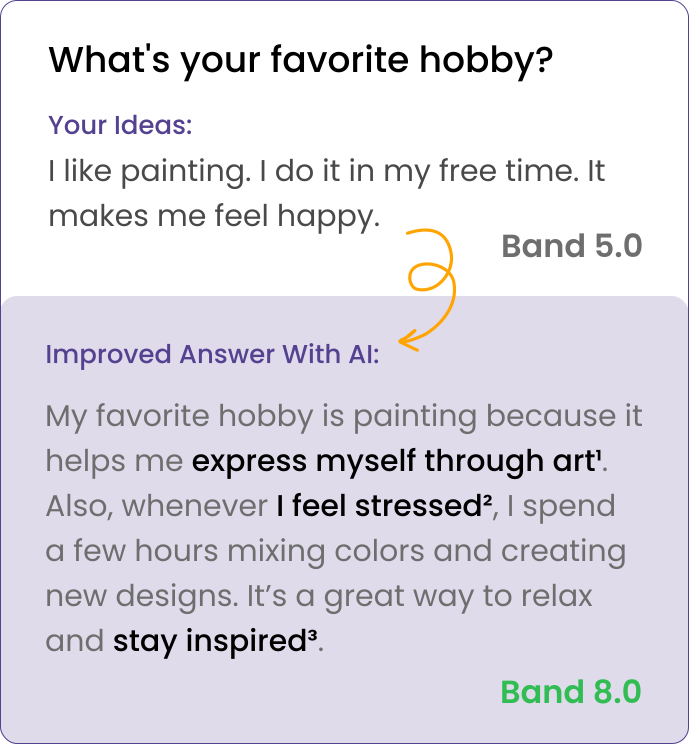
Practice IELTS Speaking answers in our free app
- Build personalized answers that match your target band.
- Turn short replies into fluent answers
- Let examiners fall in love with your answers!
Related Articles
Sample Answers
IELTS Speaking Part 1: Concentration Questions & Answers (Sep-Dec 2026)
Latest Sep-Dec 2026 IELTS Speaking Part 1 questions for Concentration. Read Band 9 sample answers, or use our AI app to turn your own ideas into perfect answers.
Sample Answers
IELTS Speaking Part 1: Jewelry Questions & Band 9 Answers (2026)
Latest Sep-Dec 2026 IELTS Speaking Part 1 questions for Jewelry. Read Band 9 sample answers or generate personal answers using our AI.
Sample Answers
IELTS Speaking Part 1: Colors Questions & Answers (Sep-Dec 2026)
Latest Sep-Dec 2026 IELTS Speaking Part 1 questions for Colors. Read Band 9 sample answers, or use our AI app to turn your own ideas into perfect answers.