Describe a Time You Helped Someone: Part 2 Cue Card (2026)
Use our AI to get a personalized Band 9 answer and vocabulary for the IELTS Speaking Part 2 Cue Card "Describe a time you helped someone".
Start Practicing →One of the most common IELTS Speaking Part 2 Cue Cards in 2026 is "Describe a time you helped someone." The examiner wants to hear a clear narrative about a specific event, focusing on the actions you took and the result. To get Band 7+, you should use helpfulness-related vocabulary such as lend a hand, grateful, and came to the rescue.
How to Use This Sample Answer
Below is a sample answer for a student who helped a friend move house. If this is your case, perfect. But what if you helped a stranger change a flat tire? Or maybe you helped your grandmother use a smartphone?
So here is the plan:
Read this sample answer to understand what a Band 7+ answer looks like.
Use the IELTS Speaking Lab App to instantly generate your own personal answer to this Cue Card with perfect vocabulary that describes your real story and matches your target Band.
Part 2 Cue Card and Sample Answer
Describe a time you helped someone. You should say:
Who you helped and why
How you helped this person
What the result was
And explain how you felt about helping them.
Band 9 Sample Answer
(Answer) I would like to describe a time I came to the rescue of my best friend, Mark, who needed help moving into his new apartment. This happened about six months ago in my hometown. Mark had just received a big promotion at his work, which was great news, but it meant he had to relocate to a different part of the city on very short notice.
(Add Detail) Since Mark is quite frugal, he didn't want to spend money on a professional moving company. I volunteered to lend a hand, assuming it would be a quick job. However, I severely underestimated the task. Mark is a bit of a hoarder and has accumulated a lot of heavy equipment for his hobbies, specifically weightlifting and playing the electric piano. We rented a small van, and the day turned into a massive game of "Tetris" trying to fit everything inside.
(Anecdote) The highlight—or perhaps the low point—was trying to maneuver his massive vintage sofa up three flights of narrow stairs. It was a comedy of errors. At one point, the sofa got completely wedged on the landing, and we were stuck there for ten minutes, sweating buckets and laughing hysterically. It felt just like that famous "Pivot!" scene from the TV show Friends. It was back-breaking labor, and we had to use every ounce of our strength to twist it through the door without scratching the walls.
(Explain) By the time we finished, it was past midnight. We were completely exhausted, but Mark was incredibly grateful and ordered us a massive pizza as a thank you. Even though my muscles were sore for days, I felt a genuine sense of satisfaction. It was a bonding experience that proved we could rely on each other, much like the camaraderie we shared during our late-night study sessions at university.
This answer uses the AAAE Strategy (Answer, Add Detail, Anecdote, Explain).
Part 3 Questions and Sample Answers
After you finish your Cue Card, the examiner will ask you deeper questions related to community and volunteering.
1. Do you think people today are as willing to help others as they were in the past?
It is hard to generalize, but I think the nature of helping has changed. In the past, communities were tight-knit, so neighbors would naturally help each other with daily chores. Today, people in big cities often live in silos and might not even know their neighbors. However, we see a lot of "digital helping" now, like crowdfunding for medical bills or sharing information online. So, the willingness is still there, but the medium has shifted.
2. Why do some people hesitate to help strangers?
I think fear and skepticism play a big role. In modern society, we are often taught to be wary of strangers for safety reasons. People might worry that it is a scam or that they will get into trouble if they intervene. There is also the bystander effect, where everyone assumes someone else will step in to help, so nobody ends up doing anything.
3. Should children be taught to help others at school?
Absolutely. Schools shouldn't just be about academic grades; they should also focus on character building. Teaching children the value of altruism and community service from a young age fosters empathy. If they learn to collaborate and support their peers early on, they are more likely to grow up into responsible, compassionate adults who contribute positively to society.
4. How can we encourage more people to do volunteer work?
I think making it more accessible and flexible is key. Many people want to help but feel they don't have enough time due to their busy careers. If organizations offered "micro-volunteering" opportunities—small tasks that can be done in an hour or online—more people might get involved. Also, companies could incentivize it by giving employees paid time off to volunteer for causes they care about.
Key Vocabulary for IELTS Cue Card: Helped Someone
Here is the complete glossary of every bolded word and phrase used in the answers above, plus extra high-level vocabulary for this topic.
Altruism: Disinterested and selfless concern for the well-being of others (doing good without expecting anything back).
Back-breaking: Physically very hard and tiring work.
Bystander effect: A psychological phenomenon where people do not help a victim when others are present (thinking "someone else will do it").
Came to the rescue: To help someone who is in a difficult or dangerous situation.
Camaraderie: A feeling of friendliness and trust among people who work or spend a lot of time together.
Comedy of errors: A situation that is funny because many things go wrong.
Frugal: Careful when using money or food; simple and plain and costing little.
Grateful: Feeling or showing an appreciation of kindness; thankful.
Hoarder: A person who collects and keeps large amounts of things (often things that are not useful).
Incentivize: To give someone a reason or reward for doing something.
Lend a hand: An idiom meaning to help someone.
Maneuver: To move someone or something with skill and care, often into a specific position.
Medium: The way or method of doing something (e.g., online vs. offline).
Micro-volunteering: Volunteer tasks that are bite-sized and can be done in short periods of time.
Relocate: To move to a new place.
Sense of satisfaction: A feeling of happiness and pride because you have achieved something or helped someone.
Short notice: With very little warning or time to prepare.
Silos: Working or living separately from others without sharing information or mixing (social isolation).
Skepticism: An attitude of doubting the truth of something.
Sweating buckets: An informal idiom meaning to sweat profusely (a lot).
Tetris: A famous puzzle video game (used here as a metaphor for trying to fit many items into a small space).
Tight-knit: A group of people bound together by strong relationships and common interests (e.g., a tight-knit community).
Underestimated: To think that something is smaller, easier, or less important than it really is.
Wary: Feeling caution about possible dangers; not completely trusting someone.
Wedged: To be stuck tightly in a narrow space.
Create Your Own Band 9 Answers
The answer above is perfect—if you are a student who helped a friend move.
But what if you helped a tourist find their way? Or what if you helped your mom cook a big dinner? Your answers need to be true so that you can easily recall them during a stressful exam.
IELTS Speaking Lab helps you turn your real ideas into Band 9 answers.
Select your cue card - Describe a time you helped someone.
Input your rough idea (e.g., "I helped a lady in the supermarket who dropped her bags").
Get personalized Band 9 answer instantly, with the perfect vocabulary for your story.
Not happy with these answers?
Change the core idea, band level difficulty, length and get a full glossary in our free app!
Start Practicing →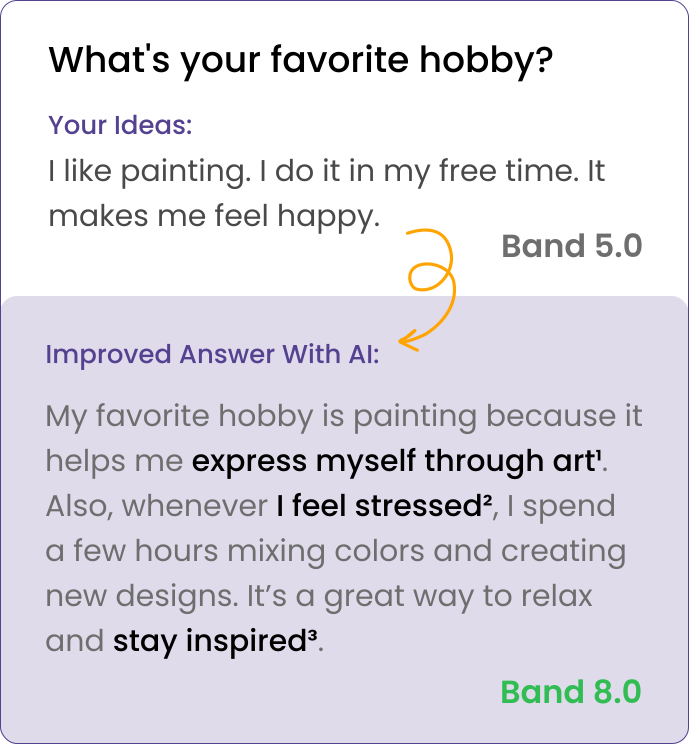
Practice IELTS Speaking answers in our free app
- Build personalized answers that match your target band.
- Turn short replies into fluent answers
- Let examiners fall in love with your answers!
Related Articles
Sample Answers
IELTS Speaking Part 1: Concentration Questions & Answers (Sep-Dec 2026)
Latest Sep-Dec 2026 IELTS Speaking Part 1 questions for Concentration. Read Band 9 sample answers, or use our AI app to turn your own ideas into perfect answers.
Sample Answers
IELTS Speaking Part 1: Jewelry Questions & Band 9 Answers (2026)
Latest Sep-Dec 2026 IELTS Speaking Part 1 questions for Jewelry. Read Band 9 sample answers or generate personal answers using our AI.
Sample Answers
IELTS Speaking Part 1: Colors Questions & Answers (Sep-Dec 2026)
Latest Sep-Dec 2026 IELTS Speaking Part 1 questions for Colors. Read Band 9 sample answers, or use our AI app to turn your own ideas into perfect answers.