Describe a Person You Admire: Part 2 Cue Card (2026)
Use our AI to get a personalized Band 9 answer and vocabulary for the IELTS Speaking Part 2 Cue Card "Describe a person you admire".
Start Practicing →One of the most popular IELTS Speaking Part 2 Cue Cards in 2026 is "Describe a person you admire." The examiner expects you to talk about someone who has influenced you positively, describing their personality, achievements, and why they inspire you. To get Band 7+, you should use character-related vocabulary such as role model, captivating, and shattered the stereotype.
How to Use This Sample Answer
Below is a sample answer for a student who admires their university professor. If this is your case, perfect. But what if you admire your hardworking father? Or maybe you admire a famous athlete?
So here is the plan:
Read this sample answer to understand what a Band 7+ answer looks like.
Use the IELTS Speaking Lab App to instantly generate your own personal answer to this Cue Card with perfect vocabulary that describes your real story and matches your target Band.
Part 2 Cue Card and Sample Answer
Describe a person you admire. You should say:
Who this person is
How you know this person
What this person is like
And explain why you admire this person.
Band 9 Sample Answer
(Introduce) I would like to talk about Elon Musk. Kidding! I am going to talk about Professor Thomas, who was my mathematics lecturer during my time at university. He is a middle-aged man, probably in his early fifties, but he has the energy and enthusiasm of someone half his age.
(Describe) I first met him in my freshman year when I took his Advanced Calculus course. To be honest, I was expecting the class to be incredibly boring because math can be a very dry subject. However, Professor Thomas was absolutely captivating. He didn't just write formulas on the board; he brought the subject to life with real-world examples and humor. He was a consummate professional who always treated his students with respect, yet he was also very approachable if you had questions after class.
(Explain) What made him truly unique was his life outside the lecture hall. We found out that he plays the electric guitar in a rock band in my hometown, which we thought was the coolest thing ever. He has a huge passion for music, and he is frequently invited as a guest expert on popular science YouTube channels to explain complex theories to the public.
(Add impact) I admire him because he shattered the stereotype that math teachers are dull or strict. He showed me that you can be highly intellectual and professional while still having a fun, creative side. He is a true role model for me, and his passion inspired me to study harder in my own field to achieve similar success.
This answer uses the IDEA Strategy (Introduce, Describe, Explain, Add impact).
Part 3 Questions and Sample Answers
After you finish your Cue Card, the examiner will ask you deeper questions related to leadership and success.
1. What qualities do you think a good leader should have?
I believe a good leader needs a combination of vision and empathy. They need to have a clear idea of where they are going, but they also need to understand the people they are leading. A leader who rules with an iron fist might get results in the short term, but they won't earn the loyalty of their team. For example, in a high-pressure work environment, a manager who listens to their employees is always more respected than one who just gives orders.
2. Do you think people are born leaders, or can this skill be learned?
That is the age-old "nature vs. nurture" debate. I think some people have innate charisma and confidence that make them natural leaders. However, I definitely believe leadership is a skill that can be honed through experience and training. Many successful CEOs were shy in their youth but learned how to command a room through public speaking courses and practice.
3. Who do young people in your country usually admire today?
Nowadays, I think the focus has shifted towards digital influencers and tech entrepreneurs. In the past, young people looked up to politicians or freedom fighters, but now they admire people who have achieved financial freedom or internet fame. For instance, many of my friends follow wealthy streamers who promote unrealistic lifestyles. While some of these figures are positive influencers, others can unfortunately lead to feelings of inadequacy among teenagers.
4. Is it important for celebrities to set a good example for the younger generation?
Yes, undeniably. Whether they asked for it or not, celebrities are constantly in the public eye. If a famous actor or musician engages in illegal or immoral behavior, their young fans might think it is cool to copy them. Therefore, they have a social responsibility to behave ethically, or at least not glorify harmful behavior.
Key Vocabulary for IELTS Cue Card: Person You Admire
Here is the complete glossary of every bolded word and phrase used in the answers above, plus extra high-level vocabulary for this topic.
Approachable: Friendly and easy to talk to.
Born leader: Someone who has natural leadership qualities.
Brought the subject to life: Made a boring subject interesting and exciting.
Captivating: Holding your attention by being extremely interesting or attractive.
Charismatic: Having a compelling charm that inspires devotion in others.
Command a room: To be so impressive that everyone in the room listens to you.
Consummate professional: Someone who is extremely skilled and perfect in their job.
Dry subject: A subject that is boring or lacks emotion (like facts and figures).
Empathy: The ability to understand and share the feelings of another.
Feelings of inadequacy: Feeling that you are not good enough compared to others.
In the public eye: Being famous and written about in the media and seen on TV.
Influencer: A person with the ability to influence potential buyers of a product or service by promoting or recommending the items on social media.
Innate: Inborn; natural (something you are born with).
Iron fist: To rule or control people very strictly and harshly.
Look up to: To admire and respect someone.
Loyalty: A strong feeling of support or allegiance.
Mentor: An experienced and trusted adviser.
Renowned: Known or talked about by many people; famous.
Role model: A person looked to by others as an example to be imitated.
Shattered the stereotype: To disprove a widely held but fixed and oversimplified image or idea of a particular type of person or thing.
Someone half his age: Having the energy or ability of a much younger person.
Treated his students with respect: Behaved politely and kindly towards students.
Vision: The ability to think about or plan the future with imagination or wisdom.
Visionary: A person with original ideas about what the future will or could be like.
Create Your Own Band 9 Answers
The answer above is perfect—if you are a student who admires a university professor. But what if you admire your grandfather? Or what if you admire a famous business leader? Your answers need to be true so that you can easily recall them during a stressful exam.
IELTS Speaking Lab helps you turn your real ideas into Band 9 answers.
Select your cue card - Describe a person you admire.
Input your rough idea (e.g., "I admire my mother because she raised three children while working a full-time job").
Get personalized Band 9 answer instantly, with the perfect vocabulary for your story.
Not happy with these answers?
Change the core idea, band level difficulty, length and get a full glossary in our free app!
Start Practicing →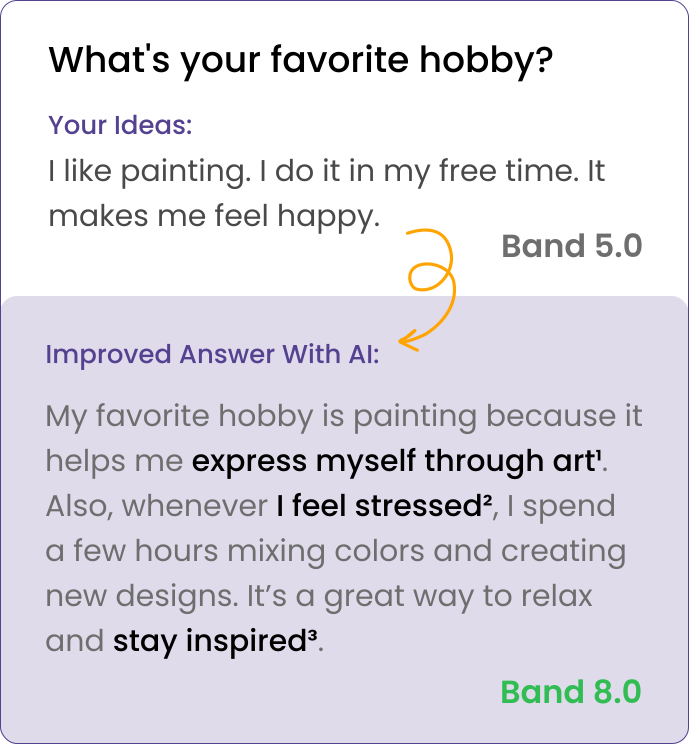
Practice IELTS Speaking answers in our free app
- Build personalized answers that match your target band.
- Turn short replies into fluent answers
- Let examiners fall in love with your answers!
Related Articles
Sample Answers
IELTS Speaking Part 1: Concentration Questions & Answers (Sep-Dec 2026)
Latest Sep-Dec 2026 IELTS Speaking Part 1 questions for Concentration. Read Band 9 sample answers, or use our AI app to turn your own ideas into perfect answers.
Sample Answers
IELTS Speaking Part 1: Jewelry Questions & Band 9 Answers (2026)
Latest Sep-Dec 2026 IELTS Speaking Part 1 questions for Jewelry. Read Band 9 sample answers or generate personal answers using our AI.
Sample Answers
IELTS Speaking Part 1: Colors Questions & Answers (Sep-Dec 2026)
Latest Sep-Dec 2026 IELTS Speaking Part 1 questions for Colors. Read Band 9 sample answers, or use our AI app to turn your own ideas into perfect answers.