IELTS Speaking Part 1: Public Places Questions & Band 9 Answers (2026)
Stop memorizing generic answers. Use our AI tools to get personalized Band 9 answers and vocabulary to talk about Public Places in your hometown.
Start Practicing →Public Places is a common topic. The examiner might ask about your favorite park, how often you visit libraries, or what your city offers to its residents. To score Band 9, avoid saying "I like quiet places." Instead, use words like sanctuary, communal, hustle and bustle, or amenities to describe your views.
How to Use These Sample Answers
Below are the latest 2026 questions for "Public Places."
Important: These answers are for a person who likes quiet and peaceful places. They prefer empty parks, silent libraries, and nature. They go to public spaces to relax and escape from noise.
But if you love loud music, huge crowds, and always want to be in the center of a busy, noisy city, these answers are probably not for you.
So, here is the plan:
Read these samples to understand the Band 9 structure.
Use the IELTS Speaking Lab App to get personalized answers. It gives you perfect vocabulary that fits your real life.
Part 1: Questions & Model Answers about Public Places
1. Do you like going to public places?
Yes, but I am quite selective. I prefer spaces that act as a sanctuary from the noise of the city, like a quiet library or a botanical garden. I usually try to avoid places with massive crowds because I find them quite overwhelming.
2. What is your favorite public place?
My favorite place is the central library. It is beautifully designed and incredibly peaceful. It is the perfect environment for my hobbies, which mostly involve reading and studying. I love the smell of old books and the hushed atmosphere.
3. Are there many public places in your hometown?
Yes, my hometown is well-planned and offers a variety of excellent amenities. We have several large squares, public swimming pools, and community centers. The local government has invested heavily in creating functional civic spaces.
4. Do people in your country often visit public places?
Absolutely. It is a big part of our culture. Families gather in parks on the weekends, especially when the weather is mild and sunny. These areas serve as vital communal hubs where neighbors can interact and socialize.
5. Do you prefer public places to be quiet or noisy?
I definitively prefer them to be quiet. I use public spaces to decompress, so I have zero tolerance for loud music or shouting. I actively try to escape the hustle and bustle of daily life, so a tranquil environment is essential for me.
6. What do people usually do in public parks?
Most people go there to unwind. You will see people jogging, walking their dogs, or just sitting on a bench admiring the plants and trees. It provides a much-needed recreational outlet for people who live in small, cramped apartments.
7. Are public places free in your city?
For the most part, yes. Access to parks, libraries, and public squares is completely free. They are heavily subsidized by the government. I think it is important that these spaces remain accessible to everyone, regardless of their socioeconomic status.
8. How could public places in your city be improved?
They could definitely benefit from better infrastructure. Many benches are broken, and the public restrooms are often unhygienic. Furthermore, they could integrate modern technology by offering free, high-speed Wi-Fi to make the spaces more useful for students and remote workers.
9. Have public places changed since you were a child?
Yes, quite drastically. Due to rapid urbanization, many old, open fields have been paved over to create modern plazas. While they are cleaner and more organized now, they have lost a bit of their natural charm and feel slightly more sterile.
10. Do you think there should be more public places?
Undoubtedly. They are crucial for a city's livability. Without public spaces, people become isolated in their homes. Having accessible areas to walk and gather is fundamental for public health and social cohesion.
11. Why do some people dislike public places?
Some individuals value their privacy above all else. In a public area, you are constantly exposed to strangers, noise, and sometimes poor hygiene. For someone who is introverted, sharing a space with hundreds of unpredictable people can feel quite claustrophobic.
12. How do public places change in different seasons?
The usage shifts dramatically. In the summer, outdoor plazas are vibrant and packed with tourists and street performers. However, during the harsh winter months, these spaces become deserted, and people flock to indoor venues like museums and indoor markets to stay warm.
Key Vocabulary for IELTS Topic: Public Places
Here is the complete glossary of every bolded word and phrase used in the answers above.
Amenities: Desirable or useful features or facilities of a building or place.
Civic spaces: Areas in a city or town designed for public use and community gathering.
Claustrophobic: Experiencing an extreme or irrational fear of confined places or large crowds.
Communal hubs: Central places where people from a community gather and interact.
Hushed atmosphere: A very quiet and calm environment.
Hustle and bustle: Busy and noisy activity, usually in a city.
Infrastructure: The basic physical and organizational structures (e.g., buildings, roads, power supplies) needed for a society to function.
Introverted: A person who prefers calm environments and time alone over highly stimulating social situations.
Livability: The sum of the factors that add up to a community's quality of life.
Overwhelming: Very intense and difficult to deal with.
Recreational outlet: A place or activity that provides relaxation and enjoyment.
Sanctuary: A place of refuge, safety, or peace.
Social cohesion: The willingness of members of a society to cooperate with each other in order to survive and prosper.
Socioeconomic status: An individual's or group's position within a hierarchical social structure based on wealth, education, and occupation.
Sterile: Lacking in imagination, creativity, or excitement; overly clean and bare.
Subsidized: Supported financially by the government or an organization.
Tranquil environment: A calm, peaceful, and quiet place.
Urbanization: The process of making an area more urban (building more cities and roads).
Venues: The places where something happens, especially an organized event such as a concert, conference, or sports competition.
Create Your Own Band 9 Answers
The answers above are perfect—if you are a person who likes quiet and peaceful places. But what if you love loud concerts? Or what if you prefer crowded city centers?
Your answers need to be true so that you can easily recall them during a stressful exam.
IELTS Speaking Lab helps you turn your real ideas into Band 9 answers.
Select your topic - Public Places.
Input your rough idea (e.g., "I love going to the busy public square on weekends to watch the street dancers").
Get personalized Band 9 answers instantly, with the perfect vocabulary for your story.
Not happy with these answers?
Change the core idea, band level difficulty, length and get a full glossary in our free app!
Start Practicing →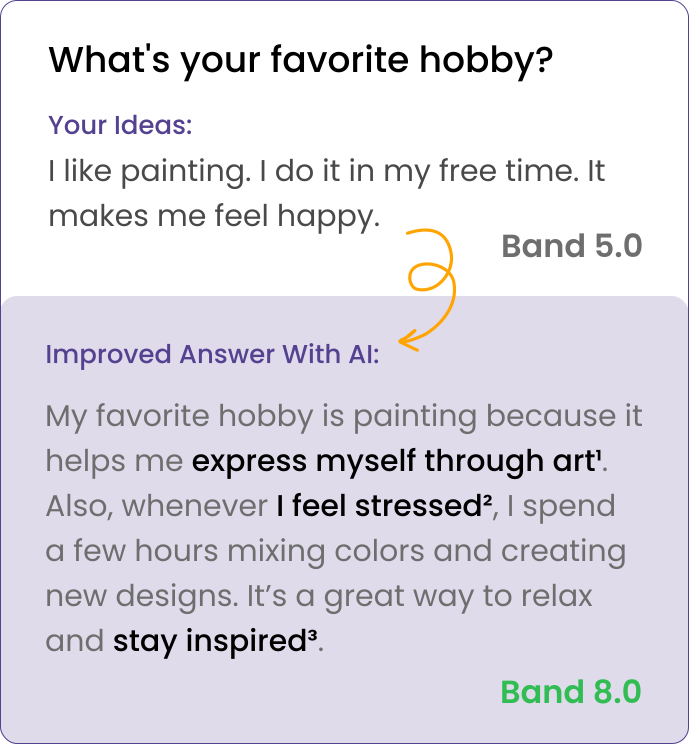
Practice IELTS Speaking answers in our free app
- Build personalized answers that match your target band.
- Turn short replies into fluent answers
- Let examiners fall in love with your answers!
Related Articles
Sample Answers
IELTS Speaking Part 1: Concentration Questions & Answers (Sep-Dec 2026)
Latest Sep-Dec 2026 IELTS Speaking Part 1 questions for Concentration. Read Band 9 sample answers, or use our AI app to turn your own ideas into perfect answers.
Sample Answers
IELTS Speaking Part 1: Jewelry Questions & Band 9 Answers (2026)
Latest Sep-Dec 2026 IELTS Speaking Part 1 questions for Jewelry. Read Band 9 sample answers or generate personal answers using our AI.
Sample Answers
IELTS Speaking Part 1: Colors Questions & Answers (Sep-Dec 2026)
Latest Sep-Dec 2026 IELTS Speaking Part 1 questions for Colors. Read Band 9 sample answers, or use our AI app to turn your own ideas into perfect answers.