IELTS Speaking Part 1: Hometown Questions & Band 9 Answers (2026)
Latest Sep-Dec 2026 IELTS Speaking Part 1 questions for Hometown. Read Band 9 sample answers or generate personal answers using our AI.
Start Practicing →Hometown is a guaranteed topic. You will almost certainly be asked about where you grew up. The examiner is tired of hearing "My hometown is beautiful." To score Band 9, you need to describe the atmosphere using words like bustling, provincial, or picturesque, and explain exactly why you left (or why you stayed).
Latest Sep-Dec 2026: Hometown Questions & Sample Answers
1. Where is your hometown?
I come from a small, provincial town in the north. It is a very rural area, surrounded by farmland. It is a stark contrast to the bustling city where I currently live.
2. Do you like your hometown?
I have mixed feelings. On one hand, it is incredibly picturesque and the air is pristine, which is great for my health. On the other hand, it is incredibly dull. Nothing ever happens there, so it can feel quite isolating.
3. Do you often visit your hometown?
Not really. I am very busy with my study schedule and exams right now. Also, the journey is quite long and arduous, so I only manage to go back once a year to visit my parents.
4. Is your hometown a good place for children to grow up?
Absolutely. It is a very tight-knit community where everyone knows everyone. It is idyllic and safe, with very little crime. Children can play outside freely, unlike in the concrete jungle where I live now.
5. What kind of jobs do people do in your hometown?
That is the main problem—the economy is stagnant. Most people work in agriculture or small family businesses. There are very few opportunities for work in the technology sector, which is exactly why I had to move away.
6. Has your hometown changed much since you were a child?
Yes, quite a lot. There has been some gentrification recently. New cafes and expensive houses have appeared. It is becoming more modernized, but some older locals feel it is losing its traditional charm.
7. Is there anything you dislike about it?
The public transport is abysmal. The buses are unreliable and infrequent, so you absolutely need a car to get around. This makes it very difficult to travel to nearby cities if you don't drive.
8. Are there any interesting places to visit?
There are a few historical landmarks, like an ancient church in the town square. We also have a famous hiking trail. However, it is certainly not a tourist hotspot; it is quite off the beaten track.
9. Would you say it is a good place for young people?
Honestly, no. There is a severe lack of amenities and entertainment. There are no malls or nightclubs. Most young people suffer from boredom and usually move to bigger cities to find a more vibrant social scene.
10. Do you plan to live there in the future?
I don’t think so. I am happy with my current home in the city. While I feel a sense of nostalgia when I visit, my lifestyle doesn't fit a small town anymore. I need a faster pace of life.
11. How could your hometown be improved?
It desperately needs better infrastructure. The roads are full of potholes and the internet is slow. Better connectivity would help businesses grow and might stop so many young people from leaving.
12. What is the oldest part of your hometown?
The historic center is the oldest part. It has cobblestone streets and buildings that are hundreds of years old. It is a protected heritage site, so nobody is allowed to change the architecture.
Key Vocabulary from the Answers
Here is the complete glossary of every bolded word and phrase used in the answers above.
Abysmal: Extremely bad; terrible.
Agriculture: Farming (growing crops or keeping animals).
Amenities: Useful features or facilities (cinemas, shops, gyms).
Arduous: Difficult and tiring; involving a lot of effort.
Boredom: The feeling of being bored or uninterested.
Bustling: Full of activity and noise (usually used for big cities).
Charm: The quality of being pleasant or attractive.
Cobblestone streets: Streets surfaced with round stones (often found in old towns).
Concrete jungle: A city area with a high density of modern buildings and few trees.
Connectivity: The ability to connect systems or people (often used for internet/transport).
Dull: Lacking interest or excitement; boring.
Gentrification: The process of renovating a poor area so it becomes more expensive and middle-class.
Heritage site: A place preserved because of its cultural or historical importance.
Historic center: The oldest part of a town or city.
Idyllic: Extremely happy, peaceful, or picturesque.
Infrequent: Not happening often.
Infrastructure: Basic systems and services (transport, power, roads).
Isolating: Making you feel alone or cut off from others.
Landmarks: Well-known objects or features of a landscape (e.g., a statue or church).
Modernized: Adapted to modern needs or habits.
Nostalgia: A sentimental longing for the past.
Off the beaten track: Far away from the places that people (and tourists) usually visit.
Pace of life: The speed at which life is lived (fast in cities, slow in villages).
Picturesque: Visually attractive, especially in a quaint or pretty style.
Pristine: In its original condition; unspoiled; clean and fresh.
Provincial: Concerning a small town or rural area (often implies it is simple or old-fashioned).
Rural: Relating to the countryside rather than the town.
Stagnant: Showing no activity; dull and sluggish (often used for the economy).
Stark contrast: A very obvious difference between two things.
Tight-knit community: A group of people who know each other well and help each other.
Tourist hotspot: A place that is very popular with tourists.
Vibrant: Full of energy, life, and activity.
Create Your Own Band 9 Answers
IELTS Speaking Lab helps you turn your real ideas into Band 9 answers.
Select your topic/question - Hometown/Where is your hometown?
Input your rough idea - "I grew up in a noisy city, and I love it."
Get a personalized Band 9 answer instantly, with the perfect vocabulary for your story.
Not happy with these answers?
Change the core idea, band level difficulty, length and get a full glossary in our free app!
Start Practicing →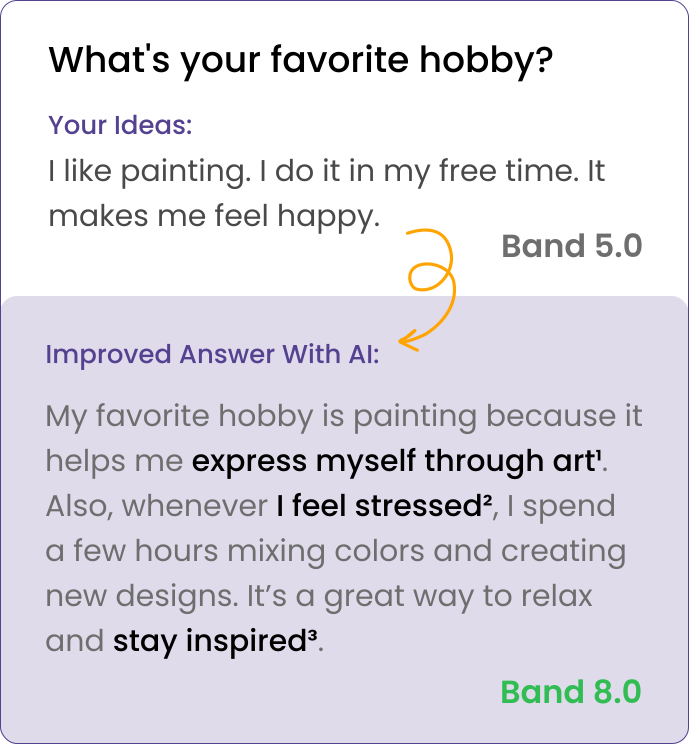
Practice IELTS Speaking answers in our free app
- Build personalized answers that match your target band.
- Turn short replies into fluent answers
- Let examiners fall in love with your answers!
Related Articles
Sample Answers
IELTS Speaking Part 1: Concentration Questions & Answers (Sep-Dec 2026)
Latest Sep-Dec 2026 IELTS Speaking Part 1 questions for Concentration. Read Band 9 sample answers, or use our AI app to turn your own ideas into perfect answers.
Sample Answers
IELTS Speaking Part 1: Jewelry Questions & Band 9 Answers (2026)
Latest Sep-Dec 2026 IELTS Speaking Part 1 questions for Jewelry. Read Band 9 sample answers or generate personal answers using our AI.
Sample Answers
IELTS Speaking Part 1: Colors Questions & Answers (Sep-Dec 2026)
Latest Sep-Dec 2026 IELTS Speaking Part 1 questions for Colors. Read Band 9 sample answers, or use our AI app to turn your own ideas into perfect answers.