IELTS Speaking Part 1: Walking Questions & Band 9 Answers (2026)
Stop memorizing generic answers. Use our AI tools to get personalized Band 9 answers and vocabulary to talk about daily steps, pedestrian areas, and staying active.
Start Practicing →Walking is one of the newest and most common topics in the 2026 IELTS exam. The examiner might ask if you walk a lot, where you like to walk, or if you walked often as a child. To score Band 9, avoid saying "I walk every day." Instead, use words like stamina, stroll, sedentary, or invigorating to describe your experience.
How to Use These Sample Answers
Below are the latest 2026 questions for "Walking."
Important: These answers are for a person who likes walking to stay healthy and clear their mind. They prefer quiet places like parks and avoid walking in bad weather.
But if you hate walking and drive everywhere, or if you walk 20 kilometers every day in the mountains, these answers are probably not for you.
So, here is the plan:
Read these samples to understand the Band 9 structure.
Use the IELTS Speaking Lab App to get personalized answers. It gives you perfect vocabulary that fits your real life.
Part 1: Questions & Model Answers about Walking
1. Do you walk a lot?
Yes, I absolutely do. Since I work at a desk all day, my lifestyle is quite sedentary. To counteract this, I make a conscious effort to achieve at least ten thousand steps every single day to maintain my health and build my overall cardiovascular stamina.
2. Did you often go outside to have a walk when you were a child?
Yes, constantly. I grew up in an era before digital entertainment completely took over. My parents would frequently take me for a leisurely stroll around the neighborhood after dinner. It was a wonderful way to bond and expend some excess childhood energy.
3. Why do people like to walk in parks?
I believe it is primarily to escape the urban chaos. Parks offer a tranquil oasis away from the noisy, concrete city center. Being surrounded by nature provides a significant psychological boost and allows people to quietly decompress from their stressful daily routines.
4. Where would you like to take a long walk if you had the chance?
I would absolutely love to hike along a rugged coastal path. While the local parks in my hometown are quite pleasant, they lack dramatic scenery. Walking alongside the ocean, with the fresh sea breeze and crashing waves, sounds incredibly invigorating.
5. Do you prefer walking alone or with others?
I strongly prefer walking by myself. I view it as a form of moving meditation. Walking alone gives me the opportunity to process my thoughts and enjoy some much-needed solitude without feeling obligated to entertain someone or maintain a conversation.
6. How does the climate affect your walking habits?
It dictates my routine entirely. I am very much a fair-weather walker. If the weather is bitterly cold or heavily raining, I will immediately abandon my walking plans and stay indoors. I strongly dislike dealing with inclement conditions.
7. Do you walk when you are running errands?
Yes, whenever practically possible. If the grocery store or the mall where I do my shopping is within a two-kilometer radius, I will always choose to walk. It is highly pragmatic and saves me the intense frustration of trying to find a parking space in crowded areas.
8. Do you think people will walk more in the future?
I genuinely hope so. With the growing awareness of our changing environment, many cities are actively trying to reduce vehicle emissions. By creating wider sidewalks and pedestrian zones, urban planners are actively encouraging a shift towards walking and cycling.
9. Is the pedestrian infrastructure good where you live?
Unfortunately, it is severely lacking. The city is designed almost exclusively for cars, meaning the pedestrian infrastructure is incredibly narrow and often poorly maintained. It makes navigating the streets on foot feel quite hazardous during rush hour traffic.
10. Is footwear important when you are walking?
It is absolutely paramount. Attempting a long walk in inappropriate shoes is a guaranteed way to develop painful blisters or severe joint pain. Investing in high-quality, ergonomic footwear with proper arch support is essential for avoiding long-term physical damage.
11. Do you walk to work or school?
No, it is simply too far. The distance is well over fifteen kilometers, making a daily commute on foot completely unfeasible. However, I usually get off the subway one stop early just to guarantee I get a brisk walk in before sitting at my desk.
12. How do you feel after a long walk?
I always feel profoundly refreshed. Even if my legs are physically fatigued, my mind feels completely clear and sharp. It is a fantastic mechanism for burning off excess adrenaline and reducing my overall anxiety levels after a highly demanding day.
Key Vocabulary for IELTS Topic: Walking
Here is the complete glossary of every bolded word and phrase used in the answers above.
Arch support: A feature of a shoe designed to support the arch of the foot, preventing pain.
Brisk walk: A quick, energetic, and active walk.
Commute: A regular journey of some distance to and from one's place of work.
Decompress: To calm down and relax after a period of stress or tension.
Ergonomic: Designed for efficiency and physical comfort in the working or living environment.
Hazardous: Risky; dangerous.
Inclement: (Of the weather) unpleasantly cold, wet, or stormy.
Invigorating: Making one feel strong, healthy, and full of energy.
Paramount: More important than anything else; supreme.
Pedestrian infrastructure: The physical facilities provided for people traveling on foot, like sidewalks and crosswalks.
Pedestrian zones: Areas of a city or town reserved strictly for people walking, where cars are banned.
Pragmatic: Dealing with things sensibly and realistically in a way that is based on practical considerations.
Profoundly: To a very great or intense extent; extremely.
Sedentary: Tending to spend much time seated; somewhat inactive.
Solitude: The state or situation of being alone, often by choice.
Stamina: The ability to sustain prolonged physical or mental effort.
Stroll: A short, leisurely walk.
Unfeasible: Inconvenient or impractical; not possible to do easily or conveniently.
Urban chaos: The busy, noisy, and disorganized environment typical of large cities.
Create Your Own Band 9 Answers
The answers above are perfect—if you are a person who likes walking to stay healthy and clear their mind. But what if you hate walking and drive everywhere? Or what if you walk 20 kilometers every day in the mountains?
Your answers need to be true so that you can easily recall them during a stressful exam.
IELTS Speaking Lab helps you turn your real ideas into Band 9 answers.
Select your topic - Walking.
Input your rough idea (e.g., "I never walk anywhere because my city is too hot").
Get personalized Band 9 answers instantly, with the perfect vocabulary for your story.
Not happy with these answers?
Change the core idea, band level difficulty, length and get a full glossary in our free app!
Start Practicing →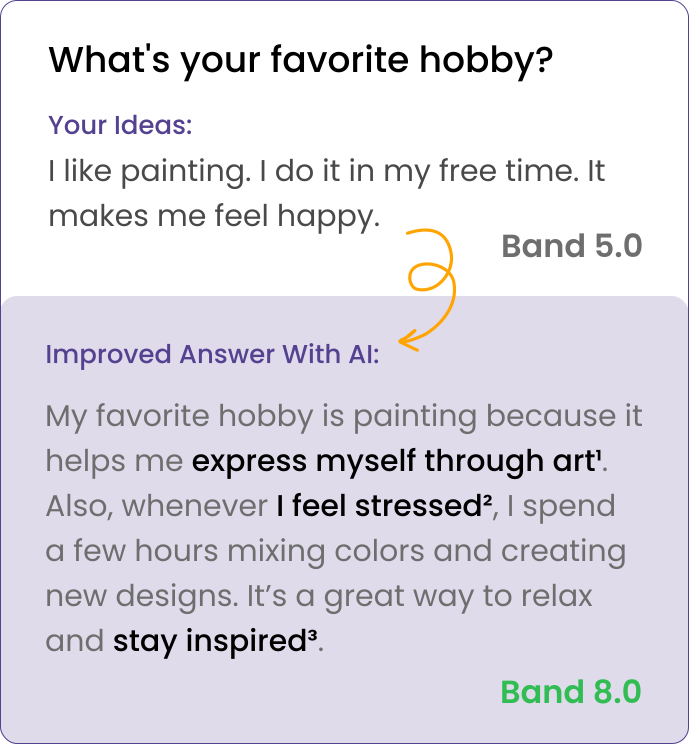
Practice IELTS Speaking answers in our free app
- Build personalized answers that match your target band.
- Turn short replies into fluent answers
- Let examiners fall in love with your answers!
Related Articles
Sample Answers
IELTS Speaking Part 1: Concentration Questions & Answers (Sep-Dec 2026)
Latest Sep-Dec 2026 IELTS Speaking Part 1 questions for Concentration. Read Band 9 sample answers, or use our AI app to turn your own ideas into perfect answers.
Sample Answers
IELTS Speaking Part 1: Jewelry Questions & Band 9 Answers (2026)
Latest Sep-Dec 2026 IELTS Speaking Part 1 questions for Jewelry. Read Band 9 sample answers or generate personal answers using our AI.
Sample Answers
IELTS Speaking Part 1: Colors Questions & Answers (Sep-Dec 2026)
Latest Sep-Dec 2026 IELTS Speaking Part 1 questions for Colors. Read Band 9 sample answers, or use our AI app to turn your own ideas into perfect answers.