IELTS Speaking Part 1: Crowded Places Questions & Band 9 Answers (2026)
Stop memorizing generic answers. Use our AI tools to get personalized Band 9 answers and vocabulary to talk about busy cities, heavy traffic, and avoiding crowds.
Start Practicing →Expect to see Crowded Places in your 2026 IELTS speaking exam. The examiner might ask if your city is crowded, how you feel in busy places, or where you go to avoid people. To score Band 9, avoid saying "I do not like crowds." Instead, use words like claustrophobic, densely populated, overwhelming, or congestion to describe your experience.
How to Use These Sample Answers
Below are the latest 2026 questions for "Crowded Places."
Important: These answers are for a person who hates big crowds, likes quiet places, and feels claustrophobic or overwhelmed in busy streets.
But if you love the fun energy of a big crowd, or if you go to loud music festivals every weekend, these answers are probably not for you.
So, here is the plan:
Read these samples to understand the Band 9 structure.
Use the IELTS Speaking Lab App to get personalized answers. It gives you perfect vocabulary that fits your real life.
Part 1: Questions & Sample Answers about Crowded Places
1. Is the city where you live crowded?
Yes, absolutely. My hometown is a major metropolitan hub, so it is incredibly densely populated. During peak hours, the streets are completely packed with commuters, which can feel quite overwhelming if you are not used to the fast-paced, high-stress environment of a mega-city.
2. Is there a crowded place near where you live?
Yes, there is a massive commercial district just a few blocks from my apartment. It is a famous tourist attraction, so it is perpetually bustling with foot traffic. Trying to navigate through the throngs of people there is an absolute nightmare, especially on weekends when everyone is out.
3. Do you like crowded places?
To be completely honest, I despise them. I have a slight tendency toward being claustrophobic, so being surrounded by a massive crowd makes me feel incredibly anxious and trapped. I strongly prefer quiet, peaceful environments where I have plenty of personal space and freedom to move.
4. Do most people like crowded places?
I think it depends entirely on their personality. Extroverts seem to genuinely enjoy the vibrant, contagious energy of a packed stadium or a busy music festival. However, I believe most ordinary people tolerate crowds out of necessity rather than actively seeking out that kind of exhausting sensory overload.
5. When do you go to crowded places?
I usually only go when it is absolutely unavoidable, such as doing my weekly shopping for groceries. Even then, I make a conscious effort to go very early in the morning to avoid the peak rush and minimize my exposure to the chaotic, noisy environment.
6. How do you feel in a crowded place?
I generally feel quite tense and agitated. The constant bumping of shoulders and the loud, cacophonous noise levels quickly drain my social battery. It is a highly stress-inducing experience that leaves me desperate to return to the absolute tranquility of my own home.
7. What is the most crowded place you have ever been to?
It would definitely be the main underground transport terminal in Tokyo during the morning rush hour. The sheer volume of people moving simultaneously was staggering, and the train carriages were so tightly squeezed that we were literally packed like sardines for the entire journey.
8. Do you prefer going to places with many people or few people?
I unequivocally prefer places with very few people. During national holidays, when every major tourist destination is overflowing with visitors, I purposely choose to visit remote, off-the-beaten-path locations to ensure I can actually enjoy some much-needed peace and quiet away from the masses.
9. Are there any benefits to crowded places?
I suppose they can be highly beneficial for local economies. A high concentration of foot traffic guarantees excellent revenue for small businesses and street vendors. Furthermore, crowds can create a strong sense of community and solidarity during public celebrations or major sporting events.
10. What problems do crowded places cause?
They frequently lead to severe traffic congestion and a significant increase in minor opportunistic crimes like pickpocketing. Additionally, when a massive group of people is confined to a small area, there is always a dangerous risk of a stampede if a sudden panic breaks out.
11. How can cities solve the problem of crowding?
Urban planners need to drastically improve public infrastructure. By decentralizing commercial zones and encouraging remote work, cities can significantly reduce the number of people who need to travel into the city center every single day, thereby alleviating the intense pressure on our public spaces.
12. Where do you go to avoid crowds?
On my days off, I usually retreat to a beautiful, secluded nature reserve located on the outskirts of my city. It is blissfully quiet and completely devoid of the usual urban hustle, making it the perfect sanctuary to mentally recover from the busy workweek.
Key Vocabulary for IELTS Topic: Crowded Places
Here is the complete glossary of every bolded word and phrase used in the answers above.
Alleviating: Making (suffering, deficiency, or a problem) less severe.
Cacophonous: Involving or producing a harsh, discordant mixture of sounds.
Claustrophobic: Having an extreme or irrational fear of confined places.
Congestion: The state of being crowded and full of traffic.
Contagious energy: A feeling of excitement or enthusiasm that spreads quickly from person to person.
Decentralizing: Moving departments of a large organization away from a single administrative center to other locations.
Densely populated: Containing a large number of people within a relatively small area.
Off-the-beaten-path: Not known or popular with many people; in a remote location.
Overwhelming: Very great in amount; having such a great effect on you that you feel confused and do not know how to react.
Packed like sardines: Crowded very close together in a small space.
Secluded: (Of a place) not seen or visited by many people; sheltered and private.
Sensory overload: A condition where one or more of the body's senses experiences over-stimulation from the environment.
Solidarity: Unity or agreement of feeling or action, especially among individuals with a common interest.
Staggering: Deeply shocking; astonishing.
Stampede: A sudden panicked rush of a number of horses, cattle, or other animals (or people).
Stress-inducing: Causing a person to feel emotional or mental strain.
Throngs of people: Large, densely packed crowds of people or animals.
Create Your Own Band 9 Answers
The answers above are perfect—if you are a person who hates big crowds, likes quiet places, and feels claustrophobic or overwhelmed in busy streets. But what if you love the fun energy of a big crowd? Or what if you go to loud music festivals every weekend?
Your answers need to be true so that you can easily recall them during a stressful exam.
IELTS Speaking Lab helps you turn your real ideas into Band 9 answers.
Select your topic - Crowded Places.
Input your rough idea (e.g., "I love crowded places because I enjoy meeting new people").
Get personalized Band 9 answers instantly, with the perfect vocabulary for your story.
Not happy with these answers?
Change the core idea, band level difficulty, length and get a full glossary in our free app!
Start Practicing →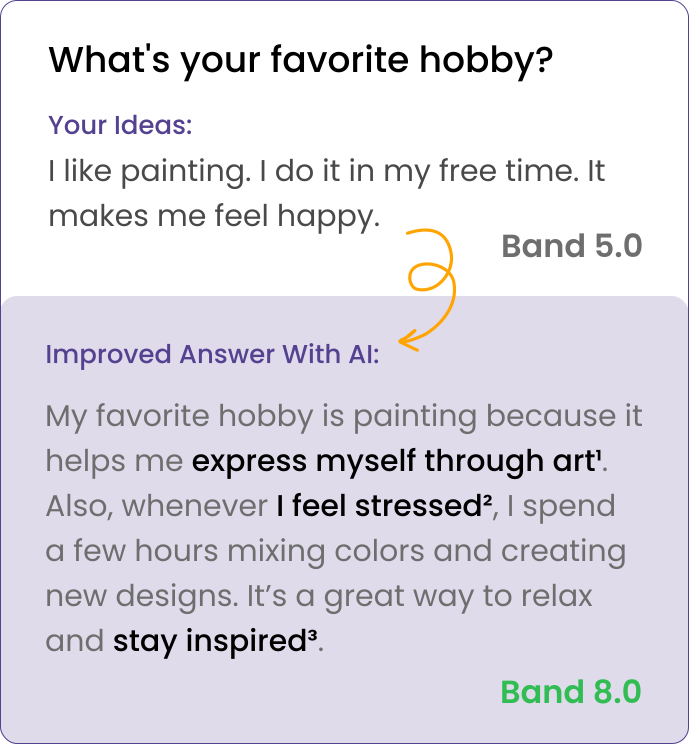
Practice IELTS Speaking answers in our free app
- Build personalized answers that match your target band.
- Turn short replies into fluent answers
- Let examiners fall in love with your answers!
Related Articles
Sample Answers
IELTS Speaking Part 1: Concentration Questions & Answers (Sep-Dec 2026)
Latest Sep-Dec 2026 IELTS Speaking Part 1 questions for Concentration. Read Band 9 sample answers, or use our AI app to turn your own ideas into perfect answers.
Sample Answers
IELTS Speaking Part 1: Jewelry Questions & Band 9 Answers (2026)
Latest Sep-Dec 2026 IELTS Speaking Part 1 questions for Jewelry. Read Band 9 sample answers or generate personal answers using our AI.
Sample Answers
IELTS Speaking Part 1: Colors Questions & Answers (Sep-Dec 2026)
Latest Sep-Dec 2026 IELTS Speaking Part 1 questions for Colors. Read Band 9 sample answers, or use our AI app to turn your own ideas into perfect answers.