IELTS Speaking Part 1: Reading Questions & Band 9 Answers (2026)
Use our AI tools to get personalized Band 9 answers and vocabulary lists to talk about books, newspapers, and magazines.
Start Practicing →Reading is a classic IELTS topic. The examiner will ask about your favorite books, or if you read newspapers. To score Band 9, avoid saying "I like reading interesting books." Instead, use words like avid reader, page-turner, lose myself in a book, or keep up with current events to describe your habits.
How to Use These Sample Answers
Below are the latest 2026 questions for "Reading."
Important: These answers are for a person who loves stories about real people and relationships. They like romantic books or funny books about modern life. But if you are a fantasy fan who likes dragons and magic, or if you prefer comic books and superheroes, these answers are probably not for you.
So, here is the plan:
Read these samples to understand the Band 9 structure.
Use the IELTS Speaking Lab App to get personalized answers. It gives you perfect vocabulary that fits your real life—whether you love Harry Potter or reading the news.
Part 1: Questions & Model Answers about Reading
1. Do you like reading?
Yes, I am an avid reader. It is my primary way to relax. I love nothing more than curling up on the sofa and losing myself in a book for a few hours. It is much more stimulating than watching TV.
2. What kind of books do you usually read?
I prefer contemporary fiction that focuses on human relationships and social issues. I enjoy character-driven stories where you really get inside the protagonist's head. I also have a soft spot for romance novels that are witty and heartwarming.
3. Do you usually read for leisure or for work?
Mostly for leisure. Reading is one of my main hobbies. After a stressful day, I need a lighthearted story to help me unwind. I try to avoid heavy academic texts or business books in my free time.
4. Do you prefer e-books or paper books?
I am a traditionalist; I definitely prefer paperbacks. I love the tactile feel of turning the pages and the smell of a new book. E-readers are convenient, but they lack the charm and authenticity of a physical copy.
5. How many hours a day do you spend reading?
It depends on my schedule, but I try to read for at least 30 minutes before I go to sleep. If the book is a real page-turner, I might stay up way too late because I just can't put it down.
6. Do you read newspapers?
Not in print, no. I find physical newspapers cumbersome and messy. However, I do keep up with current events by reading news apps on my phone. It is important to stay informed about what is happening in the world.
7. Do you subscribe to any magazines?
I don't have a subscription, but I occasionally buy glossy magazines if I am at the airport or a train station. They are great for light reading, especially fashion or lifestyle publications that are full of photos.
8. Do you like reading in public places?
Yes, it is the perfect way to block out noise. If I am on the bus or waiting in a café, I always have a book with me. It creates a nice little bubble of solitude even when I am surrounded by people.
9. What was the last book you read?
I just finished a novel about a socially awkward woman finding love in the city. It was incredibly moving and poignant. The narrative was so engaging that I finished the whole thing in two days.
10. Do you think reading is a popular hobby?
I think it is making a comeback. Thanks to social media trends like "BookTok," a lot of younger people are getting back into reading. However, I think many people still prefer the instant gratification of technology like scrolling through Instagram.
11. Do you prefer to borrow books or buy them?
I have a bad habit of buying them. I love building my own personal library. I like looking at the colorful spines on my bookshelf. Borrowing is cheaper, but I like to own the copy so I can annotate it or lend it to family.
12. Did you read much when you were a child?
Yes, constantly. My parents always encouraged me to read. I used to hide under the covers with a flashlight to finish my chapters. I think that early exposure fostered a lifelong love of literature.
13. Do you ever read in a foreign language?
I try to, but it is quite a struggle. I sometimes buy simplified readers to help with my language skills, but I miss the nuance and subtext that I understand when I read in my native language.
14. What makes a book a bestseller?
I think it needs a gripping plot and relatable characters. Word of mouth is also powerful; if everyone is talking about a book, it generates hype. A catchy title and an attractive cover design certainly help too.
15. Is reading good for your health?
Absolutely. It is great for mental health as it reduces stress. Also, reading complex stories improves your empathy and cognitive function. It is a perfect activity for a rainy day when the weather is bad and you can't go outside.
Key Vocabulary for IELTS Topic: Reading
Here is the complete glossary of every bolded word and phrase used in the answers above.
Annotate: To add notes or comments to a text (writing in the margins).
Authenticity: The quality of being real or true (not digital/fake).
Avid reader: Someone who reads a lot and enjoys it very much.
Can't put it down: A phrase used to describe a book that is so exciting you don't want to stop reading.
Character-driven: A story that focuses more on the characters' feelings/growth than on action.
Charm: The power or quality of giving delight or arousing admiration.
Contemporary fiction: Stories set in the present day (modern times).
Empathy: The ability to understand and share the feelings of another.
Glossy magazines: Expensive magazines printed on shiny paper (usually about fashion/lifestyle).
Gripping plot: A storyline that holds your attention completely; very exciting.
Hype: Intensive publicity or promotion (everyone talking about it).
Keep up with current events: To stay informed about the news and what is happening now.
Light reading: Books or articles that are easy to understand and not serious.
Lighthearted: Cheerful and carefree; not serious or sad.
Love of literature: A deep passion for books and writing.
Lose myself in a book: To become so interested in a story that you forget everything else.
Moving: Producing strong emotion, especially sadness or sympathy.
Narrative: A spoken or written account of connected events; a story.
Nuance: A subtle difference in or shade of meaning, expression, or sound.
Page-turner: A very exciting book that you want to read quickly.
Paperbacks: Books with a flexible paper cover (not hardback).
Poignant: Evoking a keen sense of sadness or regret; touching.
Solitude: The state of being alone (usually in a positive way).
Spines: The part of a book's cover that encloses the inner edges of the pages (visible on a shelf).
Struggle: To try very hard to do something difficult.
Subtext: An underlying and often distinct theme in a piece of writing or conversation.
Create Your Own Band 9 Answers
The answers above are perfect—if you are a fan of realistic stories. But what if you are a fantasy fan? Or what if you prefer comic books?
Your answers need to be true so that you can easily recall them during a stressful exam.
IELTS Speaking Lab helps you turn your real ideas into Band 9 answers.
Select your topic - Reading.
Input your rough idea (e.g., "I love reading Batman comics").
Get personalized Band 9 answers instantly, with the perfect vocabulary for your story.
Not happy with these answers?
Change the core idea, band level difficulty, length and get a full glossary in our free app!
Start Practicing →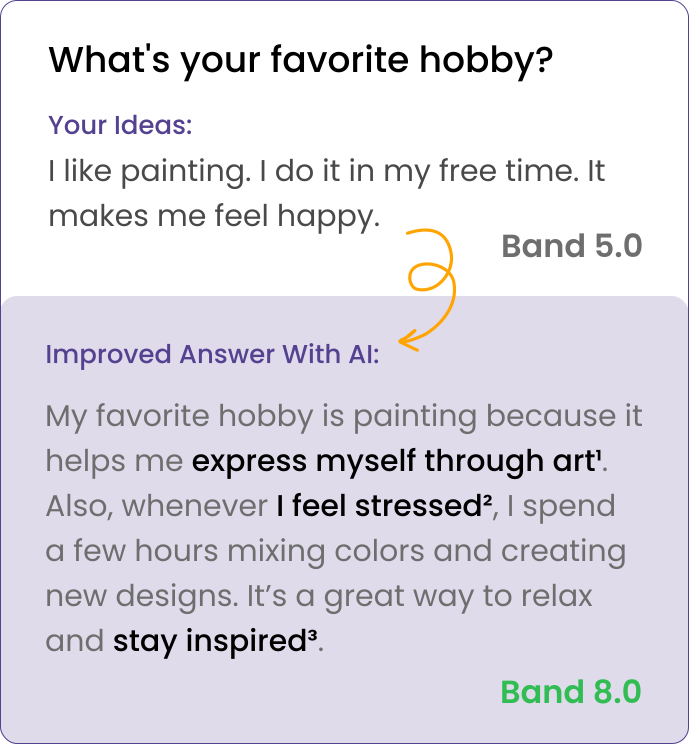
Practice IELTS Speaking answers in our free app
- Build personalized answers that match your target band.
- Turn short replies into fluent answers
- Let examiners fall in love with your answers!
Related Articles
Sample Answers
IELTS Speaking Part 1: Concentration Questions & Answers (Sep-Dec 2026)
Latest Sep-Dec 2026 IELTS Speaking Part 1 questions for Concentration. Read Band 9 sample answers, or use our AI app to turn your own ideas into perfect answers.
Sample Answers
IELTS Speaking Part 1: Jewelry Questions & Band 9 Answers (2026)
Latest Sep-Dec 2026 IELTS Speaking Part 1 questions for Jewelry. Read Band 9 sample answers or generate personal answers using our AI.
Sample Answers
IELTS Speaking Part 1: Colors Questions & Answers (Sep-Dec 2026)
Latest Sep-Dec 2026 IELTS Speaking Part 1 questions for Colors. Read Band 9 sample answers, or use our AI app to turn your own ideas into perfect answers.