IELTS Speaking Part 1: Family Questions & Band 9 Answers (2026)
Latest Sep-Dec 2026 IELTS Speaking Part 1 questions for Family. Read Band 9 sample answers or generate personal answers using our AI.
Start Practicing →Family is one of the "Big 3" topics (along with work and study). You will definitely get questions about your parents, siblings, or childhood. The examiner wants to hear natural, emotional language. To score Band 9, you need to go beyond "I love my family." You need to discuss the real dynamics—like the generation gap, cultural expectations, or how you deal with homesickness.
Latest Sep-Dec 2026: Family Questions & Sample Answers
1. Do you have a large family or a small family?
I come from a massive family. Back in my hometown, there are three generations living under one roof: my grandparents, parents, uncles, aunts, and all my cousins. It is incredibly chaotic, but there is never a dull moment.
2. Who are you closest to in your family?
Definitely my younger cousin, Rina. We are roughly the same age, so we are more like partners in crime than cousins. She is my main source of gossip; she keeps me updated on all the family drama while I am away studying in the city.
3. Do you spend much time with your family?
Sadly, no. Since I left for university, I only see them during major festivals. Now, our relationship exists entirely through pixelated video calls. It’s hard, and I often suffer from bouts of homesickness, but we try to talk every single night.
4. Do you get along well with your family?
We love each other deeply, but there is a significant generation gap. My parents and grandparents are quite conservative and traditional, whereas I have become more modern since moving to the city. This often leads to clashes over my lifestyle.
5. Are your parents strict?
My father was a strict disciplinarian when I was growing up. He imposed a strict rule that I had to be home by sunset every day. He placed immense pressure on academic excellence, which was stressful, but I know he just wanted me to have a secure future.
6. What do you like to do together as a family?
Food is the center of our world. When I visit, my mother prepares elaborate homemade delicacies, like spicy biryani. We sit on the floor in a circle, eating with our hands and sharing stories. It’s a very communal and bonding experience that I miss terribly.
7. Who does the housework in your family?
In my ancestral home, traditional rules are still quite strong. My mother and aunts handle all the cooking and cleaning, while the men handle the finances. I personally disagree with this disparity, so when I visit, I make a point to help clear the table.
8. Do you prefer spending time with family or friends?
Right now, I prefer my friends. My friends in the city give me a sense of autonomy and freedom that I don't get at home. With my family, I always feel the weight of expectations and judgement, whereas my friends accept me exactly as I am.
9. Are you more like your mother or your father?
I have my mother's patience but my father's temperament. Like him, I can be quite stubborn. My relatives often say I am the spitting image of him when I get angry, which is not always a compliment!
10. How has your family influenced you?
They taught me to share. Growing up in a house with 15 people means you have zero privacy, so you learn to share everything from food to secrets. It made me a very adaptable person, ready to handle any social situation at work.
11. Do you want to have a family of your own in the future?
Yes, but I want a small family—just me, my spouse, and our kids. I don't think I could manage the stress of a huge family again. I want a quiet, modern home equipped with smart technology, where I can raise my children with more freedom.
12. What is your best memory with your family?
It was actually the day I left for the city. My entire family gathered at the train station to say goodbye. My grandmother gave me a blessing and pressed some money into my hand. It was a very bittersweet moment—I was excited for my new life but heartbroken to leave my safety net.
13. Do you often visit your relatives?
Not as often as I should. My extended family is quite scattered across different cities, so coordinating travel is a logistical nightmare. However, we always manage to organize at least one massive family reunion every summer.
14. Who is the head of your family?
My grandfather holds that title. He is the patriarch of our household, and his word is essentially law. Even though my parents manage the daily affairs, they always look to him as their ultimate role model when making major life choices.
15. Are family ties important in your culture?
Absolutely. In my culture, there is a strong belief that blood is thicker than water. Strong family ties create an unbreakable support system, ensuring that you are never truly alone when facing emotional or financial hardships.
Key Vocabulary for IELTS Topic: Family
Academic excellence: Performing extremely well in school/university.
Adaptable: Able to adjust to new conditions easily.
Ancestral home: The house that has belonged to your family for many generations.
Autonomy: Independence or freedom.
Bittersweet: A mixture of sadness and happiness (e.g., leaving home).
Blessing: A prayer asking for God's protection, or a formal wish for happiness.
Blood is thicker than water: A proverb meaning family relationships are the strongest and most important ones.
Chaotic: Completely confused or disordered (often used for big families).
Clashes: Arguments or disagreements.
Clear the table: To remove plates and cutlery after a meal.
Communal: Shared by all members of a group.
Conservative: Disliking change and holding traditional values.
Disparity: A great difference (often unfair, like between men's and women's work).
Expectations: Pressure from parents to behave in a certain way.
Family reunion: A social gathering of relatives, especially those who do not see each other often.
Festivals: Religious or cultural celebrations (e.g., Eid, Diwali, Christmas).
Generation gap: A difference of attitudes between old and young people.
Gossip: Casual conversation about other people's private lives.
Handle all the cooking: To be responsible for preparing all the meals.
Home by sunset: A rule requiring you to return home before it gets dark.
Homemade delicacies: Special or delicious food items made at home.
Homesickness: The sad feeling caused by being away from home.
Left for university: The moment you moved away from home to start your higher education.
Logistical nightmare: A situation that is extremely difficult to organize or plan.
Partners in crime: Close friends who have fun together (and sometimes get into trouble).
Patriarch: The male head of a family or household.
Pixelated: When a digital image/video is unclear or blocky because of a bad internet connection.
Pressed some money into my hand: A gesture where an older relative secretly or quickly gives you cash as a gift.
Role model: A person whose behavior or success is emulated by others.
Safety net: A safeguard against difficulty (e.g., knowing your family will always support you).
Sit on the floor: A traditional way of eating meals in many cultures, rather than at a table.
Spitting image: Looking exactly like someone else.
Strict disciplinarian: A parent who believes in firm rules and punishment.
Support system: A network of people who provide practical or emotional help.
Temperament: A person's nature or character (e.g., angry, calm).
Video calls: Using apps like WhatsApp or Zoom to see and talk to people.
Zero privacy: Having no space or time to be alone.
Create Your Own Band 9 Answers
IELTS Speaking Lab helps you turn your real ideas into Band 9 answers.
Select your topic/question - Family/Do you spend much time with your family?
Input your rough idea - "Yes, because I live with my parents."
Get a personalized Band 9 answer instantly, with the perfect vocabulary for your story.
Not happy with these answers?
Change the core idea, band level difficulty, length and get a full glossary in our free app!
Start Practicing →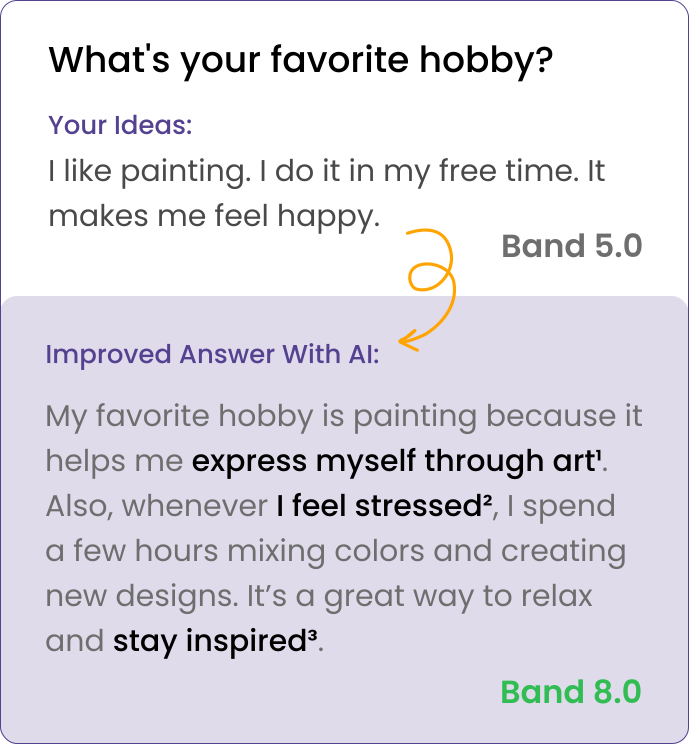
Practice IELTS Speaking answers in our free app
- Build personalized answers that match your target band.
- Turn short replies into fluent answers
- Let examiners fall in love with your answers!
Related Articles
Sample Answers
IELTS Speaking Part 1: Concentration Questions & Answers (Sep-Dec 2026)
Latest Sep-Dec 2026 IELTS Speaking Part 1 questions for Concentration. Read Band 9 sample answers, or use our AI app to turn your own ideas into perfect answers.
Sample Answers
IELTS Speaking Part 1: Jewelry Questions & Band 9 Answers (2026)
Latest Sep-Dec 2026 IELTS Speaking Part 1 questions for Jewelry. Read Band 9 sample answers or generate personal answers using our AI.
Sample Answers
IELTS Speaking Part 1: Colors Questions & Answers (Sep-Dec 2026)
Latest Sep-Dec 2026 IELTS Speaking Part 1 questions for Colors. Read Band 9 sample answers, or use our AI app to turn your own ideas into perfect answers.