IELTS Speaking Part 1: Shoes Questions & Band 9 Answers (2026)
Use our AI tools to get personalized Band 9 answers and vocabulary to talk about shoes, comfort, and style.
Start Practicing →Shoes is a very common topic. The examiner might ask about your favorite pair, shopping habits, or comfort versus fashion. To score Band 9, avoid saying "I like sneakers." Instead, use words like footwear, durability, arch support, or impulse buy to describe your habits.
How to Use These Sample Answers
Below are the latest 2026 questions for "Shoes."
Important: These answers are for a person who prioritizes comfort and practicality. They walk a lot and perhaps enjoy hiking or running. They believe that shoes should protect your feet, not just look pretty.
But if you love fashion and own 100 pairs of high heels, or if you buy expensive sneakers just to keep them in a box and never wear them, these answers are probably not for you.
So, here is the plan:
Read these samples to understand the Band 9 structure.
Use the IELTS Speaking Lab App to get personalized answers. It gives you perfect vocabulary that fits your real life.
Latest Part 1 Questions & Model Answers about Shoes
1. Have you ever bought shoes online?
Yes, I have, but I have mixed feelings about it. While it is convenient, sizing can be very inconsistent between brands. I often worry that the shoes won't fit properly, and dealing with the return policy can be a hassle. I prefer to try them on first to ensure they are comfortable.
2. Where do you usually buy your shoes?
I usually visit brick-and-mortar stores in the shopping mall. I think it is essential to walk around in the shoes to check the arch support and cushion. You just can't get that experience from a website.
3. Do you like buying shoes? How often?
Not really. I view it as a necessity rather than a hobby. I only buy a new pair when my old ones are completely worn out due to wear and tear. I prefer to invest in high-quality footwear that lasts a long time, rather than buying cheap pairs frequently.
4. Do you have a favorite pair of shoes?
Definitively. My favorite pair is my hiking boots. They are waterproof, incredibly durable, and provide excellent ankle support. They are perfect for my outdoor hobbies because they prevent me from slipping on rough terrain.
5. What kind of shoes do you usually wear?
I mostly wear casual footwear, like sneakers or running shoes. Since I walk a lot during my daily commute, comfort is my top priority. I need shoes that are breathable and lightweight so my feet don't get tired.
6. Why do some people collect many shoes?
I think for some people, shoes are a status symbol. They collect limited edition sneakers to show off their wealth or style. For others, it might just be a passion for design and aesthetics, similar to collecting art.
7. How many pairs of shoes do you own now?
I have a very modest collection, probably around five or six pairs. I try to maintain a capsule wardrobe approach. I have one pair for running, one for work, my hiking boots, and a dressy pair for formal occasions. I don't see the point in owning shoes I never wear.
8. How much money do you usually spend on shoes?
I am willing to spend a bit more for quality. I consider good shoes to be an investment in my health. Cheap shoes often lack support and can cause back problems later. So, I look for value for money rather than the lowest price tag.
9. Have you ever regretted buying a pair of shoes?
Yes, a few times. I once made an impulse buy because the shoes looked stylish in the shop window. However, they were made of stiff material and gave me terrible blisters after just one hour. It was a waste of money because I never wore them again.
10. Do you wear different shoes for different occasions?
Absolutely. It is important to follow the appropriate dress code. I wear formal leather shoes for work meetings to look professional, but I switch to athletic shoes for the gym. Wearing the wrong shoes can be both uncomfortable and socially awkward.
11. What is the most expensive pair of shoes you have bought?
The most expensive pair I own is my running shoes. They have advanced shock absorption technology to protect my joints when I exercise. Although the price tag was high, they have prevented injuries, so they were worth every penny.
12. Do you think shoes are important for a person's appearance?
Yes, I think they are. There is a saying that "you can judge a man by his shoes." Dirty or scruffy shoes can ruin an otherwise smart outfit. Wearing well-maintained shoes shows that you pay attention to detail and care about your personal grooming.
13. Did you have a favorite pair of shoes when you were a child?
Yes, I remember having a pair of sneakers that lit up when I walked. I thought they were the coolest thing ever. Looking back, it brings up a sense of nostalgia. They made me feel fast and confident on the playground.
14. Which do you prefer, fashionable shoes or comfortable shoes?
I definitely prefer comfort. I prioritize ergonomic design over style. There is nothing worse than having sore feet at the end of the day. I believe you can find shoes that are both stylish and comfortable, but if I have to choose, comfort wins every time.
15. Do you think men and women have the same attitude toward shoes?
Generally speaking, no. I think women often face more societal pressure to wear uncomfortable shoes, like high heels, for the sake of fashion. Men’s fashion tends to be more utilitarian and focused on comfort, though this is slowly changing with sneaker culture.
Key Vocabulary for IELTS Topic: Shoes
Here is the complete glossary of every bolded word and phrase used in the answers above.
Ankle support: Structure in a shoe that holds the ankle steady to prevent injury.
Arch support: The part of a shoe that supports the curved part of the bottom of the foot.
Blisters: Small bubbles on the skin caused by friction (rubbing shoes).
Breathable: Allowing air to pass through so the skin can breathe.
Brick-and-mortar: A physical shop (building) rather than an online store.
Capsule wardrobe: A small collection of clothes/shoes that are all useful and go well together.
Casual footwear: Shoes suitable for everyday use, not formal.
Dress code: A set of rules about what clothing/shoes must be worn at a specific place.
Durability: The ability to withstand wear, pressure, or damage.
Ergonomic: Designed for efficiency and comfort in the working environment.
Footwear: Items worn on the feet (shoes, boots, sandals).
Health: The state of being free from illness or injury.
High heels: Women's shoes with tall heels that raise the back of the foot.
Impulse buy: Buying something suddenly without planning.
Investment: Buying something expensive because it will be useful or valuable for a long time.
Limited edition: Products produced in very small numbers (often expensive).
Nostalgia: A sentimental longing for the past.
Personal grooming: Taking care of your appearance (hair, clothes, shoes).
Price tag: A label showing the price; the cost of something.
Return policy: The rules a shop has about bringing back items you don't want.
Shock absorption: The ability to dampen impact (important for running shoes).
Sore feet: Feet that hurt or feel painful.
Status symbol: A possession that indicates a person's wealth or importance.
Utilitarian: Designed to be useful or practical rather than attractive.
Value for money: When something is worth the price you paid for it.
Wear and tear: Damage that happens naturally as a result of using something.
Create Your Own Band 9 Answers
The answers above are perfect—if you are a practical person who loves comfort. But what if you have 50 pairs of expensive sneakers? Or what if you love wearing high heels every day?
Your answers need to be true so that you can easily recall them during a stressful exam.
IELTS Speaking Lab helps you turn your real ideas into Band 9 answers.
Select your topic - Shoes.
Input your rough idea (e.g., "I have a collection of 50 pairs of Jordans in my closet").
Get personalized Band 9 answers instantly, with the perfect vocabulary for your story.
Not happy with these answers?
Change the core idea, band level difficulty, length and get a full glossary in our free app!
Start Practicing →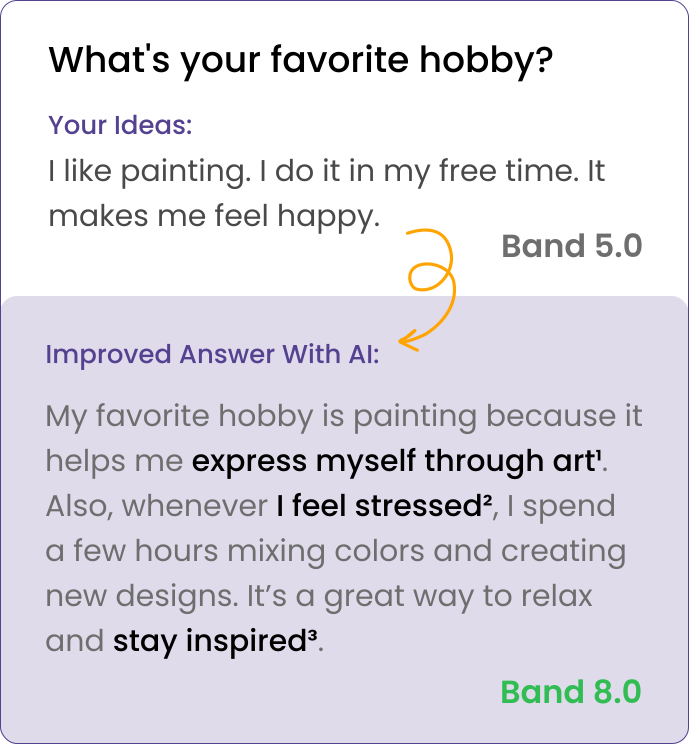
Practice IELTS Speaking answers in our free app
- Build personalized answers that match your target band.
- Turn short replies into fluent answers
- Let examiners fall in love with your answers!
Related Articles
Sample Answers
IELTS Speaking Part 1: Concentration Questions & Answers (Sep-Dec 2026)
Latest Sep-Dec 2026 IELTS Speaking Part 1 questions for Concentration. Read Band 9 sample answers, or use our AI app to turn your own ideas into perfect answers.
Sample Answers
IELTS Speaking Part 1: Jewelry Questions & Band 9 Answers (2026)
Latest Sep-Dec 2026 IELTS Speaking Part 1 questions for Jewelry. Read Band 9 sample answers or generate personal answers using our AI.
Sample Answers
IELTS Speaking Part 1: Colors Questions & Answers (Sep-Dec 2026)
Latest Sep-Dec 2026 IELTS Speaking Part 1 questions for Colors. Read Band 9 sample answers, or use our AI app to turn your own ideas into perfect answers.