IELTS Speaking Part 1: Work Questions & Band 9 Answers (2026)
Latest Sep-Dec 2026 IELTS Speaking Part 1 questions for Work. Read Band 9 sample answers, or use our AI app to turn your own ideas into perfect answers.
Start Practicing →Work is the most common alternative to Study in the Sep-Dec 2026 IELTS test. If you tell the examiner you work, they will immediately ask about your daily routine and career ambitions. To score Band 9, avoid safe answers like "I work in an office." Instead, describe the reality of your profession using specific vocabulary like freelance, pipeline, or burnout.
Latest Sep-Dec 2026: Work Questions & Sample Answers
1. Do you work or are you a student?
I currently work as a freelance Graphic Designer, helping small businesses create their visual identity and marketing materials. I am also in the early stages of planning my own tech startup, which takes up a lot of my free time.
2. What are your main responsibilities?
My main duty is interpreting client briefs and translating their ideas into visual concepts. I spend a lot of time doing revisions based on their feedback until the final design is absolutely pixel-perfect.
3. Do you enjoy your work?
I love the creative side of it and the autonomy of being my own boss. However, the administrative side, like chasing invoices and managing my project pipeline, is something I genuinely dread.
4. Is there anything you dislike about your job?
The most difficult part is definitely the inconsistent income. Since I am self-employed, it is often a case of feast or famine, and quiet months can cause a lot of financial anxiety.
5. What is your typical working day like?
My schedule is quite unstructured, but I usually start my morning time by replying to emails and prospects. Then, I spend the afternoon doing deep work on design software, often working late into the night to meet a tight deadline.
6. Do you prefer working alone or with others?
I generally prefer working alone because I need silence to focus on the aesthetic details of my designs. However, I sometimes miss the camaraderie of an office, so I occasionally visit co-working spaces to network.
7. Do you plan to change your job in the future?
Not exactly change, but I definitely want to scale up my current operations. My goal is to turn my freelance business into a full agency so I can hire other designers to handle the manual tasks.
8. What technology do you use at work?
I rely heavily on high-end technology, including a powerful laptop that can handle rendering heavy graphics. Without high-speed internet to upload large files to the cloud, I simply couldn't do my job.
9. How was your first day at work?
It wasn't a traditional first day because I started working from home. I remember landing my first paying client and suffering from imposter syndrome, constantly worrying that my portfolio wasn't good enough.
10. Do you miss being a student?
Sometimes I miss the lack of responsibility I had during my study years. When you run your own business, the buck stops with you, whereas as a student, the financial stakes were much lower.
11. Would you like to work in another country?
Absolutely, which is the beauty of being a digital nomad. As long as I have my laptop, I would love to spend a year working remotely from somewhere like Bali to escape the daily grind.
12. Is your job popular in your country?
Yes, the gig economy is booming right now, and many young people are rejecting traditional corporate structures. Everyone wants the freedom to work on their own terms, even if it means sacrificing job security.
13. Do you have to work overtime often?
All the time, because when you are self-employed, there is no such thing as clocking off at five. I often burn the candle at both ends to finish projects, which unfortunately cuts into my days off.
14. What training did you need for your job?
I have a degree in design, but this industry moves so fast that I have to constantly upskill. I regularly take online courses on building websites and user interface design to stay relevant in the market.
15. What would make your job easier?
It would be amazing if clients knew exactly what they wanted from the very beginning. Having clearer instructions would save me a lot of tedious communication and prevent creative burnout.
Key Vocabulary for IELTS Topic: Work
Agency: A business that provides a specific service on behalf of others.
Aesthetic: Concerned with beauty or the appreciation of beauty.
Anxiety: A feeling of worry, nervousness, or unease.
Autonomy: The right or condition of self-government; freedom to act independently.
Buck stops: Used to say that someone is ultimately responsible for a situation.
Burn the candle: To work late into the night and start early in the morning.
Burnout: Physical or mental collapse caused by overwork or stress.
Camaraderie: A feeling of friendship and trust among people who work together.
Cloud: Servers accessed over the internet used for storing data.
Deadline: The latest time or date by which something should be completed.
Digital nomad: Someone who earns a living working online while traveling.
Freelance: Working for different companies at different times rather than being permanently employed.
Gig economy: A labor market characterized by short-term contracts or freelance work.
Grind: Hard, dull, and repetitive work.
Imposter syndrome: Doubting your abilities and feeling like a fraud.
Inconsistent: Not staying the same throughout; varying.
Pipeline: Potential future business or projects that are currently being arranged.
Pixel-perfect: A digital design that is flawless and precise.
Prospects: Potential clients or customers.
Revisions: Changes or corrections made to a piece of work.
Scale up: To expand a business to handle more work or sales.
Security: The state of being free from danger, threat, or job loss.
Startup: A newly established business aiming for rapid growth.
Tedious: Too long, slow, or dull; tiresome and boring.
Upskill: To learn new skills to be better at your job.
Create Your Own Band 9 Answers
IELTS Speaking Lab helps you turn your real ideas into Band 9 answers.
Select your topic/question - Work / Do you work or are you a student?
Input your rough idea - "I work in a grocery store but I want to go back to university soon."
Get a personalized Band 9 answer instantly, with the perfect vocabulary for your story.
Not happy with these answers?
Change the core idea, band level difficulty, length and get a full glossary in our free app!
Start Practicing →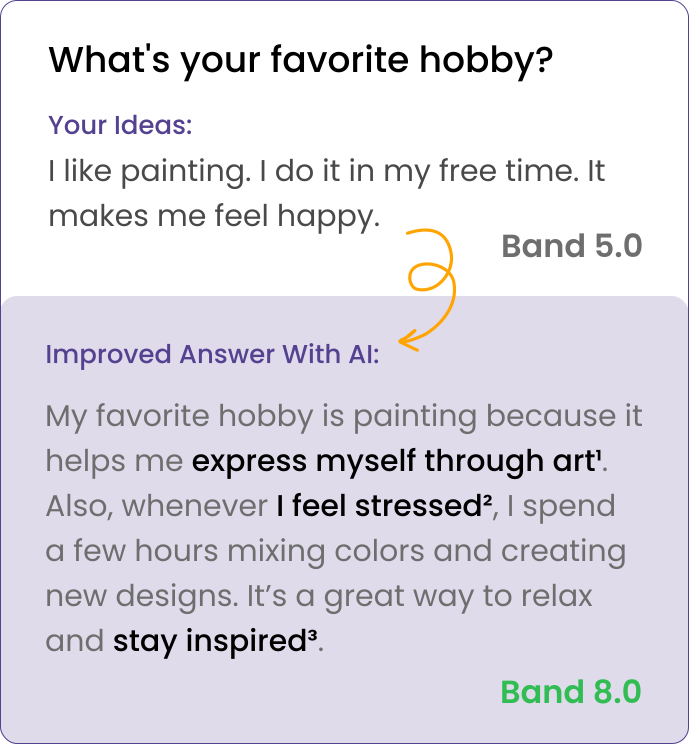
Practice IELTS Speaking answers in our free app
- Build personalized answers that match your target band.
- Turn short replies into fluent answers
- Let examiners fall in love with your answers!
Related Articles
Sample Answers
IELTS Speaking Part 1: Concentration Questions & Answers (Sep-Dec 2026)
Latest Sep-Dec 2026 IELTS Speaking Part 1 questions for Concentration. Read Band 9 sample answers, or use our AI app to turn your own ideas into perfect answers.
Sample Answers
IELTS Speaking Part 1: Jewelry Questions & Band 9 Answers (2026)
Latest Sep-Dec 2026 IELTS Speaking Part 1 questions for Jewelry. Read Band 9 sample answers or generate personal answers using our AI.
Sample Answers
IELTS Speaking Part 1: Colors Questions & Answers (Sep-Dec 2026)
Latest Sep-Dec 2026 IELTS Speaking Part 1 questions for Colors. Read Band 9 sample answers, or use our AI app to turn your own ideas into perfect answers.