IELTS Speaking Part 1: Study Questions & Band 9 Answers (2026)
Latest Sep-Dec 2026 IELTS Speaking Part 1 questions for Study. Read Band 9 sample answers or generate personal answers using our AI.
Start Practicing →The topic of Study is one of the most common openers in the IELTS Speaking test. If you tell the examiner you are a student, they will immediately ask about your major, your classes, and your preferences. To score high, you need to move beyond simple descriptions and use precise, topic-specific vocabulary like bachelor's degree, hit the books, cram for exams, or lucrative career.
Latest Sep-Dec 2026: Study Questions & Sample Answers
1. Do you work or are you a student?
Currently, I’m a full-time student. I’m in my final year majoring in Data Analysis. To be honest, I'm pretty stressed at the moment because I'm buried in assignments for my final capstone project involving predictive modeling.
2. What is your major/subject?
I study Data Analysis. It’s a highly technical course that involves a mix of statistical models, Python programming, and business intelligence. It requires a lot of logical thinking, which can be mentally draining.
3. Why did you choose that subject?
Frankly, I didn't choose it entirely for passion. My parents encouraged me to go into big data because it leads to lucrative career paths. While I'm good with numbers, sometimes I feel writing algorithms is a bit dry compared to creative subjects.
4. Do you prefer to study alone or with a group?
I prefer studying alone. Coding requires deep concentration to avoid syntax errors, and if I’m in a study group with my peers, we usually end up talking about friends or gossip. When I really need to hit the books, I need absolute isolation.
5. Is it a popular subject in your country?
Yes, absolutely. It’s booming right now because every company wants to be data-driven. It’s extremely competitive, meaning the classes are packed and it’s easy to struggle to keep up with the latest software updates.
6. Do you prefer to study in the morning or the evening?
Definitely the evening. I am not a morning person. During exam season, I often pull all-nighters because the silence of the night helps me debug my code without distractions.
7. What do you find most difficult about your studies?
The steep learning curve of new programming languages. We have to learn SQL and R simultaneously. If you miss one concept in a lecture, your entire code breaks. Last semester was a nightmare; I was completely swamped.
8. Do you plan to continue studying after you graduate?
Absolutely not. Once I obtain my degree, I am done with assessments. I am desperate to get into the corporate world and actually apply these skills to real-world datasets instead of hypothetical problems.
9. Do you get on well with your classmates?
Mostly. We are all in the same boat, suffering through the same complex data sets, so there is a sense of camaraderie. But I don't really socialize with them outside of class; I prefer to hang out with my old friends from my hometown.
10. What was your first day at university like?
It was overwhelming. I remember looking at the syllabus and realizing how much advanced calculus was involved. I felt completely out of my depth. It certainly wasn't a breeze settling in.
11. If you could change your major, would you?
In a heartbeat. If I could go back, I would choose something creative like Graphic Design. I think I would have passed those classes with flying colors because I actually enjoy art, whereas fixing bugs in a script is just a grind.
12. Do you use much technology in your studies?
Yes, my entire degree depends on technology. I live on my laptop. We use cloud computing and visualization tools daily. I honestly couldn't survive this course without high-speed internet.
13. Where do you usually study?
I try to avoid studying at home because I get distracted by [food] in the kitchen! I usually go to the computer labs on campus because they have dual monitors. The setup helps me multitask between my code and my research without slacking off.
14. How many hours a week do you spend studying?
Too many to count. When I am training a model or processing data, it feels like 24/7. Even when I'm not technically working, I'm thinking about logic problems, so it feels like I never really get a breather.
15. Which part of your course do you enjoy the most?
The only part I really enjoy is data visualization. The data cleaning process is tedious, but turning raw numbers into a clear, colorful dashboard is actually quite satisfying.
16. Do you do any extracurricular activities?
Not really. My course load is so heavy that I don't have much time for sports or clubs. I occasionally attend coding hackathons, but even that feels like work. I prefer to just sleep in my free time.
17. Is your university far from your home?
Yes, it is quite a commute. I usually have to take a long train ride, which I use to read or listen to podcasts about travel destinations I want to visit one day. It helps me escape the stress of university life for a bit.
18. What makes a good student?
I think discipline is key. You can be smart, but if you procrastinate, you will fail. Also, you need to be resilient. When your code fails for the 100th time, you have to have the patience to try again.
19. How do you prepare for exams?
I usually start revising two weeks in advance. I create a strict timetable and try to stick to it. I review all my lecture notes and do past papers. However, sometimes I panic and end up trying to cram everything in the night before.
20. Does the weather affect your studies?
Surprisingly, yes. If the weather is sunny and beautiful, I find it impossible to concentrate because I want to be outside. I actually prefer rainy days for studying because I don't feel like I'm missing out on anything.
Key Vocabulary for IELTS Topic: Study
Here is the complete glossary of every bolded word and phrase used in the answers above.
Advanced calculus: A high level of mathematics dealing with rates of change.
Algorithms: A set of rules or calculations used by computers to solve problems.
Assessments: Tests, exams, or essays used to grade students.
A breeze: Something that is very easy to do.
Breather: A short break or rest from work.
Bugs: Errors or flaws in a computer program.
Buried in assignments: Having a huge amount of homework/schoolwork to do.
Business intelligence: Strategies and technologies used by enterprises for data analysis.
Camaraderie: A feeling of friendship and trust among people in a group.
Capstone project: A final, multifaceted assignment that serves as a culminating academic experience.
Cloud computing: Using services hosted on the internet rather than a local server.
Coding hackathons: Events where programmers meet to do collaborative computer programming.
Course load: The number of courses a student takes in a term.
Cram: To study intensively over a short period of time just before an examination.
Create a strict timetable: To make a rigid schedule for your activities.
Dashboard: A visual interface that provides an at-a-glance view of key performance indicators.
Data sets: Collections of related sets of information that is composed of separate elements.
Data visualization: The representation of information and data in a graphical format.
Data-driven: Determined by or dependent on the collection or analysis of data.
Debug my code: To find and fix errors in computer software.
Discipline is key: Self-control is the most important thing.
Dry: Boring; lacking excitement (often used for academic subjects).
Dual monitors: Using two screens connected to a single computer to increase workspace.
Grind: Hard dull work.
High-speed internet: A fast and reliable internet connection.
Hit the books: To start studying with intense focus.
In the same boat: In the same difficult situation as others.
Lucrative career paths: Jobs that pay a lot of money.
Majoring in: The specific subject you are studying at university.
Mentally draining: Something that makes your brain feel very tired.
Missing out on anything: Feeling sad that you are not part of an enjoyable event happening elsewhere.
Obtain my degree: A formal way to say "graduate" or "get my diploma."
Out of my depth: Finding yourself in a situation that is too difficult for you to deal with.
Past papers: Exam papers from previous years used for practice.
Patience: The capacity to accept or tolerate delay, trouble, or suffering without getting angry.
Peers: People who are the same age or status as you (classmates).
Predictive modeling: A mathematical process used to predict future events or outcomes.
Procrastinate: To delay or postpone action; putting off doing something.
Pull all-nighters: Staying awake all night to study or work.
Python: A popular high-level programming language used in data science.
Quite a commute: A long journey to get to work or school.
Real-world datasets: Data collected from actual events or situations, not made up for a textbook.
Resilient: Able to withstand or recover quickly from difficult conditions.
Revising: Rereading work done previously to improve one's knowledge of a subject (studying for exams).
Slacking off: To work lazily or do less work than you should.
Software updates: New versions of computer programs that fix problems or add features.
SQL: (Structured Query Language) A domain-specific language used in programming for managing data.
Statistical models: Mathematical frameworks used to analyze data patterns.
Steep learning curve: Something that is difficult to learn at the beginning.
Struggle to keep up: Finding it difficult to maintain the same speed or progress as others.
Swamped: Overwhelmed with too much work.
Syllabus: An outline of the subjects in a course of study or teaching.
Syntax errors: Mistakes in the source code, such as spelling or punctuation errors.
Tedious: Boring, slow, and repetitive.
Training a model: The process of teaching an AI or algorithm to recognize patterns.
With flying colors: To pass a test or exam with a very high score.
Create Your Own Band 9 Answers
IELTS Speaking Lab helps you turn your real ideas into Band 9 answers.
Select your topic/question - Study/What is your major?
Input your rough idea - "I study Medicine and I want to be a surgeon."
Get a personalized Band 9 answer instantly, with the perfect vocabulary for your story.
Not happy with these answers?
Change the core idea, band level difficulty, length and get a full glossary in our free app!
Start Practicing →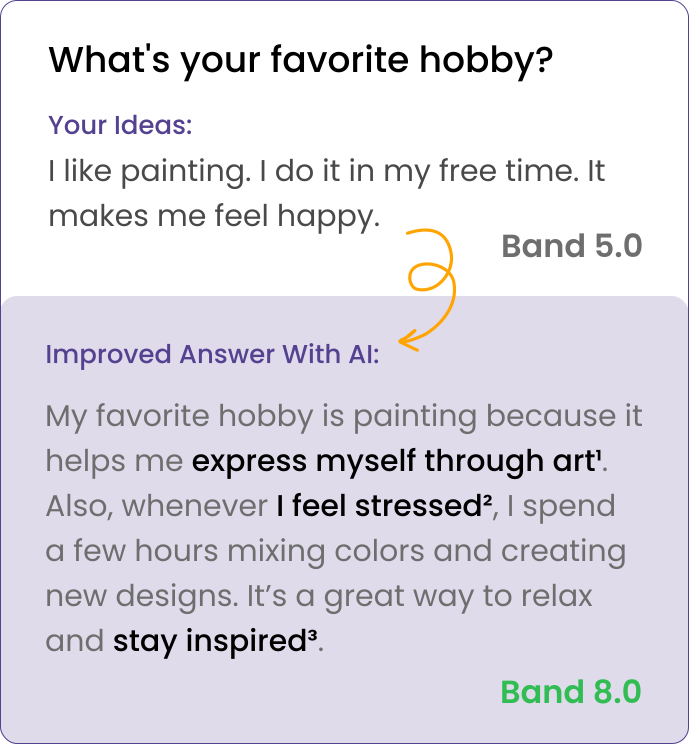
Practice IELTS Speaking answers in our free app
- Build personalized answers that match your target band.
- Turn short replies into fluent answers
- Let examiners fall in love with your answers!
Related Articles
Sample Answers
IELTS Speaking Part 1: Concentration Questions & Answers (Sep-Dec 2026)
Latest Sep-Dec 2026 IELTS Speaking Part 1 questions for Concentration. Read Band 9 sample answers, or use our AI app to turn your own ideas into perfect answers.
Sample Answers
IELTS Speaking Part 1: Jewelry Questions & Band 9 Answers (2026)
Latest Sep-Dec 2026 IELTS Speaking Part 1 questions for Jewelry. Read Band 9 sample answers or generate personal answers using our AI.
Sample Answers
IELTS Speaking Part 1: Colors Questions & Answers (Sep-Dec 2026)
Latest Sep-Dec 2026 IELTS Speaking Part 1 questions for Colors. Read Band 9 sample answers, or use our AI app to turn your own ideas into perfect answers.