IELTS Speaking Part 1: Dreams Questions & Band 9 Answers (2026)
Latest Sep-Dec 2026 IELTS Speaking Part 1 questions for Dreams. Read Band 9 sample answers or generate personal answers using our AI.
Start Practicing →You might get asked about Dreams in the Sep-Dec 2026 IELTS test. The examiner might ask about the dreams you have while sleeping, or your dreams and goals for the future. To score Band 9, avoid saying "I had a bad dream." Instead, use words like subconscious, fleeting, aspirations, or pragmatic to describe your thoughts.
Latest Sep-Dec 2026: Dreams Questions & Sample Answers
1. Do you often remember your dreams?
Very rarely. I usually fall into a deep slumber as soon as my head hits the pillow. On the rare occasions that I do remember something, the images are incredibly fleeting and fade away within seconds of waking up.
2. Do you share your dreams with others?
No, almost never. I personally find listening to other people's dreams to be quite tedious because the stories are usually entirely incoherent. Therefore, I assume no one wants to hear about my strange, unstructured thoughts either.
3. Do you think dreams have special meanings?
I am a very rational person, so I don't believe in the superstition that dreams predict the future. I think they are simply a neurological process where the brain organizes memories and emotions from the day.
4. Have you ever had a recurring dream?
Yes, mostly when I am under pressure. I sometimes have an anxiety-inducing dream where I am late for a crucial exam. It is clearly just a physical manifestation of everyday stress rather than anything mysterious.
5. Are you a day-dreamer?
Not really. I try to stay as grounded as possible. While it is nice to imagine winning the lottery occasionally, I prefer to focus my energy on tangible tasks and actual problem-solving in the present moment.
6. What was your childhood dream?
Like many children, my early aspirations were a bit naive. I desperately wanted to be an astronaut. However, as I grew older and realized how much advanced math was involved, my goals became much more pragmatic.
7. Do you think it is important to have dreams and goals?
Absolutely. Without clear goals, it is very easy to stagnate in life. Having a vision for the future helps to propel you forward. It provides motivation and gives you specific milestones to work toward.
8. Does music affect your dreams?
I think it can influence your sleep quality. If I listen to very calm, ambient music before bed, it puts me in a tranquil state of mind, which usually leads to a much more restful and undisturbed night of sleep.
9. Have you ever dreamed about traveling?
Occasionally. Sometimes if I am feeling a bit of wanderlust, I will have a very vivid dream about being in a foreign city. It usually happens right after I have been researching travel destinations online before bed.
10. Do you ever dream about your job?
Unfortunately, yes. When I have a heavy project at work, the stress tends to spill over into my sleep. I will dream about answering emails or missing deadlines. It is incredibly frustrating and a clear sign of a poor work-life balance.
11. Do you ever dream about people you know?
Yes, my brain often decides to incorporate my friends or family members into bizarre situations. For instance, I might dream that we are all back in high school together, even though that makes absolutely no logical sense.
12. Do you think technology will ever be able to record dreams?
It seems completely unfathomable to me right now, but technology is advancing at a terrifying pace. While it would be scientifically fascinating, the idea of a machine recording my subconscious thoughts feels highly intrusive.
13. Have your dreams for the future changed since you were a teenager?
Yes, they have evolved significantly. When I was younger, I dreamed of fame and adventure. Now, my priorities have shifted toward financial stability, health, and living a quiet, peaceful life.
14. Do you like hearing about other people's goals?
Yes, I find that very inspiring. Hearing about a colleague's ambition to start a business or a friend's plan to run a marathon is highly motivating. It is much more interesting than hearing about the weird things they saw in their sleep.
15. Do you think sleeping well is important for dreaming?
Yes, biologically speaking, you need to reach the stage of REM sleep to dream properly. A solid eight hours of sleep is incredibly restorative and essential for maintaining good cognitive function during the day.
Key Vocabulary for IELTS Topic: Dreams
Here is the complete glossary of every bolded word and phrase used in the answers above.
Anxiety-inducing: Causing feelings of extreme worry or nervousness.
Aspirations: A hope or ambition of achieving something.
Cognitive function: Mental abilities involving learning, thinking, reasoning, and remembering.
Deep slumber: A very heavy and peaceful sleep.
Evolved: Developed gradually over time.
Financial stability: A state where a person has enough money to manage their expenses and save for the future without worry.
Fleeting: Lasting for a very short time; passing quickly.
Grounded: Sensible, realistic, and well-balanced.
Incoherent: Expressed in an incomprehensible or confusing way; unclear.
Incorporate: To include something as part of a whole.
Intrusive: Causing disruption or annoyance through being unwelcome or uninvited into one's privacy.
Manifestation: A sign or symptom that shows something clearly.
Milestones: Significant events or stages in the life, progress, or development of a person.
Motivating: Providing a reason to do something; inspiring eagerness.
Naive: Showing a lack of experience, wisdom, or judgment.
Neurological process: A function or action relating to the nervous system and the brain.
Pragmatic: Dealing with things sensibly and realistically in a way that is based on practical rather than theoretical considerations.
Propel: To drive, push, or cause to move in a particular direction.
Rational: Based on or in accordance with reason or logic.
REM sleep: (Rapid Eye Movement) A stage of sleep characterized by rapid eye movements, more dreaming, and bodily movement.
Restorative: Having the ability to restore health, strength, or a feeling of well-being.
Spill over: To reach or influence a larger area; when emotions from one situation affect another.
Subconscious: The part of the mind of which one is not fully aware but which influences one's actions and feelings.
Superstition: A widely held but irrational belief in supernatural influences.
Tangible: Perceptible by touch; having physical substance; real and concrete.
Tedious: Too long, slow, or dull; tiresome or monotonous.
Tranquil: Free from disturbance; calm.
Unfathomable: Incapable of being fully explored or understood.
Vivid: Producing powerful feelings or strong, clear images in the mind.
Wanderlust: A strong desire to travel.
Work-life balance: The division of one's time and focus between working and family or leisure activities.
Create Your Own Band 9 Answers
IELTS Speaking Lab helps you turn your real ideas into Band 9 answers.
Select your topic/question - Dreams/Do you often remember your dreams?
Input your rough idea - "Yes, almost always."
Get a personalized Band 9 answer instantly, with the perfect vocabulary for your story.
Not happy with these answers?
Change the core idea, band level difficulty, length and get a full glossary in our free app!
Start Practicing →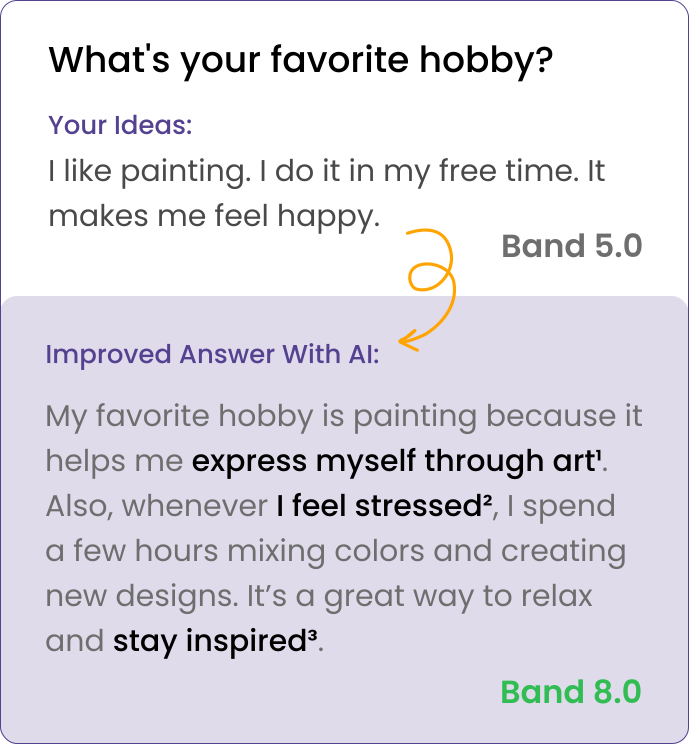
Practice IELTS Speaking answers in our free app
- Build personalized answers that match your target band.
- Turn short replies into fluent answers
- Let examiners fall in love with your answers!
Related Articles
Sample Answers
IELTS Speaking Part 1: Concentration Questions & Answers (Sep-Dec 2026)
Latest Sep-Dec 2026 IELTS Speaking Part 1 questions for Concentration. Read Band 9 sample answers, or use our AI app to turn your own ideas into perfect answers.
Sample Answers
IELTS Speaking Part 1: Jewelry Questions & Band 9 Answers (2026)
Latest Sep-Dec 2026 IELTS Speaking Part 1 questions for Jewelry. Read Band 9 sample answers or generate personal answers using our AI.
Sample Answers
IELTS Speaking Part 1: Colors Questions & Answers (Sep-Dec 2026)
Latest Sep-Dec 2026 IELTS Speaking Part 1 questions for Colors. Read Band 9 sample answers, or use our AI app to turn your own ideas into perfect answers.