IELTS Speaking Part 1: Environment Questions & Band 9 Answers (2026)
Use our AI tools to get personalized Band 9 answers and vocabulary to talk about pollution, nature, and climate change.
Start Practicing →Environment is a very common topic. The examiner might ask about pollution, recycling, or global warming. To score Band 9, avoid saying "The air is dirty." Instead, use words like hazardous, contamination, sustainability, or carbon footprint to describe your views.
How to Use These Sample Answers
Below are the latest 2026 questions for "Environment."
Important: These answers are for a person who lives in a busy city and is worried about pollution. They try to recycle and care about the planet, but they are not an expert. But if you don't care about nature, or if you think climate change is not real, these answers are probably not for you.
So, here is the plan:
Read these samples to understand the Band 9 structure.
Use the IELTS Speaking Lab App to get personalized answers. It gives you Band 7+ vocabulary that is relevant to your life.
IELTS Speaking Part 1: Questions & Model Answers about Environment
1. Is there much pollution where you live?
To be honest, yes, it is a significant issue. I live in a metropolitan area where traffic congestion is terrible, so the air quality is often quite poor. On some days, you can actually see a layer of smog hanging over the city, which is quite worrying for our health.
2. Do you take an interest in nature?
Absolutely. I have always been fascinated by the natural world. Even though I live in the city, I try to escape the concrete jungle whenever I can. I love hiking in the mountains to see the changing seasons. Being surrounded by lush greenery really helps me recharge my batteries regardless of the weather.
3. Do you or your family take steps to help the environment?
We try to do our bit. We are very strict about recycling household waste, like separating plastics, glass, and paper. My parents also recently installed solar panels on our roof to reduce our electricity bills and our carbon footprint.
4. Are there any environmental problems in your country?
Sadly, yes. One of the pressing problems we face is deforestation. Large areas of forest are being cut down to make way for agriculture. This is leading to soil erosion and the loss of natural habitat for many native animals.
5. Do you think you lead a green lifestyle?
I try to be eco-friendly, but it is difficult in a modern city. I try to use transport like buses or trains instead of driving to lower my emissions, and I always carry a reusable water bottle. However, I think it requires a collective effort to make a real difference.
6. What do you do with your garbage?
I am very careful to segregate my trash. We have different bins for recyclables and organic waste, such as leftover food. It’s a small habit, but it prevents unnecessary waste from ending up in a landfill where it would release methane gas.
7. Are you worried about global warming?
Yes, I think it is a huge global crisis. We are seeing more extreme weather events, like floods and heatwaves, which are clear signs of climate change. If we don't take drastic measures soon, the damage to our planet will be irreversible.
8. How do you get information about environmental issues?
Mostly through the internet. I follow several organizations on social media that post about conservation efforts and sustainable living. It is a great way to stay informed about current affairs and learn how to reduce my impact.
9. Does pollution affect your outdoor activities?
Yes, unfortunately. I love playing sport outside, but on days when the pollution levels are high, I have to stay indoors. Breathing in toxic fumes while exercising is dangerous and can lead to respiratory issues.
10. Is there noise pollution in your area?
Yes, quite a lot. Living near a main road means there is a constant din of traffic, honking horns, and sirens. It can be quite disturbing at night. I think noise pollution is an often overlooked form of pollution that really affects people's mental well-being.
11. How do you save energy at home?
I am quite conscientious about it. I always switch off lights when I leave a room and unplug devices that aren't in use. We also use energy-efficient LED bulbs throughout the house. It saves money and reduces our demand on the power grid.
12. What causes the most pollution in your country?
I would say it is a combination of industrial emissions from factories and vehicle exhaust. We rely heavily on fossil fuels for energy, which releases a lot of pollutants into the atmosphere. We need to transition to renewable energy sources like wind and solar power.
13. Do you use plastic bags?
I try to avoid them as much as possible. I have a cloth tote bag that I take shopping with me. Plastic bags are a terrible scourge on the environment because they take hundreds of years to decompose and often end up harming marine life.
14. Do you think schools should teach children about the environment?
Definitely. Education is key to fostering a sense of environmental stewardship in the next generation. If children learn about the importance of biodiversity early on, they are more likely to grow up making sustainable choices.
15. Would you like to live on a planet with no pollution?
Of course, that is the dream! Imagine breathing pristine air and swimming in crystal-clear water every day. It would be a healthier, happier existence for everyone. I hope that with technological advancements, we can one day achieve a pollution-free world.
Key Vocabulary for IELTS Topic: Environment
Here is the glossary of the bolded words and phrases used in the answers above.
Air quality: The degree to which the air is pollution-free.
Biodiversity: The variety of life in the world or in a particular habitat.
Carbon footprint: The amount of carbon dioxide released into the atmosphere by an individual.
Changing seasons: The transition from winter to spring, summer to autumn, etc.
Climate crisis: A situation in which urgent action is required to reduce or stop climate change.
Collective effort: A group of people working together to achieve a common goal.
Concrete jungle: A city area with a high density of buildings and few trees.
Conscientious: Wishing to do what is right; careful.
Conservation: Protecting Earth's natural resources and living things.
Decompose: To break down or rot (biological or chemical).
Deforestation: The action of clearing a wide area of trees.
Din: A loud, unpleasant, and prolonged noise.
Do our bit: To make a contribution to a task; to do one's share.
Drastic measures: Extreme actions taken to solve a problem.
Eco-friendly: Not harmful to the environment.
Emissions: The production and discharge of something, especially gas.
Energy-efficient: Using less energy to perform the same task.
Environmental stewardship: The responsible use and protection of the natural environment.
Escape the concrete jungle: To leave the noisy city for nature.
Extreme weather events: Unexpected, unusual, or severe weather.
Fossil fuels: A natural fuel such as coal or gas.
Global crisis: A difficult or dangerous situation that affects the whole world.
Industrial emissions: Pollution released into the atmosphere from factories.
Irreversible: Not possible to undo or alter.
Landfill: A place to dispose of waste by burying it.
Lush greenery: Healthy, thick, green plants and leaves.
Methane gas: A potent greenhouse gas released from rotting waste.
Metropolitan area: A densely populated urban core and its surroundings.
Natural habitat: The natural home or environment of an animal or plant.
Natural world: Animals, plants, and landscapes as opposed to human creations.
Noise pollution: Harmful or annoying levels of noise.
Organic waste: Material that is biodegradable and comes from a plant or animal (e.g., food).
Pollutants: Substances that pollute something.
Pollution-free: Containing no pollution.
Power grid: A network of electrical transmission lines.
Pressing problems: Urgent difficulties that need attention.
Pristine: In its original condition; unspoiled.
Recharge my batteries: To rest and relax in order to regain energy.
Recycling household waste: Converting home waste into new materials.
Renewable energy: Energy from a source that is not depleted (wind, solar).
Reusable: Able to be used again.
Scourge: Something that causes great trouble or suffering.
Segregate: To set apart from the rest; to separate (trash).
Significant issue: A problem that is important or large enough to be noticed.
Smog: Fog or haze combined with smoke and pollutants.
Soil erosion: The washing away of the upper layer of soil.
Solar panels: Devices that convert light from the sun into electricity.
Sustainable choices: Decisions that reduce one's impact on the environment.
Toxic fumes: Poisonous gases or smoke.
Traffic congestion: Heavy traffic characterized by slower speeds.
Create Your Own Band 9 Answers
The answers above are perfect—if you live in a city and care about nature.
But what if you live in the countryside? Or what if you don't believe in climate change?
Your answers need to be true so that you can easily recall them during a stressful exam.
IELTS Speaking Lab helps you turn your real ideas into Band 9 answers.
Select your topic - Environment.
Input your rough idea (e.g., "I don't recycle because it is too difficult").
Get personalized Band 9 answers instantly, with the perfect vocabulary for your story.
Not happy with these answers?
Change the core idea, band level difficulty, length and get a full glossary in our free app!
Start Practicing →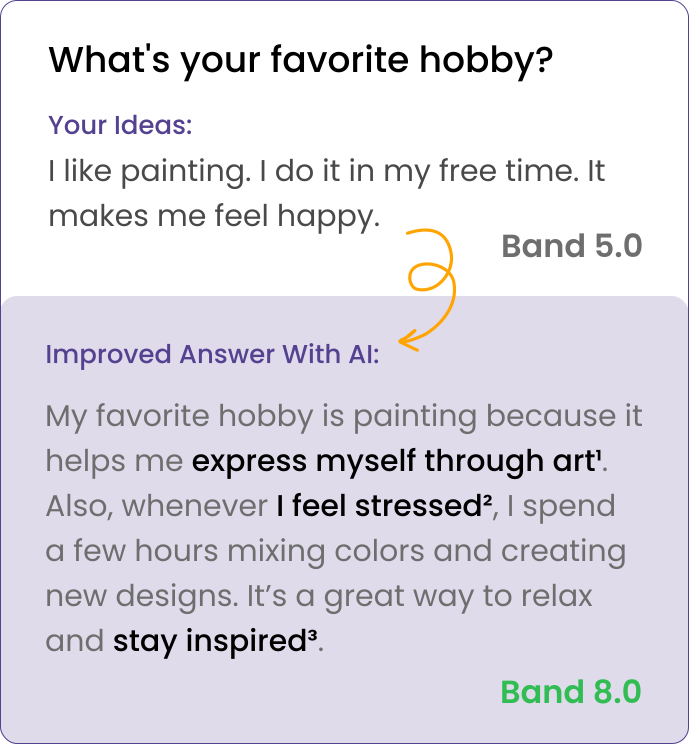
Practice IELTS Speaking answers in our free app
- Build personalized answers that match your target band.
- Turn short replies into fluent answers
- Let examiners fall in love with your answers!
Related Articles
Sample Answers
IELTS Speaking Part 1: Concentration Questions & Answers (Sep-Dec 2026)
Latest Sep-Dec 2026 IELTS Speaking Part 1 questions for Concentration. Read Band 9 sample answers, or use our AI app to turn your own ideas into perfect answers.
Sample Answers
IELTS Speaking Part 1: Jewelry Questions & Band 9 Answers (2026)
Latest Sep-Dec 2026 IELTS Speaking Part 1 questions for Jewelry. Read Band 9 sample answers or generate personal answers using our AI.
Sample Answers
IELTS Speaking Part 1: Colors Questions & Answers (Sep-Dec 2026)
Latest Sep-Dec 2026 IELTS Speaking Part 1 questions for Colors. Read Band 9 sample answers, or use our AI app to turn your own ideas into perfect answers.