IELTS Speaking Part 1: Social Media Questions & Band 9 Answers (2026)
Latest Sep-Dec 2026 IELTS Speaking Part 1 questions for Social Media. Read Band 9 sample answers or generate personal answers using our AI.
Start Practicing →Social Media is a very common IELTS topic in Sep-Dec 2026. The examiner will ask which websites you use, why you use them, or if you think they are dangerous. To score Band 9, avoid saying "I like Instagram because it is fun." Instead, use words like content creation, doomscrolling, algorithm, or digital detox to describe your online life.
Latest Sep-Dec 2026: Social Media Questions & Sample Answers
1. Do you use social media websites?
Yes, absolutely. To be honest, they are an integral part of my daily existence. I run a personal cooking blog, so I am constantly online to promote my latest recipes. I treat my social media profiles as a portfolio where I post highly curated images to attract followers and grow my work.
2. Which social media platform is your favorite?
I would say Instagram is my top choice, largely because it is so visually oriented. Since my main hobbies involve food presentation and photography, this platform allows me to showcase the aesthetic side of my work perfectly. However, I also have a soft spot for YouTube; the algorithm there is uncannily good at suggesting videos that keep me entertained.
3. Do you think you spend too much time on social media?
Admittedly, yes. It can be a bit of a double-edged sword. On one hand, I need to be active to maintain my engagement rates and respond to my audience. On the other hand, it is very easy to fall down a rabbit hole of scrolling through short videos when I should be focusing on my study or other responsibilities.
4. Is there anything you don't like about social media?
Definitely. The pressure to maintain a perfect digital footprint can be exhausting. Sometimes, I feel like I am constantly comparing my behind-the-scenes reality with everyone else's highlight reel, which can be discouraging. Also, the sheer volume of advertisements and the toxicity of some comment sections can be quite draining.
5. How do you think social media has changed the way we communicate?
It has revolutionized communication, mostly for the better. We can now stay in touch with friends across the globe instantly, which is great for travel planning or keeping up with long-distance relatives. For me, it has democratized content creation; I can share my culinary skills with the world without needing a TV show. However, I do miss the days when people had longer conversations without the distraction of notifications.
6. Do you post many photos on social media?
Yes, constantly. Since I blog about food, posting high-quality images is part of the job. I spend a lot of time editing them to ensure the lighting and composition are perfect. I want my feed to look professional and appetizing to anyone who visits my profile.
7. Do you follow many people on social media?
Yes, I follow quite a few influencers, mostly in the lifestyle space. I look to them for inspiration and new ideas. I also follow close friends and family to keep up with their lives, though I pay more attention to the educational content related to my interests.
8. Have you ever unfriended someone on social media?
Yes, I have. I try to curate my feed to be a positive space. If someone posts offensive content or spreads fake news, I will unfollow or block them. I believe it is important to protect your mental peace by filtering out negativity and trolls.
9. Do you think social media is good for children?
Generally, no. I think it exposes them to cyberbullying and unrealistic beauty standards far too early. While there are educational aspects, the risks often outweigh the benefits. I believe their usage should be heavily supervised to protect their health and well-being.
10. Do you like reading news on social media?
I do, but I take it with a grain of salt. It is very convenient to get breaking news alerts on my phone, but I am wary of clickbait headlines designed just to get views. I usually verify any important stories with a reputable news website before I believe them.
11. Do you prefer sending messages or calling?
I prefer sending messages. It allows me to think about what I want to say and respond at my own convenience. However, if it is an urgent matter or a complex topic, I will hop on a call. But for day-to-day chatter, messaging apps are my go-to method.
12. Do you think people are more open on social media than in real life?
Paradoxically, yes. People often feel a sense of anonymity online, or "keyboard courage," which makes them share personal details or opinions they would never voice face-to-face. This can lead to genuine connections, but also to oversharing and regret.
13. Do you ever take a break from social media?
I try to do a digital detox every now and then, usually on weekends. It helps me recharge my batteries and reconnect with the physical world. However, because of my blog, I can't stay away for too long or I risk losing momentum with my audience.
14. What kind of videos do you watch on YouTube?
I watch a mix of things. I love watching tutorials to learn new cooking techniques, but I also watch highlights of sport matches and travel vlogs to unwind. It is my primary source of entertainment when I want to relax in the evening.
15. Do you care about how many likes you get?
I would like to say no, but truthfully, yes. The instant gratification of seeing likes and positive comments is addictive. From a business perspective, those metrics are proof that my content is resonating with people, so I track them quite closely.
16. Are you worried about privacy online?
Yes, very much so. Data breaches are becoming common, and it is scary how much information big tech companies collect about us. I try to be mindful of my privacy settings and limit the amount of personal data I share publicly.
17. Do you use social media for work or study?
Yes. Aside from my blog, I use platforms like LinkedIn for networking and gathering research materials. Social media is a powerful tool for professional development if you use it the right way, rather than just for wasting time.
18. Do you think social media makes people lonely?
It can. It creates an illusion of connection, but scrolling through a feed alone in your room is not the same as genuine human interaction. It is easy to feel isolated when you see everyone else seemingly having a better time than you.
19. What would you do if social media disappeared tomorrow?
I would panic at first because my blog relies on it! But eventually, I think I would adapt. I might start a newsletter or open a physical café. On a personal level, I would probably read more books and have better focus without the constant distractions.
20. Will social media change in the future?
I am sure it will. I think it will become even more immersive, perhaps with virtual reality. The line between the digital world and the real world will continue to blur. I just hope we find ways to make it healthier for our minds.
Key Vocabulary for IELTS Topic: Social Media
Adapt: To become adjusted to new conditions.
Addictive: Causing a strong and harmful need to do something or use something.
Aesthetic: Concerned with beauty or the appreciation of beauty.
Algorithm: A set of rules used by social media to decide which posts or videos to show you.
Anonymity: The state of being anonymous (not identified by name).
Appetizing: Stimulating one's appetite; looking good to eat.
Beauty standards: The socially constructed notion that physical attractiveness is one of a person's most important assets.
Behind-the-scenes: The reality of what happens secretly, not shown in the final perfect image.
Big tech companies: The largest and most dominant companies in the information technology industry (e.g., Google, Facebook).
Blur: To become unclear or less distinct.
Clickbait: Content (usually headlines) designed to attract attention and encourage visitors to click on a link.
Comment sections: The area below a post where users can write their opinions.
Composition: The artistic arrangement of the parts of a picture.
Content creation: The act of producing entertaining or educational material (videos, photos) for the internet.
Convenience: The state of being able to proceed with something with little effort or difficulty.
Cooking blog: A website where someone writes about food and recipes.
Curate my feed: To carefully select what accounts you follow so your home page shows only what you want to see.
Curated: Carefully selected and organized to look perfect.
Cyberbullying: The use of electronic communication to bully or threaten a person.
Data breaches: Security incidents where sensitive, protected, or confidential data is copied or stolen.
Day-to-day chatter: Casual, daily conversation about unimportant things.
Democratized: Made something accessible to everyone, not just the rich or famous.
Digital detox: A period of time during which a person refrains from using electronic devices.
Digital footprint: The trail of data you leave behind when you use the internet.
Doomscrolling: Spending an excessive amount of screen time devoted to the absorption of negative news.
Double-edged sword: Something that has both positive and negative effects.
Educational content: Material designed to teach you something.
Engagement rates: A measurement of how many people like, comment, or share your posts.
Fake news: False or misleading information presented as news.
Feed: The constantly updating list of stories, pictures, or videos on a social media platform.
Focus: The center of interest or activity; the state of having clear visual definition.
Genuine connections: Real and authentic relationships with people.
Go-to method: The method you rely on or use most often.
Grain of salt: To view something with skepticism or not take it literally (idiom).
Highlight reel: A collection of the best moments, often hiding the boring or bad parts of life.
Hop on a call: To quickly join a phone conversation.
Human interaction: Communication or engagement between people.
Illusion of connection: Feeling like you are connected to people when you are actually alone.
Immersive: Noting a digital technology that provides a sense of deep engagement.
Influencers: People on social media who have a lot of followers and can persuade them to buy things or do things.
Instant gratification: The desire to experience pleasure or fulfillment without delay (e.g., getting a 'like' immediately).
Integral: Essential or necessary for completeness.
Isolated: Far away from other places, buildings, or people; remote.
Keyboard courage: The bravery people feel to say things online that they wouldn't say in person.
Lifestyle space: A category of content focusing on hobbies, travel, and daily life.
Losing momentum: Slowing down or losing the energy/success you had built up.
Mental peace: A state of calm and tranquility in the mind.
Metrics: Figures or statistics used to measure performance (e.g., number of likes).
Mindful: Conscious or aware of something.
Networking: The action or process of interacting with others to exchange information and develop professional or social contacts.
Notifications: Alerts or messages sent by an app to your device.
Outweigh the benefits: When the negatives are greater than the positives.
Oversharing: Revealing an inappropriate amount of detail about one's personal life.
Paradoxically: In a seemingly absurd or self-contradictory way.
Personal data: Information that relates to an identified or identifiable individual.
Primary source: The main place you get something from.
Privacy settings: Controls available on social networking sites which allow users to limit who can access their profile.
Professional development: Learning to earn or maintain professional credentials.
Rabbit hole: A situation where you get so interested in something that you spend a long time on it (often wasting time).
Recharge my batteries: To rest and recover energy.
Relies on it: Depends on it.
Reputable: Having a good reputation; trustworthy.
Resonating: Evoking or suggesting images, memories, and emotions; connecting with people.
Revolutionized: Changed (something) radically or fundamentally.
Scroll: To move text or images up or down on a screen to view them.
Scrolling: The action of moving through a feed.
Supervised: Watched over or directed.
Trolls: People who post deliberately offensive or provocative messages online to upset others.
Tutorials: A period of tuition given by a university tutor to an individual or very small group; online instructional videos.
Uncannily: In a strange or mysterious way, especially one that is unsettling.
Unwind: To relax after a period of work or tension.
Verify: Make sure or demonstrate that (something) is true, accurate, or justified.
Virtual reality: The computer-generated simulation of a three-dimensional image or environment.
Visually oriented: Focusing on how things look (images/video) rather than text.
Wasting time: Using time inefficiently or unproductively.
Create Your Own Band 9 Answers
IELTS Speaking Lab helps you turn your real ideas into Band 9 answers.
Select your topic/question - Social Media/Do you use social media websites?
Input your rough idea - "Websites? No. Only social media apps on my phone."
Get a personalized Band 9 answer instantly, with the perfect vocabulary for your story.
Not happy with these answers?
Change the core idea, band level difficulty, length and get a full glossary in our free app!
Start Practicing →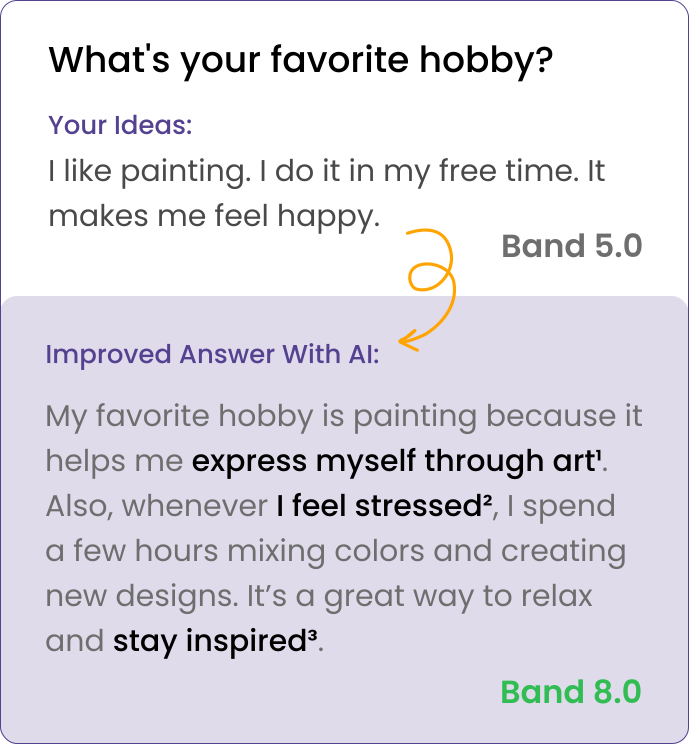
Practice IELTS Speaking answers in our free app
- Build personalized answers that match your target band.
- Turn short replies into fluent answers
- Let examiners fall in love with your answers!
Related Articles
Sample Answers
IELTS Speaking Part 1: Concentration Questions & Answers (Sep-Dec 2026)
Latest Sep-Dec 2026 IELTS Speaking Part 1 questions for Concentration. Read Band 9 sample answers, or use our AI app to turn your own ideas into perfect answers.
Sample Answers
IELTS Speaking Part 1: Jewelry Questions & Band 9 Answers (2026)
Latest Sep-Dec 2026 IELTS Speaking Part 1 questions for Jewelry. Read Band 9 sample answers or generate personal answers using our AI.
Sample Answers
IELTS Speaking Part 1: Colors Questions & Answers (Sep-Dec 2026)
Latest Sep-Dec 2026 IELTS Speaking Part 1 questions for Colors. Read Band 9 sample answers, or use our AI app to turn your own ideas into perfect answers.