IELTS Speaking Part 1: Transport Questions & Band 9 Answers (2026)
Use our AI tools to get personalized Band 9 answers and vocabulary lists to talk about public transport, driving, and travel.
Start Practicing →Transport is a very common topic. The examiner might ask how you get to work, if you like riding bikes, or what the traffic is like in your city. To score Band 9, avoid saying "The traffic is bad." Instead, use words like congestion, commute, reliable, or environmentally friendly to describe your experience.
How to Use These Sample Answers
Below are the latest 2026 questions for "Transport."
Important: These answers are for a person who lives in a big city. They take the bus or train to work, and they ride a bicycle for fun. But if you own a car and drive every day, or if you have an electric bike, these answers are probably not for you.
So, here is the plan:
Read these samples to understand the Band 9 structure.
Use the IELTS Speaking Lab App to get personalized answers. It gives you perfect vocabulary that fits your real life—whether you love driving fast cars or walking everywhere.
Part 1: Questions & Model Answers about Transport
1. How did you come here today? I came by metro. It is the most efficient way to get around the city during rush hour. If I had taken a taxi, I would have been stuck in gridlock for ages, but the subway is always on time.
2. What is your favorite mode of transport? I definitely prefer cycling. It gives me a sense of freedom and it is great for my health. I love being able to weave through traffic and bypass the long queues of cars. plus, it is completely eco-friendly.
3. Do you ever drive a car? No, I don't even have a driver's license. In a metropolis like this, owning a car is more of a burden than a benefit. You have to worry about maintenance, insurance, and the nightmare of finding a parking space.
4. Is the public transport system good in your city? It is decent, but it could be better. The network coverage is extensive, so you can get almost anywhere. However, the buses are often overcrowded and packed like sardines during peak times, which is quite uncomfortable.
5. Do you think traffic congestion is a big problem? Yes, absolutely. The infrastructure just cannot cope with the volume of vehicles. There are constant bottlenecks on the main highways, and the noise from the honking horns is deafening.
6. Do you prefer to travel by bus or train? I prefer the train. It offers a much smoother ride than the bus, which constantly stops and starts. Also, trains have dedicated lines, so they are not affected by road traffic, making them more reliable.
7. How long does your daily commute take? It takes about 45 minutes door-to-door. It’s not too bad. I usually use that time to listen to podcasts or catch up on emails for work, so it feels like productive time rather than wasted time.
8. Do you use ride-hailing apps (like Uber)? Only occasionally. I rely on technology like Uber when it is late at night or if I am in a rush. However, the fares can be quite exorbitant during busy periods due to surge pricing, so I try to avoid them.
9. Do you like traveling long distances? Yes, I love it. Traveling to new places is a great way to broaden your horizons. I usually prefer taking the high-speed rail for long trips because it is faster than driving and more comfortable than flying.
10. Is it safe to ride a bike in your city? It is getting better, but it is still risky. We have some designated cycle lanes, which helps separate us from the cars. However, as a vulnerable road user, you still need to be hyper-aware and always wear a helmet.
11. Do you prefer the window seat or the aisle seat? I always choose the window seat. I enjoy watching the scenery go by, especially if I am traveling through the countryside. It allows me to daydream and disconnect from the world for a while.
12. How do people in your country usually travel for holidays? Most people go by car or train. Domestic tourism is popular, so families often pack up their cars and take a road trip to the coast. It gives them the flexibility to stop whenever they want and take the scenic route.
13. Do you think cars are a status symbol? Yes, definitely. Many people buy expensive luxury cars just to show off their wealth, even if they don't enjoy driving. They view the vehicle as a reflection of their success rather than just a tool for mobility.
14. What do you do when you are stuck in traffic? Since I am usually on the bus, I just put on my noise-canceling headphones and listen to music. I try to remain zen about it. Getting angry or suffering from road rage won't make the traffic move any faster.
15. Is walking popular in your city? In the city center, yes. My hometown has become quite pedestrian-friendly recently. They have widened the sidewalks and created car-free zones, which makes strolling around much more pleasant.
16. Does the weather affect how you travel? Significantly. If the weather is sunny, I will always cycle. But if there is a downpour or strong winds, I will begrudgingly take the bus. Cycling in the rain is miserable and dangerous due to slippery roads.
17. Do you think transport will change in the future? I think we will see a shift towards autonomous vehicles (self-driving cars) and more sustainable options. I hope that public transit becomes fully electric to help reduce the city’s carbon footprint and improve air quality.
18. Have you ever missed a flight or train? Yes, once. I underestimated the traffic and arrived at the airport late. It was a stressful ordeal. Since then, I always leave with plenty of time to spare to account for any unforeseen delays.
19. Do you get travel sick? Fortunately, no. I have a strong stomach. I can read books or look at my phone on a moving bus without feeling nauseous. My sister, however, suffers terribly from motion sickness on winding roads.
20. What is the most expensive way to travel in your city? Definitely by taxi. The flag-fall rate (starting price) is high, and the meter ticks up quickly. Unless it is an emergency or I am carrying heavy luggage, I stick to budget-friendly options like the metro.
Key Vocabulary for IELTS Topic: Transport
Here is the complete glossary of every bolded word and phrase used in the answers above.
Autonomous vehicles: Cars that can drive themselves without a human driver.
Bottlenecks: A narrow section of road where traffic flow stops or slows down.
Broaden your horizons: To expand your range of interests, knowledge, and experiences.
Budget-friendly: Cheap; good for people who don't have much money.
Burden: A heavy load or responsibility (something difficult to deal with).
Carbon footprint: The amount of carbon dioxide released into the atmosphere as a result of the activities of a particular individual or community.
Car-free zones: Areas where cars are not allowed, only walkers.
Commute: The daily journey you make between your home and work.
Congestion: A situation where there is too much traffic and vehicles cannot move freely.
Daydream: To think about pleasant things while you are awake.
Dedicated lines: Tracks or lanes used only for one type of transport (e.g., trains/buses) so they don't get stuck in traffic.
Designated cycle lanes: Parts of the road painted and reserved specifically for bicycles.
Door-to-door: The total time from leaving your house to arriving at your destination.
Downpour: A heavy fall of rain.
Driver's license: An official document permitting a specific individual to operate one or more types of motorized vehicles.
Eco-friendly: Not harmful to the environment.
Efficient: Achieving maximum productivity with minimum wasted effort or expense.
Environmentally friendly: Good for the planet (same as eco-friendly).
Exorbitant: Unreasonably high (usually used for prices).
Fares: The money a passenger on public transportation has to pay.
Finding a parking space: The difficult act of looking for a place to leave your car.
Flag-fall rate: The fixed starting price of a taxi journey before you start moving.
Gridlock: A traffic jam so bad that no vehicles can move at all.
Helmet: A hard or padded protective hat.
High-speed rail: Passenger trains that travel significantly faster than traditional trains.
Honking: The sound of a car horn.
Infrastructure: The basic physical and organizational structures (e.g., roads, bridges) needed for the operation of a society.
Mobility: The ability to move or be moved driving freely and easily.
Motion sickness: Feeling sick because of the movement of a car, boat, or plane.
Nauseous: Feeling like you are going to vomit.
Network coverage: How much of the city is reached by the transport system.
On time: Punctual; not late.
Overcrowded: Containing too many people.
Packed like sardines: Idiom meaning extremely crowded with people pressed close together.
Pedestrian-friendly: Safe and pleasant for people walking.
Productive time: Time spent doing something useful.
Public transit: Buses, trains, subways, etc., that are available for the public to use.
Reflection of their success: Something that shows other people you have done well in life.
Reliable: Consistently good in quality or performance; able to be trusted.
Road rage: Sudden violent anger provoked in a motorist by the actions of another driver.
Road trip: A long journey made by car.
Rush hour: A time during each day when traffic is at its heaviest.
Scenery: The natural features of a landscape considered in terms of their appearance.
Scenic route: A road that is longer but goes through beautiful areas.
Slippery roads: Roads that are dangerous because they are wet or icy.
Smoother ride: A journey that is comfortable with no bumps or sudden stops.
Status symbol: A possession that is taken to indicate a person's wealth or high social status.
Strolling: Walking in a leisurely, relaxed way.
Surge pricing: When prices go up because demand is high (used by Uber).
Time to spare: Arriving earlier than necessary; having extra time.
Unforeseen delays: Problems that make you late which you did not expect.
Vulnerable road user: People on the road who are not in cars (cyclists, pedestrians) and can get hurt easily.
Weave through traffic: To move between cars quickly on a bike or motorcycle.
Zen: Relaxed and not worrying about things you cannot control.
Create Your Own Band 9 Answers
The answers above are perfect—if you use public transport and bikes. But what if you own a car? Or what if you have an electric bike?
Your answers need to be true so that you can easily recall them during a stressful exam.
IELTS Speaking Lab helps you turn your real ideas into Band 9 answers.
Select your topic - Transport.
Input your rough idea (e.g., "I love driving my Tesla because it's fast").
Get personalized Band 9 answers instantly, with the perfect vocabulary for your story.
Not happy with these answers?
Change the core idea, band level difficulty, length and get a full glossary in our free app!
Start Practicing →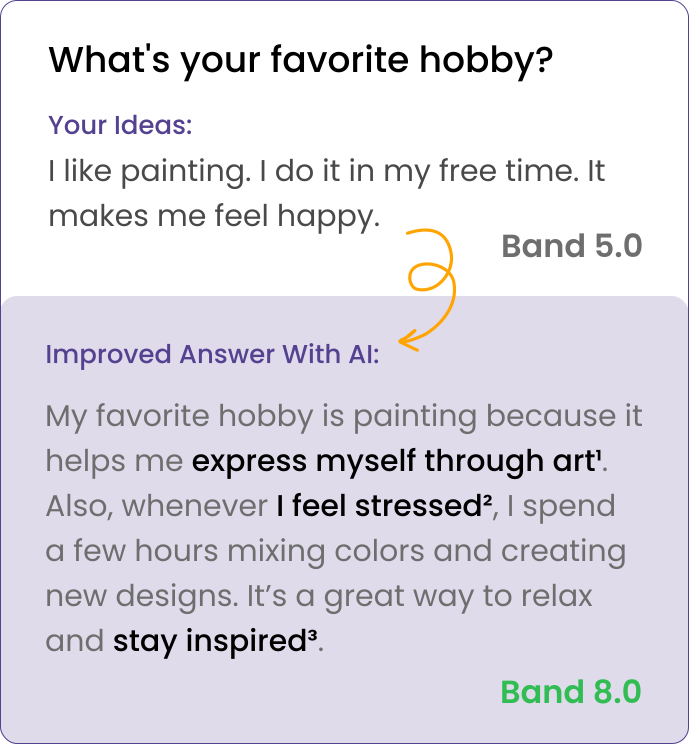
Practice IELTS Speaking answers in our free app
- Build personalized answers that match your target band.
- Turn short replies into fluent answers
- Let examiners fall in love with your answers!
Related Articles
Sample Answers
IELTS Speaking Part 1: Concentration Questions & Answers (Sep-Dec 2026)
Latest Sep-Dec 2026 IELTS Speaking Part 1 questions for Concentration. Read Band 9 sample answers, or use our AI app to turn your own ideas into perfect answers.
Sample Answers
IELTS Speaking Part 1: Jewelry Questions & Band 9 Answers (2026)
Latest Sep-Dec 2026 IELTS Speaking Part 1 questions for Jewelry. Read Band 9 sample answers or generate personal answers using our AI.
Sample Answers
IELTS Speaking Part 1: Colors Questions & Answers (Sep-Dec 2026)
Latest Sep-Dec 2026 IELTS Speaking Part 1 questions for Colors. Read Band 9 sample answers, or use our AI app to turn your own ideas into perfect answers.