IELTS Speaking Part 1: Movies Questions & Band 9 Answers (2026)
Use our AI tools to get personalized Band 9 answers and vocabulary lists to talk about films and cinema.
Start Practicing →Movies are a standard IELTS topic. The examiner might ask about your favorite genre, the last film you saw, or if you prefer streaming to the cinema. To score Band 9, avoid saying "It was funny." Instead, use words like hilarious, predictable, cinematography, or escapism to describe your experience.
How to Use These Sample Answers
Below are the latest 2026 questions for "Movies."
Important: These answers are for a person who loves watching thrillers on Netflix at home. But if you love going to the cinema every weekend, or if you watch romantic comedies or sitcoms on TV, these answers are probably not for you.
So, here is the plan:
Read these samples to understand the Band 9 structure.
Use the IELTS Speaking Lab App to get personalized answers. It gives you perfect vocabulary that fits your real life—whether you love Hollywood blockbusters or obscure documentaries.
Part 1: Questions & Model Answers about Movies
1. Do you like watching movies?
Yes, absolutely. For me, movies are the ultimate form of escapism. After a long, stressful week at work, I love to immerse myself in a different world for two hours. It helps me switch off completely.
2. How often do you watch movies?
I try to watch at least one or two movies every weekend. I subscribe to several streaming giants like Netflix and Prime, so I have a huge library of content at my fingertips. Occasionally, I will binge-watch a whole franchise in one day.
3. Do you prefer watching movies at home or in the cinema?
I definitely prefer watching at home. Cinemas have become exorbitantly expensive, and I find other people’s behavior—like talking or texting—very annoying. In my living room, I can pause the movie whenever I want. It is a much more relaxing experience.
4. What is your favorite genre of movie?
I am really into psychological thrillers. I love films that mess with your mind and have a huge plot twist at the end. I enjoy movies that require you to pay close attention to the dialogue and the subtle details.
5. Is there any genre you dislike?
I generally dislike romantic comedies (Rom-Coms). People say they are hilarious, but I find the storylines to be incredibly predictable and unrealistic. You always know exactly how the movie is going to end, which I find quite tedious.
6. Do you have a favorite movie star?
I don't really follow celebrity culture, but I admire actors who have great range. For example, I love actors who can play a villain in one movie and a hero in the next. I appreciate talent over looks.
7. What was the last movie you watched?
I watched a sci-fi movie last night. The cinematography was incredible—it was visually stunning. However, the plot was a bit thin and lacked emotional depth. It was a classic popcorn movie—fun but forgettable.
8. Do you like foreign films?
Yes, I actually prefer them to Hollywood movies. I think foreign cinema often takes more risks and tells more unique stories. I don't mind reading subtitles at all; in fact, I think watching foreign films is a great way to learn about other cultures and hometown traditions.
9. Do you cry during movies?
Sometimes, if the movie is a real tearjerker. If the acting is convincing and the music—the soundtrack—is sad, I can get quite emotional. I think it shows that the director has done a good job of making you suspend disbelief.
10. Do you prefer watching movies alone or with friends?
I prefer watching alone or with a partner. If I watch with a large group of friends, everyone talks and cracks jokes, which ruins the atmosphere. I take movies quite seriously, so I prefer total silence so I can focus.
11. Do you think movies are educational?
They can be. Historical dramas or documentaries are great for learning about the past. However, you have to be careful because Hollywood often changes the facts for dramatic effect. You shouldn't treat movies as history books.
12. Is the film industry big in your country?
Yes, we have a thriving film industry. While we don't have the huge budgets of American studios, our independent films are gaining international recognition. They are known for their gritty realism and strong character development.
13. Would you like to be in a movie?
No, I don't think so. I have terrible stage fright and I hate being the center of attention. I think the process of making a movie involves a lot of waiting around on set, which would be very monotonous for me.
14. Do you prefer movies or books?
That is a tough question. Generally, I think the book is always better than the movie because it allows you to get inside the characters' heads. Movies often have to cut out important scenes to fit the running time, which can leave the story feeling rushed.
15. How has technology changed the way we watch movies?
Technology has completely revolutionized it. With high-speed internet and 4K TVs, we can now have a cinematic experience in our living rooms. It has made movies more accessible, but it has also hurt the traditional box office numbers.
Key Vocabulary for IELTS Topic: Movies
Here is the complete glossary of every bolded word and phrase used in the answers above.
Atmosphere: The mood or feeling of a place or situation.
At my fingertips: Readily available; easy to reach or use.
Binge-watch: To watch many episodes or movies in a short period of time.
Box office: The place where cinema tickets are sold; used to describe how much money a movie makes.
Celebrity culture: The tendency of people to care too much about famous people's lives.
Center of attention: Being the person that everyone is looking at.
Character development: The way a character changes or grows throughout the story.
Cinematic experience: High-quality sound and visuals that feel like a movie theater.
Cinematography: The art of making motion pictures (lighting and camera work).
Dramatic effect: Something done just to make a scene more exciting, even if it isn't realistic.
Emotional depth: Having serious feelings and meaning; not superficial.
Escapism: An activity that helps you avoid or forget unpleasant or boring reality.
Exorbitantly expensive: Unreasonably high price; costing too much money.
Get inside the characters' heads: To understand what the characters are thinking and feeling.
Gritty realism: A style of film that shows real life, even the dirty or unpleasant parts.
Hilarious: Extremely funny.
Huge budgets: A very large amount of money available to spend on a film.
Immerse myself: To involve oneself deeply in a particular activity or interest.
Independent films (Indie): Movies made by smaller companies without big Hollywood budgets.
Mess with your mind: To confuse or psychologically challenge someone (often in a fun way in movies).
Monotonous: Dull, tedious, and repetitious; lacking in variety.
Plot: The main story of a film or book.
Plot twist: An unexpected development in a story that changes the ending.
Popcorn movie: A movie that is purely for entertainment (usually action/blockbuster) with no deep meaning.
Predictable: Easy to guess what will happen next (boring).
Psychological thrillers: A genre of movie that focuses on the unstable emotional states of characters.
Range: The ability of an actor to play many different types of roles well.
Relaxing experience: Something that calms you down.
Romantic comedies (Rom-Coms): Movies about love that are funny and lighthearted.
Running time: The length of the movie (e.g., 2 hours).
Soundtrack: The music recorded for a motion picture.
Special effects (CGI): Computer-Generated Imagery used to create visual scenes.
Stage fright: Nervousness before or during a performance in front of an audience.
Streaming giants: Big companies like Netflix, Disney+, or Amazon Prime.
Subtitles: Text at the bottom of the screen translating the dialogue.
Subtle details: Small facts or features that are not immediately obvious but important.
Suspend disbelief: To allow yourself to believe something impossible for the sake of enjoying a story.
Switch off: To stop thinking about work or problems; to relax completely.
Talent: Natural aptitude or skill.
Tearjerker: A movie or story that is very sad and makes you cry.
Tedious: Too long, slow, or dull; tiresome.
Total silence: Complete quietness.
Unique stories: Narratives that are different and original.
Villain: The "bad guy" or evil character in a story.
Visually stunning: Extremely beautiful to look at.
Create Your Own Band 9 Answers
The answers above are perfect—if you are a streaming enthusiast. But what if you are a cinema lover? Or what if you are a documentary filmmaker?
Your answers need to be true so that you can easily recall them during a stressful exam.
IELTS Speaking Lab helps you turn your real ideas into Band 9 answers.
Select your topic - Movies.
Input your rough idea (e.g., "I love going to the IMAX to see superhero movies").
Get personalized Band 9 answers instantly, with the perfect vocabulary for your story.
Not happy with these answers?
Change the core idea, band level difficulty, length and get a full glossary in our free app!
Start Practicing →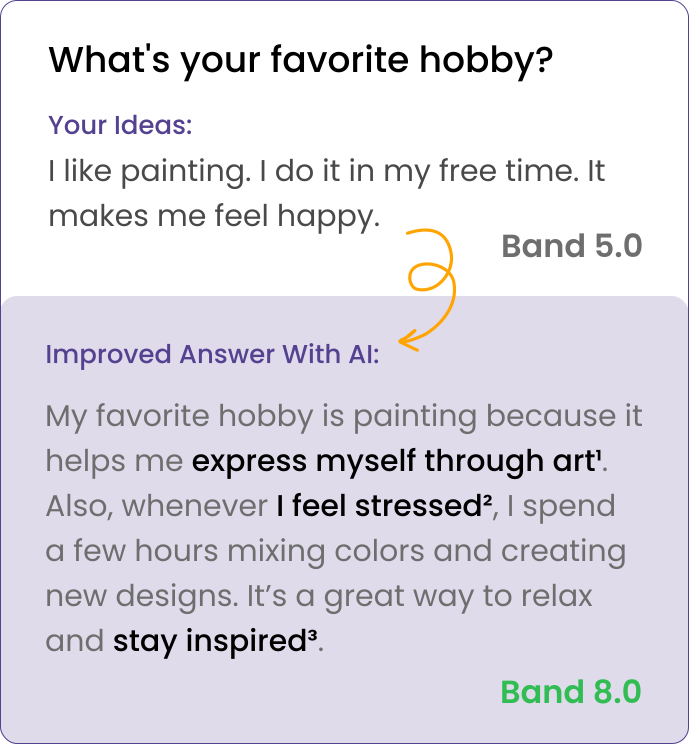
Practice IELTS Speaking answers in our free app
- Build personalized answers that match your target band.
- Turn short replies into fluent answers
- Let examiners fall in love with your answers!
Related Articles
Sample Answers
IELTS Speaking Part 1: Concentration Questions & Answers (Sep-Dec 2026)
Latest Sep-Dec 2026 IELTS Speaking Part 1 questions for Concentration. Read Band 9 sample answers, or use our AI app to turn your own ideas into perfect answers.
Sample Answers
IELTS Speaking Part 1: Jewelry Questions & Band 9 Answers (2026)
Latest Sep-Dec 2026 IELTS Speaking Part 1 questions for Jewelry. Read Band 9 sample answers or generate personal answers using our AI.
Sample Answers
IELTS Speaking Part 1: Colors Questions & Answers (Sep-Dec 2026)
Latest Sep-Dec 2026 IELTS Speaking Part 1 questions for Colors. Read Band 9 sample answers, or use our AI app to turn your own ideas into perfect answers.