Describe a Gift You Received: Part 2 Cue Card (2026)
Use our AI to get a personalized Band 9 answer and vocabulary for the IELTS Speaking Part 2 Cue Card "Describe a gift you received".
Start Practicing →The "Describe a gift you received that you liked" Cue Card is a classic IELTS topic. It tests your ability to describe physical objects (appearance, material) and express abstract feelings (gratitude, sentimentality). To achieve Band 7+, you should move beyond simple adjectives like "nice" or "expensive" and use descriptive phrases like sentimental value, token of appreciation, and stand the test of time.
How to Use This Sample Answer
Below is a sample answer for a student who received a Swiss watch from their father. If this matches your story, great. But what if you received a handmade scarf from your grandmother? Or a laptop for your birthday?
So here is the plan:
Read this sample answer to understand the structure of a Band 7+ answer.
Use the IELTS Speaking Lab App to instantly generate your own personal answer to this Cue Card with perfect vocabulary that describes your specific gift.
Part 2 Cue Card and Sample Answer
Describe a gift you received that you liked. You should say:
What the gift was
Who gave it to you
What it looks like
And explain why this gift is important to you.
Band 9 Sample Answer
(Introduce) I would like to talk about a gift that is incredibly special to me: a classic Swiss wristwatch. It was given to me by my father on the day I finally completed my university study. It wasn't just a birthday present; it was a token of appreciation for the years of hard work I had put into my degree.
(Describe) The watch itself is a masterpiece of craftsmanship. It is a Swiss-made model with a genuine brown leather strap and a steel case that features subtle gold accents. It manages to be both elegant and practical at the same time. It has a minimalist white dial with gold hands, which makes it very easy to read. It feels solid and durable on my wrist, not flimsy like some modern fashion watches.
(Explain) I was absolutely over the moon when I opened the box because I know my father had been saving up for months to buy it. He told me that a watch represents the value of time and the start of my professional life. I wear it almost every day now. It is versatile enough to wear during formal job interviews, but it also looks great when I’m just hanging out casually with my friends.
(Add impact) This gift is important to me not because of its price tag, but because of its sentimental value. Every time I check the time, I am reminded of my father’s generosity and support. It gives me a confidence boost. I hope to keep it for decades, as it is designed to stand the test of time, and perhaps one day I can pass it down as a family heirloom.
This answer uses the IDEA Strategy (Introduce, Describe, Explain, Add impact).
Part 3 Questions and Sample Answers
After you finish your Cue Card, the examiner will ask you deeper questions related to gifts and consumerism.
1. Do you think the price of a gift is important?
Not necessarily. While an expensive gift can show generosity, I believe the thought counts more than the price tag. A handwritten letter or a small, personalized item can often hold more sentimental value than a luxury product. For instance, if someone cooks my favorite food for me as a surprise, that means more to me than a generic store-bought item because it required time and effort.
2. How has the way we buy gifts changed in recent years?
The biggest change is the shift to online shopping. In the past, people had to physically visit shops, which limited their choices. Now, with a few clicks, you can order exotic items from halfway across the world. However, I think this has made gift-giving a bit more impersonal. Sometimes people just send digital gift cards instead of choosing something specific to the recipient's hobby or interests.
3. Do you think advertisements influence what children want as gifts? Absolutely. Children are very impressionable, and marketing companies know this. They use catchy music and bright colors in commercials to make toys look indispensable. This creates a "pester power" dynamic where kids pressure their parents to buy the latest trends, often leading to unnecessary consumption and waste.
4. Is it better to give money or a physical gift?
It depends on the situation. Money is certainly practical and gives the recipient the freedom to buy what they truly need, especially if they are saving for something big like travel. However, a physical gift feels more personal and thoughtful. Giving money can sometimes be interpreted as lazy or cold, whereas a carefully chosen object shows you truly know the person.
Key Vocabulary for IELTS Cue Card: A Gift
Here is the complete glossary of the vocabulary used in the answers above, plus extra high-level words relevant to this topic.
Automatic movement: (Noun) A watch that winds itself as you move your arm (mechanical, not battery-powered).
Craftsmanship: (Noun) The quality of design and work shown in something made by hand.
Dial: (Noun) The face of a watch or clock that shows the time.
Durable: (Adj) Able to withstand wear, pressure, or damage; hard-wearing.
Engraved: (Adj) To cut or carve a text or design on a hard surface (often done on the back of watches).
Generosity: (Noun) The quality of being kind and generous.
Heirloom: (Noun) A valuable object that has belonged to a family for several generations.
Impressionable: (Adj) Easily influenced because of a lack of critical ability (often used for children).
Leather strap: (Noun) A band made of animal skin used to hold a watch on the wrist.
Masterpiece: (Noun) A work of outstanding artistry, skill, or workmanship.
Minimalist: (Adj) Simple, with very few details or decorations.
Over the moon: (Idiom) Extremely happy and excited.
Priceless: (Adj) So precious that its value cannot be determined.
Sentimental value: (Noun) The value of an object derived from personal or emotional association rather than its material worth.
Stand the test of time: (Idiom) To last for a long time; to remain popular or durable over a long period.
Subtle: (Adj) So delicate or precise as to be difficult to analyze or describe; not loud or bright.
Swiss-made: (Adj) Made in Switzerland (synonymous with high quality for watches).
The thought counts: (Idiom) Used to say that the good intention behind a gift is more important than the gift itself.
Token of appreciation: (Phrase) A small gift given to express gratitude.
Versatile: (Adj) Able to adapt or be adapted to many different functions or activities.
Create Your Own Band 9 Answers
The answer above is perfect—if you received a watch. But what if you received a necklace? Or a rare book?
Your answers need to be true so that you can easily recall them during a stressful exam.
IELTS Speaking Lab helps you turn your real ideas into Band 9 answers.
Select your cue card - Describe a gift you received.
Input your rough idea (e.g., "My grandmother gave me a handmade sweater before she passed away").
Get personalized Band 9 answer instantly, with the perfect vocabulary for your story.
Not happy with these answers?
Change the core idea, band level difficulty, length and get a full glossary in our free app!
Start Practicing →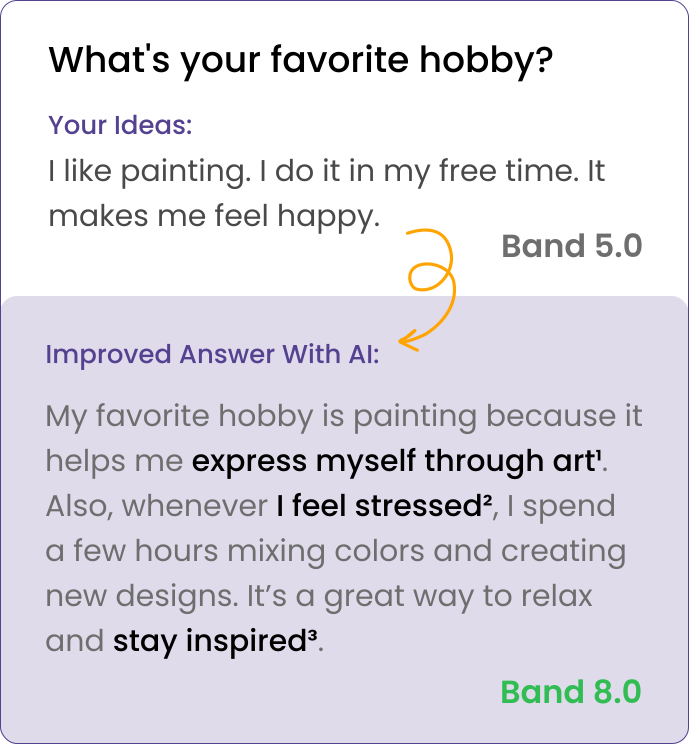
Practice IELTS Speaking answers in our free app
- Build personalized answers that match your target band.
- Turn short replies into fluent answers
- Let examiners fall in love with your answers!
Related Articles
Sample Answers
IELTS Speaking Part 1: Concentration Questions & Answers (Sep-Dec 2026)
Latest Sep-Dec 2026 IELTS Speaking Part 1 questions for Concentration. Read Band 9 sample answers, or use our AI app to turn your own ideas into perfect answers.
Sample Answers
IELTS Speaking Part 1: Jewelry Questions & Band 9 Answers (2026)
Latest Sep-Dec 2026 IELTS Speaking Part 1 questions for Jewelry. Read Band 9 sample answers or generate personal answers using our AI.
Sample Answers
IELTS Speaking Part 1: Colors Questions & Answers (Sep-Dec 2026)
Latest Sep-Dec 2026 IELTS Speaking Part 1 questions for Colors. Read Band 9 sample answers, or use our AI app to turn your own ideas into perfect answers.