Describe a Small Business You Want to Start: Part 2 Cue Card (2026)
Use our AI to get a personalized Band 9 answer and vocabulary for the IELTS Speaking Part 2 Cue Card "Describe a small business you want to start".
Start Practicing →The "Describe a small business you want to start" Cue Card is a highly popular topic in 2026 that tests your ability to talk about entrepreneurial aspirations in detail. To hit a Band 7+, you must avoid simply giving generic ideas or basic adjectives like "profitable." Examiners want you to create a vivid description of your business model and explain the specific reasons why it appeals to you, using advanced vocabulary such as niche market, bridge the gap, and lucrative venture.
How to Use This Sample Answer
Below is a sample answer for a tech enthusiast who wants to open an AI-powered photobooth. If this is your case, perfect. But what if you are a fitness junkie who wants to launch an online coaching platform? Or maybe you are a talented baker who dreams of opening a boutique cafe?
So here is the plan:
Read this sample answer to understand what a Band 7+ answer looks like.
Use the IELTS Speaking Lab App to instantly generate your own personal answer to this or other Cue Cards with perfect vocabulary that describes your real story and matches your target Band.
Part 2 Cue Card and Sample Answer
Describe a small business you want to start. You should say:
What business it would be
Where you would open it
What you would sell or do
And explain why you want to start this business.
Band 9 Sample Answer
Describe: I would absolutely love to launch a lucrative venture centered around an interactive, AI-powered photobooth. It wouldn't just be a boring camera in a box. Instead, it would use the latest technology to instantly turn regular pictures into really cool themed digital art before printing them out. The whole idea is to mix image-generation software with the nostalgic feel of a classic photo booth.
Add detail: I'd want to set these automated kiosks up in busy entertainment areas or shopping malls. People could step inside, take a quick snapshot, and then use a touchscreen to completely change their background or swap their outfits using AI. It perfectly manages to bridge the gap between modern editing and the fun of a physical printout.
Link to self: I've always been super into photography as a hobby, and I frequently tinker with different design apps in my free time. Turning this passion into an actual niche market just feels like a natural progression for me. Plus, I love the idea of giving people a physical memory they can actually stick on their fridge instead of just losing it in an endless camera roll.
Example: For instance, imagine a group of friends jumping in, tapping a filter that makes them look like astronauts, and walking away with a custom photo strip a minute later. It offers a totally unique, memorable experience that standard smartphone selfies just can't match, which is exactly why I think it would be a massive hit.
This answer uses the DALE Strategy (Describe, Add detail, Link to self, Example).
Part 3 Questions and Sample Answers
After you finish your Cue Card, the examiner will ask you deeper questions related to business and entrepreneurship.
1. What are the main challenges of starting a small business?
Getting enough money to survive the first year is definitely the hardest part. A lot of new owners completely underestimate the massive costs of advertising and rent, which usually leads to severe cash flow problems before they even get a chance to build a loyal customer base.
2. Why do some people prefer to work for a large company rather than start their own business?
It honestly comes down to safety and having a predictable schedule. Corporate jobs offer a steady paycheck and paid time off, whereas running your own startup means you have to hustle constantly and usually end up giving up your weekends just to keep things afloat.
3. How has the internet changed the way small businesses operate?
It has been an absolute game-changer, especially for reaching customers. Small shops can now run targeted social media campaigns to find their exact audience globally, which completely wipes out the need to spend a fortune on a physical storefront.
4. Do you think universities should teach more practical business skills?
Absolutely, because right now there is a massive disconnect. Students spend years studying complex theories, but they graduate without a clue on how to legally register a company, file their taxes, or successfully pitch an idea to a real investor.
5. What qualities make a successful entrepreneur?
You definitely need to be incredibly adaptable and have a thick skin to handle inevitable rejections. The market changes so fast, so you have to be ready to pivot your strategy on the fly and bounce back quickly when things don't go according to plan.
Key Vocabulary for IELTS Cue Card: Small Business You Want to Start
Angel investor: A wealthy individual who provides money for a business startup.
Break-even point: The moment when a business makes exactly as much money as it has spent.
Brick-and-mortar store: A traditional business that operates in a physical building.
Bridge the gap: To connect two unconnected things or reduce the difference between them.
Cash flow problems: Difficulties a company faces when it has more money going out than coming in.
Competitive advantage: A condition that puts a company in a favorable or superior business position.
Endless camera roll: A smartphone photo gallery that has too many pictures to look through.
Frequently tinker: To regularly experiment or play around with something to figure it out.
Game-changer: A new idea or event that significantly changes the way things are done.
Hustle constantly: To work extremely hard and continuously without taking breaks.
Image-generation software: Computer programs that use artificial intelligence to create pictures.
Inevitable rejections: Refusals or failures that are absolutely certain to happen.
Keep things afloat: To manage to survive financially and avoid going out of business.
Lucrative venture: A business project or activity that makes a lot of money.
Market research: The process of gathering information about what customers want and need.
Memorable experience: An event that is very special and easy to remember.
Niche market: A small, specialized segment of the population with specific needs or tastes.
Overhead costs: Ongoing business expenses like rent or electricity.
Pitch an idea: To present and explain a concept to someone, usually to get funding.
Pivot your strategy: To quickly change the direction or focus of a business plan.
Predictable schedule: A routine or timetable that is steady and easy to foresee.
Profit margin: The amount by which revenue from sales exceeds costs in a business.
Take a quick snapshot: To capture a fast, casual photograph.
Target audience: The specific group of people a product or service is aimed at.
Themed digital art: Computer-made pictures that follow a specific style or topic.
Venture capital: Money given by investors to startup firms with massive growth potential.
Word-of-mouth marketing: When customers tell their friends and family about a good business.
Create Your Own Band 9 Answers
The answer above is perfect—if you are a tech enthusiast who wants to open an AI-powered photobooth. But what if you are a fitness junkie who wants to launch an online coaching platform? Or what if you are a talented baker who dreams of opening a boutique cafe?
Your answers need to be true so that you can easily recall them during a stressful exam.
IELTS Speaking Lab helps you turn your real ideas into Band 9 answers.
Select your cue card - Describe a small business you want to start.
Input your rough idea (e.g., "I want to open a small coffee shop because I love baking and meeting new people.").
Get personalized Band 9 answer instantly, with the perfect vocabulary for your story.
Not happy with these answers?
Change the core idea, band level difficulty, length and get a full glossary in our free app!
Start Practicing →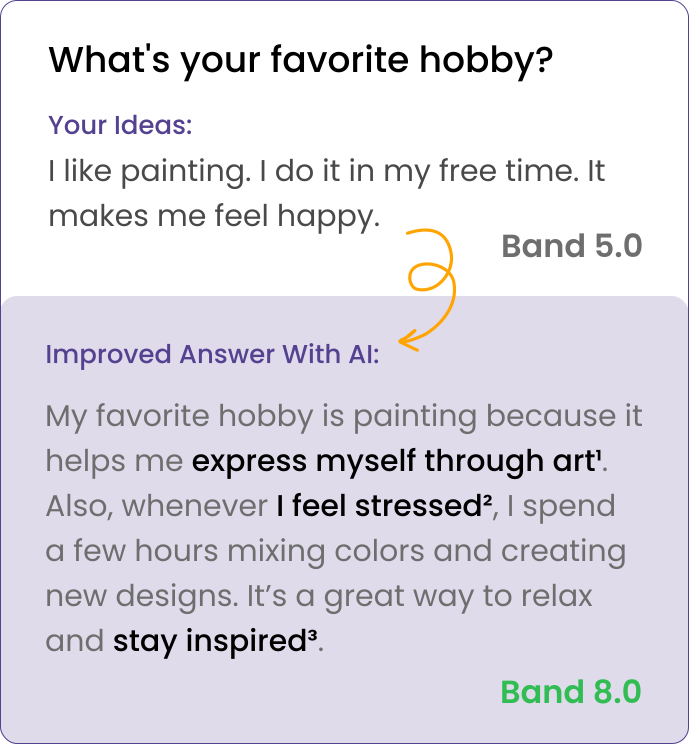
Practice IELTS Speaking answers in our free app
- Build personalized answers that match your target band.
- Turn short replies into fluent answers
- Let examiners fall in love with your answers!
Related Articles
Sample Answers
IELTS Speaking Part 1: Concentration Questions & Answers (Sep-Dec 2026)
Latest Sep-Dec 2026 IELTS Speaking Part 1 questions for Concentration. Read Band 9 sample answers, or use our AI app to turn your own ideas into perfect answers.
Sample Answers
IELTS Speaking Part 1: Jewelry Questions & Band 9 Answers (2026)
Latest Sep-Dec 2026 IELTS Speaking Part 1 questions for Jewelry. Read Band 9 sample answers or generate personal answers using our AI.
Sample Answers
IELTS Speaking Part 1: Colors Questions & Answers (Sep-Dec 2026)
Latest Sep-Dec 2026 IELTS Speaking Part 1 questions for Colors. Read Band 9 sample answers, or use our AI app to turn your own ideas into perfect answers.