IELTS Speaking Part 1: Animals Questions & Band 9 Answers (2026)
Latest Sep-Dec 2026 IELTS Speaking Part 1 questions for Animals. Read Band 9 sample answers or generate personal answers using our AI.
Start Practicing →If you are taking the test between September and December 2026, get ready for Animals. The examiner might ask about your pets, your favorite wild animal, or your opinion on zoos. To score Band 9, avoid saying "I like cats." Instead, use words like feline, companionship, animal welfare, or natural habitat to describe your views.
Latest Sep-Dec 2026: Animals Questions & Sample Answers
1. Do you like animals?
Yes, absolutely. I have a deep respect for all living creatures. I believe that animals are sentient beings capable of feeling pain and joy, which is why I try to coexist with them peacefully. The biodiversity of the animal kingdom fascinates me.
2. Do you have a pet?
Yes, I have a rescue cat named Luna. She is my cherished pet. She is very independent but also affectionate on her own terms. Having her purring beside me is the best way to relax; she offers a silent companionship that is often better than being with human friends.
3. Do you prefer cats or dogs?
I am definitely a "cat person." I find cats to be elegant, quiet, and low-maintenance. Dogs, on the other hand, are a bit too boisterous for me. I prefer the subtle, calming presence of a feline over the chaotic energy of a dog.
4. Why don't you like dogs?
It’s not that I hate them, but I find them overwhelming. They tend to be needy, requiring constant attention and walks. Also, the loud barking and the slobber are things I find quite off-putting. I value a tranquil environment, which dogs often disrupt.
5. What is the most popular pet in your country?
I think dogs are the most common status symbol. People value their unwavering loyalty and ability to function as a guard dog. However, in my hometown, cats are becoming increasingly popular because they are better suited for apartment living.
6. Have you ever visited a zoo?
I used to go as a child, but I boycott them now. I find zoos depressing. Seeing majestic animals locked in captivity for human entertainment is heartbreaking. They often look bored and exist in cramped enclosures rather than roaming free.
7. Do you think zoos are useful?
Only if they focus on conservation and breeding endangered species to release them back into the wild. But most zoos are just commercial businesses exploiting animals. I believe animals belong in their natural habitat, not behind bars.
8. What wild animal would you like to see?
I would love to see a snow leopard in the wild. They are elusive and solitary creatures. Seeing such an apex predator in its natural ecosystem would be a breathtaking experience, far superior to seeing one in a cage.
9. Are you a vegetarian?
Yes, I am. I stopped eating meat five years ago for ethical reasons. I don't believe in the slaughter of animals for food when there are plenty of plant-based alternatives available. It is my way of taking a stand against factory farming.
10. Is it popular to keep exotic pets in your country?
Unfortunately, yes. Some people keep snakes or spiders as a vanity project. I completely disagree with this. Exotic animals have complex needs that cannot be met in a domestic setting. Trying to domesticate wild creatures is essentially animal cruelty.
11. Do you watch TV programs about animals?
Yes, frequently. Watching nature documentaries is a great way to study animal behavior. I love programs that give us an insight into the survival of the fittest. It highlights how fragile our ecosystem really is.
12. Do you think animals have feelings?
Undoubtedly. Scientific studies have proven that many species display empathy, grief, and joy. Anyone who has observed an animal closely can see their emotional intelligence. They are not just biological machines; they have personalities.
13. How should we treat animals?
We should treat them with dignity and compassion. As the dominant species, humans should act as guardians of the natural world, rather than exploiters. We have a moral duty to prevent suffering.
14. Are there laws to protect animals in your country?
Yes, there is legislation against abuse, but I think the penalties are too lenient. People who are guilty of negligence or cruelty often get away with a small fine. We need stricter laws to act as a deterrent.
15. Do you like seeing animals in the circus?
No, I detest it. Forcing animals to perform unnatural tricks through fear and intimidation is barbaric. I am glad that many countries are now banning the use of wild animals in circuses to protect animal rights.
16. Would you like to work with animals?
I would love to volunteer at a sanctuary. It would be incredibly rewarding to help rehabilitate animals that have been abandoned or abused. Giving a neglected animal a second chance at life would be amazing.
17. Did you have a pet as a child?
Yes, I grew up with cats. It taught me valuable lessons about responsibility and nurturing. Caring for a living creature is a vital part of childhood development as it fosters empathy.
18. What do you feed your pet?
My cat is a carnivore, so she needs a meat-based diet for her health. I buy her premium, grain-free food to ensure she gets the right nutrition. While I am vegetarian, I cannot force my diet on an obligate carnivore.
19. Do you let your pet sleep in your bed?
Yes, it is part of our daily routines. She sleeps at the foot of my bed every night. Some people think it is unhygienic, but I find her purring very soothing. It reinforces the bond between us.
20. Do you think city life is suitable for animals?
For cats, yes, because they are happy indoors. But for large dogs, the concrete jungle is too restrictive. They need green spaces to run. Keeping a high-energy animal in a small city apartment can lead to behavioral issues.
Key Vocabulary for IELTS Topic: Animals
Here is the complete glossary of every bolded word and phrase used in the answers above.
Affectionate: Showing that you love or like someone (or an animal).
Animal kingdom: The group of all living creatures that are animals.
Animal rights: The idea that animals should be treated fairly and not used for human benefit.
Apex predator: An animal at the top of the food chain with no natural predators.
Barking: The loud explosive sound a dog makes.
Behind bars: Locked up; in a cage or prison.
Behavioral issues: Problems with how an animal acts (often caused by stress).
Biodiversity: The variety of life in the world or in a particular habitat.
Boisterous: Noisy, energetic, and cheerful; rowdy.
Bond: A strong connection or relationship.
Boycott: To refuse to buy or use something as a form of protest.
Captivity: The condition of being imprisoned or confined (e.g., in a zoo).
Carnivore: An animal that feeds on flesh (meat).
Cat person: Someone who likes cats more than dogs.
Cherished pet: A pet that is loved and protected very much.
Coexist: To live together in the same place at the same time peacefully.
Companionship: The feeling of friendship or fellowship.
Concrete jungle: A modern city area with many buildings and few plants.
Conservation: Protecting Earth's natural resources and living things.
Cramped enclosures: Small spaces where animals are kept that are too tight.
Deep respect: A strong feeling of admiration or deference.
Detest: To dislike someone or something very much.
Deterrent: Something that discourages someone from doing something.
Dignity: The state or quality of being worthy of honor or respect.
Domesticate: To tame an animal and keep it as a pet.
Ecological footprint: The impact of a person or community on the environment.
Ecosystem: A biological community of interacting organisms and their physical environment.
Elusive: Difficult to find, catch, or achieve.
Emotional intelligence: The capacity to be aware of, control, and express one's emotions.
Empathy: The ability to understand and share the feelings of another.
Endangered species: Species that are at risk of extinction.
Ethical reasons: Decisions made based on morals (right vs. wrong).
Exotic animals: Rare or unusual animals not native to the country.
Exploiters: People who use others (or animals) unfairly for their own advantage.
Factory farming: Intensive agriculture aimed at maximizing production (often cruel).
Feline: Relating to cats; a cat.
Green spaces: Areas of grass, trees, or other vegetation set apart for recreational use.
Guard dog: A dog kept to watch over and protect property.
Guardians: People who protect or look after something.
Health: The state of being free from illness or injury.
Intimidation: Frightening someone to make them do what you want.
Legislation: Laws, considered collectively.
Lenient: Not strict; merciful.
Low-maintenance: Easy to care for; doesn't need much work.
Majestic: Having or showing impressive beauty or dignity.
Natural habitat: The natural home or environment of an animal.
Nature documentaries: TV shows about wildlife and the environment.
Needy: Demanding a lot of attention or affection.
Negligence: Failure to take proper care in doing something.
Nurturing: Caring for and encouraging the growth or development of someone/something.
Nutrition: The process of providing the food necessary for health and growth.
Obligate carnivore: An animal that must eat meat to survive.
Overwhelming: Very intense; too much to handle.
Personalities: The combination of characteristics or qualities that form an individual's distinctive character.
Rehabilitate: To help an animal return to a normal, healthy life.
Rescue cat: A cat adopted from a shelter, often having had a bad past.
Responsibility: The state or fact of having a duty to deal with something.
Sanctuary: A safe place where injured or unwanted animals are cared for.
Second chance: An opportunity to try something again or start over.
Sentient beings: Creatures that can feel and perceive things.
Slaughter: The killing of animals for food.
Slobber: Saliva dripping from the mouth.
Solitary creatures: Animals that prefer to live alone.
Soothing: Having a gently calming effect.
Status symbol: A possession that indicates a person's wealth or high social status.
Suffering: The state of undergoing pain, distress, or hardship.
Survival of the fittest: The continued existence of organisms that are best adapted to their environment.
Tranquil environment: A calm, peaceful, and quiet place.
Unnatural tricks: Actions animals are forced to do that they wouldn't do in the wild.
Unwavering loyalty: Faithfulness that does not change or falter.
Vanity project: Something done to show off rather than for a good reason.
Create Your Own Band 9 Answers
IELTS Speaking Lab helps you turn your real ideas into Band 9 answers.
Select your topic/question - Animals/ Do you have a pet?
Input your rough idea - "No, but I've always wanted to have a dog."
Get a personalized Band 9 answer instantly, with the perfect vocabulary for your story.
Not happy with these answers?
Change the core idea, band level difficulty, length and get a full glossary in our free app!
Start Practicing →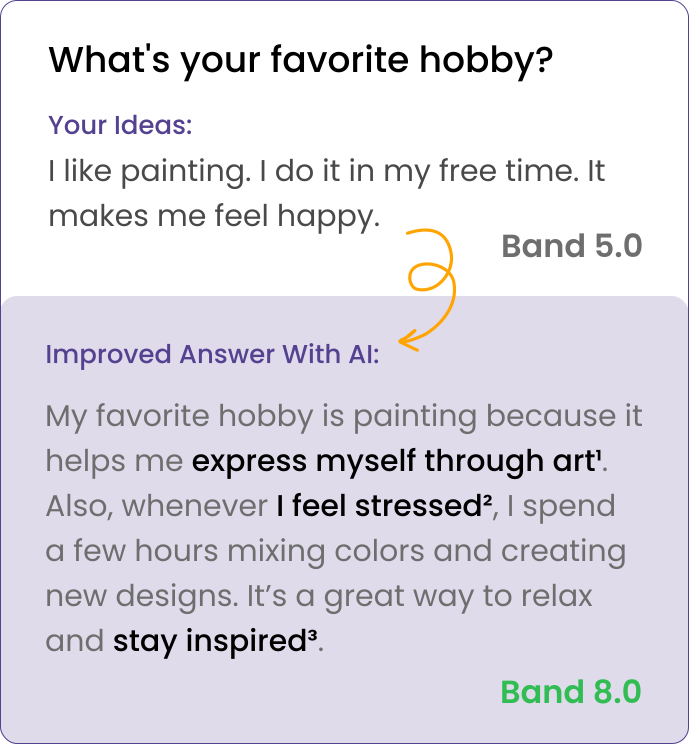
Practice IELTS Speaking answers in our free app
- Build personalized answers that match your target band.
- Turn short replies into fluent answers
- Let examiners fall in love with your answers!
Related Articles
Sample Answers
IELTS Speaking Part 1: Concentration Questions & Answers (Sep-Dec 2026)
Latest Sep-Dec 2026 IELTS Speaking Part 1 questions for Concentration. Read Band 9 sample answers, or use our AI app to turn your own ideas into perfect answers.
Sample Answers
IELTS Speaking Part 1: Jewelry Questions & Band 9 Answers (2026)
Latest Sep-Dec 2026 IELTS Speaking Part 1 questions for Jewelry. Read Band 9 sample answers or generate personal answers using our AI.
Sample Answers
IELTS Speaking Part 1: Colors Questions & Answers (Sep-Dec 2026)
Latest Sep-Dec 2026 IELTS Speaking Part 1 questions for Colors. Read Band 9 sample answers, or use our AI app to turn your own ideas into perfect answers.