IELTS Speaking Part 1: Borrowing & Lending Questions & Band 9 Answers (2026)
Stop memorizing generic answers. Use our AI tools to get personalized Band 9 answers and vocabulary to talk about borrowing money, lending items, and trust.
Start Practicing →Borrowing and Lending is a slightly tricky but very common IELTS topic. The examiner might ask if you borrow money from friends, or how you feel when someone breaks an item they borrowed from you. To score Band 9, avoid saying "I don't like giving my things." Instead, use words like meticulous, indebted, risk-averse, or fiscal responsibility to explain your opinions clearly.
How to Use These Sample Answers
Below are the latest 2026 questions for "Borrowing & Lending."
Important: These answers are for a person who is very careful with their belongings. They do not like lending items because they worry people will break them. They also hate borrowing money because it causes them stress and anxiety.
But if you share everything you own with everyone, or if you constantly borrow money from your friends without worrying, these answers are probably not for you.
So, here is the plan:
Read these samples to understand the Band 9 structure.
Use the IELTS Speaking Lab App to get personalized answers. It gives you perfect vocabulary that fits your real life.
Part 1: Questions & Model Answers about Borrowing & Lending
1. Have you ever borrowed books from others?
Yes, but only occasionally. I am incredibly meticulous with books, so I prefer to buy my own copies. I hate the anxiety of accidentally tearing a page or damaging someone else's property.
2. Do you like lending things to others?
Honestly, no. I am quite protective of my belongings. People are often careless, and I find it highly aggravating when items are returned in poor condition or not returned at all.
3. How do you feel when people don't return things they borrowed?
I feel deeply resentful. It shows a blatant lack of respect for the lender. If it happens, I usually consider the item a loss and permanently sever that line of trust with the person.
4. Have you ever borrowed money from a friend?
I try to avoid it at all costs. Mixing finances with friends is a recipe for disaster. It creates an awkward power dynamic and can easily ruin a perfectly good relationship over a trivial monetary dispute.
5. Do you often borrow things from your family?
Only in absolute emergencies. Even with my own family, I strive for complete financial independence and self-reliance. I don't want to be a burden or feel indebted to my relatives.
6. What do people usually borrow from each other?
Mostly everyday items. Neighbors might borrow a cup of sugar or gardening tools. In an office setting, people constantly ask to use chargers or stationery, which are notoriously prone to disappearing.
7. Would you ever lend a large amount of money to someone?
Absolutely not. I am extremely risk-averse when it comes to personal wealth. If someone needs a substantial loan, they should approach a bank, not ask individuals to act as their personal guarantor.
8. Is it easy to borrow money from banks in your country?
It depends on your credit score. If you have a solid income from your work and a clean financial history, the process is quite streamlined. However, for freelancers or younger people, the bureaucratic hurdles can be immense.
9. Do you think borrowing money is a bad habit?
Generally, yes. While taking out a mortgage for a house is a necessary investment, constantly relying on loans for consumer goods indicates a severe lack of fiscal responsibility and can lead to a dangerous spiral of debt.
10. Have you ever lent equipment for your hobbies?
I refuse to do that. My hobbies require highly specialized, expensive gear. I once lent a professional camera lens to an acquaintance, and it came back scratched. Since then, I have maintained a strict no-lending policy.
11. How should someone ask to borrow something?
They should be extremely polite and specify exactly when they will return it. Setting a clear timeline shows respect. Moreover, they should accept a refusal gracefully without trying to guilt-trip the owner.
12. Why do some people borrow things instead of buying them?
It is mostly due to economic constraints or simple convenience. For items that are only needed once or twice, like a specialized power tool, it is much more pragmatic and environmentally friendly to borrow it rather than making a superfluous purchase.
Key Vocabulary for IELTS Topic: Borrowing & Lending
Here is the complete glossary of every bolded word and phrase used in the answers above.
Aggravating: Making a problem or offense worse or more serious; highly irritating.
Bureaucratic hurdles: Complex, time-consuming administrative procedures or obstacles, usually involving official paperwork.
Financial independence: The status of having enough income or wealth to pay one's living expenses without depending on others.
Fiscal responsibility: The act of managing money in a careful, wise, and sustainable way.
Guarantor: A person or organization that promises to pay a debt if the person who borrowed the money fails to do so.
Guilt-trip: To make someone feel bad about something they have or haven't done in order to manipulate them into doing what you want.
Indebted: Owing money or gratitude to someone.
Meticulous: Showing great attention to detail; very careful and precise.
Monetary dispute: A disagreement or argument concerning money.
No-lending policy: A strict personal rule against allowing others to borrow one's belongings.
Pragmatic: Dealing with things sensibly and realistically in a way that is based on practical rather than theoretical considerations.
Prone to disappearing: Having a tendency to go missing easily or frequently.
Protective: Having or showing a strong wish to keep someone or something safe from harm or damage.
Resentful: Feeling or expressing bitterness or indignation at having been treated unfairly.
Risk-averse: Disinclined or reluctant to take risks, especially financial ones.
Sever: To put an end to (a connection or relationship), suddenly and completely.
Spiral of debt: A situation where a person borrows more and more money to pay off previous debts, making their financial situation increasingly worse.
Streamlined: Designed or organized to be as efficient and simple as possible.
Superfluous: Unnecessary, especially through being more than enough.
Timeline: A schedule or deadline for when something will happen or be completed.
Create Your Own Band 9 Answers
The answers above are perfect—if you are a person who hates lending items and avoids borrowing money. But what if you happily share all your belongings with your neighbors? Or what if you frequently borrow money from your parents to buy clothes?
Your answers need to be true so that you can easily recall them during a stressful exam.
IELTS Speaking Lab helps you turn your real ideas into Band 9 answers.
Select your topic - Borrowing & Lending.
Input your rough idea (e.g., "I always lend my car to my friends because I want to help them").
Get personalized Band 9 answers instantly, with the perfect vocabulary for your story.
Not happy with these answers?
Change the core idea, band level difficulty, length and get a full glossary in our free app!
Start Practicing →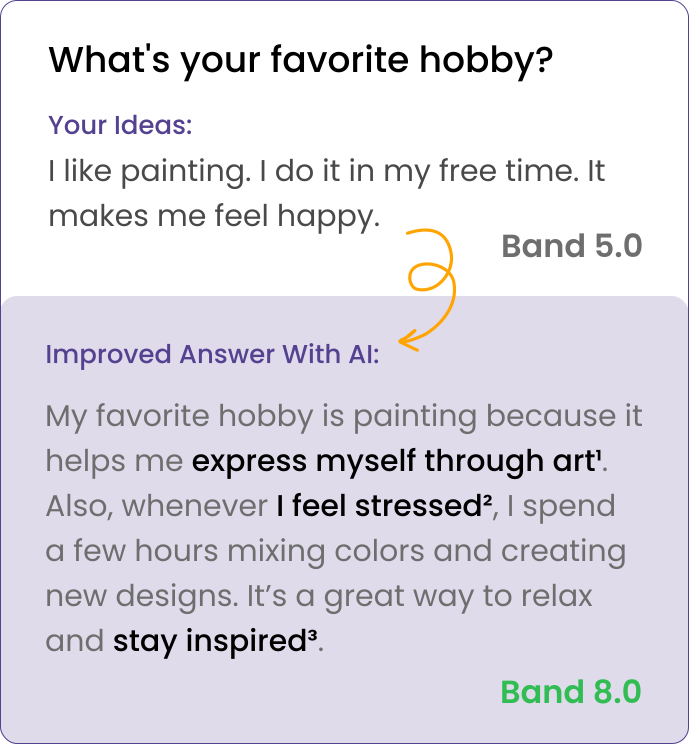
Practice IELTS Speaking answers in our free app
- Build personalized answers that match your target band.
- Turn short replies into fluent answers
- Let examiners fall in love with your answers!
Related Articles
Sample Answers
IELTS Speaking Part 1: Concentration Questions & Answers (Sep-Dec 2026)
Latest Sep-Dec 2026 IELTS Speaking Part 1 questions for Concentration. Read Band 9 sample answers, or use our AI app to turn your own ideas into perfect answers.
Sample Answers
IELTS Speaking Part 1: Jewelry Questions & Band 9 Answers (2026)
Latest Sep-Dec 2026 IELTS Speaking Part 1 questions for Jewelry. Read Band 9 sample answers or generate personal answers using our AI.
Sample Answers
IELTS Speaking Part 1: Colors Questions & Answers (Sep-Dec 2026)
Latest Sep-Dec 2026 IELTS Speaking Part 1 questions for Colors. Read Band 9 sample answers, or use our AI app to turn your own ideas into perfect answers.