IELTS Speaking Part 1: Chatting Questions & Band 9 Answers (2026)
Stop memorizing generic answers. Use our AI tools to get personalized Band 9 answers and vocabulary to talk about messaging, deep conversations, and small talk.
Start Practicing →Chatting is a very common topic. The examiner might ask if you prefer texting or talking face-to-face, how often you chat with friends, or if you like talking to strangers. To score Band 9, avoid saying "I like talking to my friends." Instead, use words like small talk, body language, asynchronous, or vocal inflection to describe your communication style.
How to Use These Sample Answers
Below are the latest 2026 questions for "Chatting."
Important: These answers are for a person who prefers deep conversations with a few close friends. They do not like small talk, and they mostly use text messages because they are very busy.
But if you love talking to strangers on the bus, or if you spend hours gossiping on the phone every day, these answers are probably not for you.
So, here is the plan:
Read these samples to understand the Band 9 structure.
Use the IELTS Speaking Lab App to get personalized answers. It gives you perfect vocabulary that fits your real life.
Part 1: Chatting Questions & Model Answers
1. Do you like chatting with friends?
Yes, I do, but I prefer meaningful discussions over trivial small talk. I usually catch up with my friends on the weekends to discuss our lives, goals, and challenges in depth rather than just exchanging superficial pleasantries.
2. What do you usually chat about?
It really varies. We often discuss current events, our career aspirations, or even just exchange humorous anecdotes about our daily lives. Sometimes, we debate interesting concepts we came across while reading books or articles online.
3. Do you prefer to chat online or face-to-face?
Face-to-face is definitely better for reading body language and showing genuine empathy. However, due to my hectic schedule, I rely heavily on technology to stay in touch through instant messaging apps. It is simply more convenient.
4. Do you often chat with strangers?
Not really. I am quite reserved, so striking up a conversation with someone I don't know feels a bit daunting. I prefer to stick to my established social circle unless I am at a professional networking event.
5. Do you like group chats?
I have mixed feelings about them. They are great for organizing events, but the constant notifications can be incredibly distracting. I often mute them so I can focus on my work without constant interruptions.
6. Have your chatting habits changed since you were a child?
Drastically. When I was younger, I used to spend hours on the landline phone. Now, almost all my communication is asynchronous. I send text messages or voice notes, which allows me to reply at my own convenience rather than engaging in real-time conversations.
7. Do you ever chat with older people?
Yes, especially with my grandparents and other members of my family. I find it fascinating to listen to their life experiences. They offer a completely different perspective and often give very wise advice that you cannot find on the internet.
8. Is it polite to chat on a mobile phone in public?
I think it is highly inappropriate if it disturbs others. Having a loud, private conversation on a train or in a quiet cafe shows a complete lack of consideration. People should keep their voices down or wait until they are in a private space.
9. Do you use video chat often?
Occasionally, mostly for professional meetings or catching up with relatives who live abroad. It is a great way to bridge the distance, but I find prolonged video calls quite exhausting. There is definitely a phenomenon called screen fatigue.
10. What is the difference between chatting and discussing?
Chatting is generally lighthearted, casual, and unstructured. Discussing, on the other hand, implies a more serious, focused exchange of ideas where people are trying to reach a conclusion or analyze a specific topic in detail.
11. Do you think people communicate less these days?
I don't think we communicate less; we just communicate differently. We are constantly exchanging text messages, but we might be losing the art of deep, uninterrupted conversation. As a result, the quality of our interactions has become somewhat superficial.
12. How do you start a conversation with someone new?
I usually start by asking open-ended questions about their interests or their profession. Finding common ground is the easiest way to break the ice and ensure the conversation flows naturally without awkward silences.
13. Do you ever misunderstand people when chatting online?
Yes, quite frequently. Text messages lack vocal inflection and facial expressions, so it is very easy to misinterpret someone's tone. A sarcastic joke can easily be mistaken for a genuine insult, which can lead to unnecessary conflict.
14. Are you a talkative person?
Not at all. I am definitely more of an active listener. I prefer to absorb information and only speak when I have something meaningful to contribute. I find excessive talking to be quite draining.
15. Do you prefer sending text messages or voice messages?
I prefer text messages because they are quick and discreet. Voice notes can be inconvenient because you have to stop what you are doing, find a quiet place, and actively listen to the audio. Texting is much more efficient for my lifestyle.
Key Vocabulary for IELTS Topic: Chatting
Here is the complete glossary of every bolded word and phrase used in the answers above.
Active listener: A person who fully concentrates, understands, responds, and remembers what is being said.
Anecdotes: Short, amusing, or interesting stories about real incidents or people.
Asynchronous: Communication that does not happen at the same time (e.g., sending an email or text message to be read later).
Body language: Non-verbal communication through conscious or unconscious gestures and movements.
Break the ice: To do or say something to relieve tension or get conversation going in a new situation.
Common ground: Opinions or interests shared by two or more people.
Consideration: Thoughtfulness and sensitivity toward others.
Daunting: Seeming difficult to deal with in anticipation; intimidating.
Discreet: Careful and circumspect in one's speech or actions, especially to avoid causing offense or drawing attention.
Distracting: Preventing someone from giving full attention to something.
Draining: Causing someone to lose their energy; exhausting.
Hectic schedule: A very busy and tightly packed daily routine.
Inconvenient: Causing trouble, difficulties, or discomfort.
Instant messaging: The exchange of text messages through a software application in real-time.
Lighthearted: Amusing and entertaining; not serious.
Misinterpret: To understand something wrongly.
Perspective: A particular attitude toward or way of regarding something; a point of view.
Real-time: The actual time during which a process or event occurs.
Reserved: Slow to reveal emotion or opinions; private.
Screen fatigue: Physical and mental exhaustion caused by looking at screens for too long.
Small talk: Polite conversation about unimportant or uncontroversial matters.
Social circle: A group of people who are socially connected.
Superficial: Existing or occurring at or on the surface; lacking depth of character or understanding.
Vocal inflection: The modulation of intonation or pitch in the voice.
Create Your Own Band 9 Answers
The answers above are perfect—if you are a person who prefers deep conversations and hates small talk. But what if you love making new friends wherever you go? Or what if you spend hours on video calls every night?
Your answers need to be true so that you can easily recall them during a stressful exam.
IELTS Speaking Lab helps you turn your real ideas into Band 9 answers.
Select your topic - Chatting.
Input your rough idea (e.g., "I love sending voice notes to my friends because it is faster than typing").
Get personalized Band 9 answers instantly, with the perfect vocabulary for your story.
Not happy with these answers?
Change the core idea, band level difficulty, length and get a full glossary in our free app!
Start Practicing →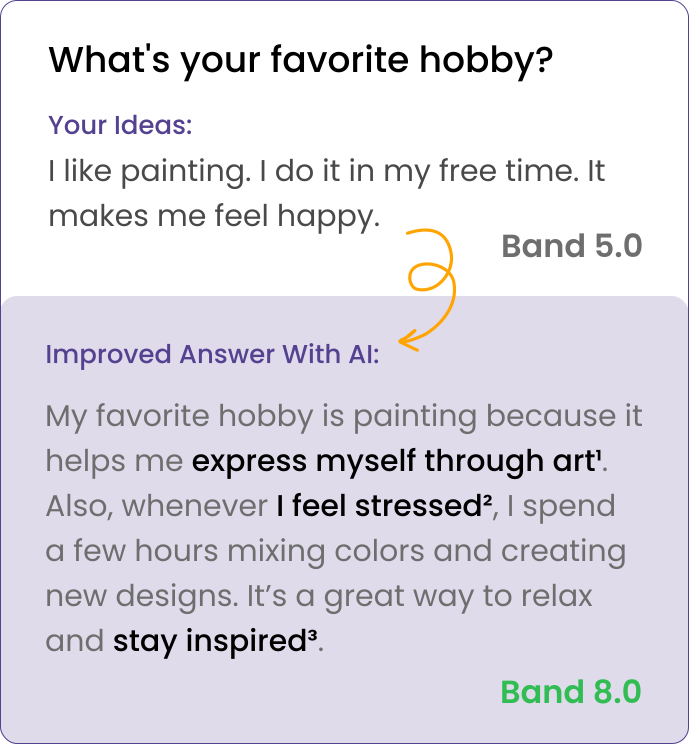
Practice IELTS Speaking answers in our free app
- Build personalized answers that match your target band.
- Turn short replies into fluent answers
- Let examiners fall in love with your answers!
Related Articles
Sample Answers
IELTS Speaking Part 1: Concentration Questions & Answers (Sep-Dec 2026)
Latest Sep-Dec 2026 IELTS Speaking Part 1 questions for Concentration. Read Band 9 sample answers, or use our AI app to turn your own ideas into perfect answers.
Sample Answers
IELTS Speaking Part 1: Jewelry Questions & Band 9 Answers (2026)
Latest Sep-Dec 2026 IELTS Speaking Part 1 questions for Jewelry. Read Band 9 sample answers or generate personal answers using our AI.
Sample Answers
IELTS Speaking Part 1: Colors Questions & Answers (Sep-Dec 2026)
Latest Sep-Dec 2026 IELTS Speaking Part 1 questions for Colors. Read Band 9 sample answers, or use our AI app to turn your own ideas into perfect answers.