IELTS Speaking Part 1: Childhood Activities Questions & Band 9 Answers (2026)
Stop memorizing generic answers. Use our AI tools to get personalized Band 9 answers and vocabulary to talk about childhood pastimes.
Start Practicing →Childhood Activities is a brand-new and highly frequent topic in the 2026 IELTS exam. The examiner might ask what you played when you were little, if you liked playing alone, or what your favorite games were. To score Band 7.5 - 9.0, avoid saying "I played a lot." Instead, use words and phrases like nostalgia, explore my own creativity, unstructured play, or retreat to my bedroom to describe your experience naturally.
How to Use These Sample Answers
Below are the latest 2026 questions for "Childhood Activities."
Important: These answers are for someone who loved quiet, indoor games like drawing or building things, and liked playing alone or with family.
But if you spent all your time playing loud sports outside, or if you were the boss of a big group of neighborhood kids, these answers are probably not for you.
So, here is the plan:
Read these sample answers to understand the Band 9 structure.
Use the IELTS Speaking Lab App to get personalized answers. It gives you perfect vocabulary that fits your real life.
Part 1: Questions & Sample Answers about Childhood Activities
1. What were your favorite activities when you were a child?
I was a pretty quiet kid, so I mostly enjoyed solitary things. I would spend hours building little houses out of Lego or just drawing. It was a great way to explore my own creativity without any pressure from anyone else.
2. Did you prefer to do activities alone or with a group of people when you were a child?
Honestly, I almost always preferred my own company. Being around big, noisy groups of kids felt a bit overwhelming to me. Playing by myself meant I could just do my own thing and make up the rules as I went along.
3. Did you like to play outside?
Not really. If the weather in my hometown was super nice, I might go sit under a tree and read, but I wasn't the type to run around getting muddy. I found all that running and shouting pretty draining.
4. What did you usually do after school?
Well, as soon as I finished my study assignments, I would immediately retreat to my bedroom. I really needed that quiet time to wind down and just escape the noise of the classroom.
5. Did you often play with toys?
Oh, definitely. They were a huge part of my formative years. I wasn't into action figures, though. I loved puzzles and complicated building sets that required a lot of focus and fine dexterity.
6. Who did you play with the most?
Aside from playing by myself, I hung out with my immediate family a lot. My older brother was usually my go-to person for board games, mostly because we had similar, quiet personalities.
7. Did your childhood activities help you learn anything?
Yeah, I'm pretty sure they did. Things like putting together 1000-piece puzzles really helped sharpen my problem-solving skills, and all that drawing definitely taught me patience.
8. Did you ever play sports when you were young?
Hardly ever, unless the school forced me to during P.E. class. I just completely lacked the coordination and the competitive drive that you need for team sports, so I actively stayed away from them.
9. What did you do during your school holidays?
During the long summer holidays, my days were super relaxed. I'd usually get completely lost in a good book for hours on end. It was just a really nice, carefree time with zero schedule.
10. Have your hobbies changed much since you were a child?
Not really, the core stuff has stayed pretty much the same. While I've picked up new hobbies, I still lean towards quiet, solo activities. I just traded building blocks for coding, and drawing for graphic design.
11. What is your happiest childhood memory?
I feel a huge wave of nostalgia whenever I think about Sunday mornings building model cars at the kitchen table. It's funny how just the smell of that plastic glue can bring back such warm memories.
12. Did you share your toys with other children?
To be honest, I was super possessive of my stuff, so sharing was tough for me. I kept all my things perfectly organized, and I was always worried other kids would mess up my cherished belongings.
13. Do you think children today have the same activities as you did?
No, I think there's been a massive shift. When I was little, we relied on physical toys and imagination, but nowadays, it feels like kids are just constantly glued to screens and dependent on endless digital stimulation.
14. Did you often visit friends' houses to play?
Sometimes, but usually only to see one or two really close friends. Big sleepovers were way too chaotic for me. I just preferred my own house where I felt totally safe and in my comfort zone.
15. What is the most important thing for a child to do in their free time?
I think it's incredibly important for kids to have plenty of unstructured play. When parents schedule every single minute of their day, it kills their natural curiosity. Having free time lets them figure out what they actually love doing and helps build emotional resilience.
Key Vocabulary for IELTS Topic: Childhood Activities
Here is the complete glossary of every bolded word and phrase used in the answers above.
Bring back such warm memories: (General) To cause someone to remember happy times from the past.
Build emotional resilience: (Specific) To develop the ability to adapt to stressful situations or crises.
Carefree: (Specific) Free from anxiety or responsibility; having no worries.
Competitive drive: (Specific) A strong, internal motivation to win or be better than others.
Dexterity: (Specific) Skill in performing tasks, especially with the hands.
Do my own thing: (General) To act independently or pursue one's own interests.
Draining: (General) Causing you to lose energy and feel very tired.
Endless digital stimulation: (Specific) A continuous flow of entertainment or information from electronic screens.
Explore my own creativity: (Specific) To try new ways of expressing one's imagination without limits.
Formative years: (Specific) The early years of a person's life when their character and personality are developing.
Go-to person: (General) The person you regularly choose to do something with or ask for help.
In my comfort zone: (General) In a situation where one feels safe, relaxed, and at ease.
Lost in a good book: (General) Completely absorbed and focused on reading.
Mess up my cherished belongings: (Specific) To ruin or damage items that are loved and protected.
Nostalgia: (Specific) A sentimental longing or affectionate feeling for the past.
Retreat to my bedroom: (Specific) To withdraw to a private space for rest or safety.
Sharpen my problem-solving skills: (General) To improve one's ability to figure out solutions to difficult situations.
Unstructured play: (Specific) Free time where children direct their own games without adult rules or schedules.
Wind down: (General) To relax gradually after a period of work or stress.
Create Your Own Band 9 Answers
The sample answers above are perfect—if you are a person who loved quiet, indoor games like drawing or building things, and liked playing alone or with family. But what if you spent all your time playing loud sports outside? Or what if you were the boss of a big group of neighborhood kids?
Your answers need to be true so that you can easily recall them during a stressful exam.
IELTS Speaking Lab helps you turn your real ideas into Band 9 sample answers.
Select your topic - Childhood Activities.
Input your rough idea (e.g., "I spent my whole childhood climbing trees and playing football with my neighbors").
Get personalized Band 9 answers instantly, with the perfect vocabulary for your story.
Not happy with these answers?
Change the core idea, band level difficulty, length and get a full glossary in our free app!
Start Practicing →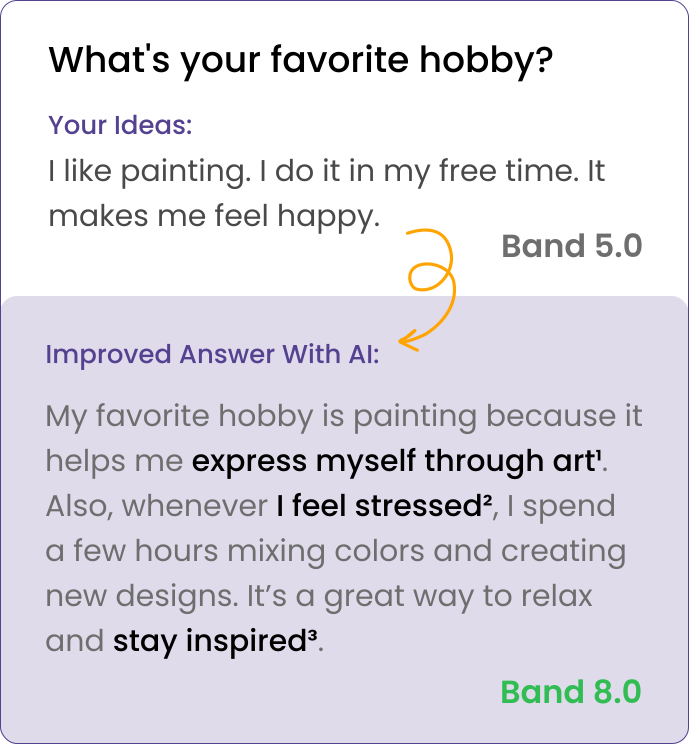
Practice IELTS Speaking answers in our free app
- Build personalized answers that match your target band.
- Turn short replies into fluent answers
- Let examiners fall in love with your answers!
Related Articles
Sample Answers
IELTS Speaking Part 1: Concentration Questions & Answers (Sep-Dec 2026)
Latest Sep-Dec 2026 IELTS Speaking Part 1 questions for Concentration. Read Band 9 sample answers, or use our AI app to turn your own ideas into perfect answers.
Sample Answers
IELTS Speaking Part 1: Jewelry Questions & Band 9 Answers (2026)
Latest Sep-Dec 2026 IELTS Speaking Part 1 questions for Jewelry. Read Band 9 sample answers or generate personal answers using our AI.
Sample Answers
IELTS Speaking Part 1: Colors Questions & Answers (Sep-Dec 2026)
Latest Sep-Dec 2026 IELTS Speaking Part 1 questions for Colors. Read Band 9 sample answers, or use our AI app to turn your own ideas into perfect answers.