IELTS Speaking Part 1: History Questions & Band 9 Answers (2026)
Latest Sep-Dec 2026 IELTS Speaking Part 1 questions for History. Read Band 9 sample answers or generate personal answers using our AI.
Start Practicing →History just hit the official IELTS question list for Sep-Dec 2026. The examiner might ask if you like learning about the past, who your favorite historical figure is, or if you enjoy visiting museums. To score Band 9, avoid saying "I think history is good." Instead, use natural, conversational phrases like cultural heritage, laid the foundation, or romanticize the past.
Latest Sep-Dec 2026: History Questions & Sample Answers
1. Do you like learning about history?
Yes, I actually find it quite fascinating. I wasn't a huge fan back in high school, but nowadays I really enjoy watching historical documentaries during my free time, especially ones focusing on ancient civilizations and how they lived.
2. What historical event do you find most interesting?
I am completely captivated by the Industrial Revolution. It radically changed the way we work and live on a daily basis, and it basically laid the foundation for the modern, fast-paced world we inhabit today.
3. Do you think history is an important subject to study?
Absolutely. As the famous saying goes, those who cannot remember the past are condemned to repeat it. It gives us vital context for understanding our current societal issues and navigating complex political conflicts.
4. How did you learn history when you were a child?
Mostly through dry textbooks and formal study in the classroom. Our teachers focused heavily on memorizing specific dates and the names of famous generals, which honestly made the subject feel a bit tedious and disconnected from reality at the time.
5. Have you ever visited a historical site?
Yes, quite a few! Last year I visited a remarkably well-preserved ancient castle while I was on travel in Europe. Walking through those stone corridors made the past feel incredibly real and tangible.
6. Do you like watching historical movies or documentaries?
I prefer documentaries, to be honest. Hollywood historical epics tend to heavily romanticize the past or twist the facts for dramatic effect, whereas documentaries usually provide a much more balanced, objective perspective.
7. Who is your favorite historical figure?
I have a deep admiration for Leonardo da Vinci. He wasn't just a brilliant painter, but also a visionary inventor and scientist whose radical ideas were centuries ahead of his time.
8. Do you prefer local history or global history?
I definitely lean towards global history. Learning about the rise and fall of massive empires across different continents helps me understand the broad, interconnected timeline of human progress.
9. Are there any historical museums in your hometown?
Yes, we have a fantastic local museum right in the center of my hometown. It is packed with fascinating artifacts and tools from the indigenous tribes that originally settled in this region centuries ago.
10. Would you like to live in the past?
Definitely not. While it might seem romantic in movies, the reality is that life back then involved rampant disease, backbreaking labor, no modern technology, and extremely poor living conditions. I am very grateful for modern medicine!
11. How do people in your country preserve history?
We place a heavy emphasis on architectural preservation. The government invests significantly in restoring heritage buildings, and we also maintain vast digital archives of historical texts and oral traditions in our national libraries.
12. Is it easier to learn history now than in the past?
Oh, without a doubt. Thanks to the internet, we have instant access to endless digital archives, interactive timelines, and incredibly detailed books and podcasts that make learning about the past highly engaging.
13. Do you think history museums should be free to the public?
I strongly believe they should be heavily subsidized, if not completely free. Preserving our shared cultural heritage is a public good, and I think everyone should have equal access to these educational resources regardless of their income.
14. What can we learn from history?
The biggest takeaway for me is human resilience. By studying how our ancestors overcame massive plagues, brutal wars, and economic depressions, we can find the courage to navigate the complex crises of our own modern era.
15. Have you ever read any historical fiction?
Yes, it is actually one of my favorite literary genres. I love how a talented author can take a rigid, factual timeline and breathe life into it by creating relatable, three-dimensional characters navigating real-world historical events.
Key Vocabulary for IELTS Topic: History
Artifact: An object made by a human being, typically one of cultural or historical interest, such as a tool or weapon.
Condemned to repeat it: Forced to make the exact same mistakes again because one did not learn from past errors.
Cultural heritage: The traditions, monuments, physical artifacts, and culture passed down from previous generations.
Historical epic: A large-scale film or book set in a past time period, often focusing on heroic figures and massive conflicts.
Indigenous: Originating or occurring naturally in a particular place; the original native inhabitants of a region.
Interconnected: Having all constituent parts linked or connected together, showing how one event affects another.
Laid the foundation: To provide the basic ideas, structures, or inventions from which something much larger develops.
Objective perspective: A neutral viewpoint based strictly on facts and evidence rather than feelings or personal opinions.
Oral traditions: Cultural material, stories, and historical traditions transmitted verbally from one generation to another without being written down.
Resilience: The extraordinary capacity of humans to recover quickly from devastating difficulties, disasters, or trauma.
Romanticize: To deal with or describe in an idealized or unrealistic fashion; to make a difficult past era seem better than it actually was.
Tangible: Perceptible by touch; having a physical presence that makes an abstract concept feel real.
Tedious: Too long, slow, or dull; tiresome or monotonous to study.
Create Your Own Band 9 Answers
IELTS Speaking Lab helps you turn your real ideas into Band 9 answers.
Select your topic/question - History/Do you like learning about history?
Input your rough idea - "I completely hated the subject at school."
Get a personalized Band 9 answer instantly, with the perfect vocabulary for your story.
Not happy with these answers?
Change the core idea, band level difficulty, length and get a full glossary in our free app!
Start Practicing →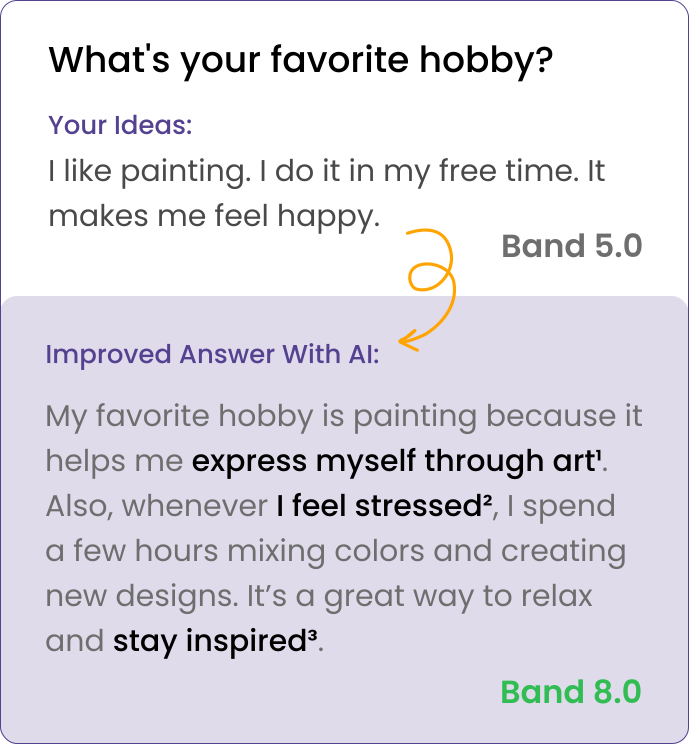
Practice IELTS Speaking answers in our free app
- Build personalized answers that match your target band.
- Turn short replies into fluent answers
- Let examiners fall in love with your answers!
Related Articles
Sample Answers
IELTS Speaking Part 1: Concentration Questions & Answers (Sep-Dec 2026)
Latest Sep-Dec 2026 IELTS Speaking Part 1 questions for Concentration. Read Band 9 sample answers, or use our AI app to turn your own ideas into perfect answers.
Sample Answers
IELTS Speaking Part 1: Jewelry Questions & Band 9 Answers (2026)
Latest Sep-Dec 2026 IELTS Speaking Part 1 questions for Jewelry. Read Band 9 sample answers or generate personal answers using our AI.
Sample Answers
IELTS Speaking Part 1: Colors Questions & Answers (Sep-Dec 2026)
Latest Sep-Dec 2026 IELTS Speaking Part 1 questions for Colors. Read Band 9 sample answers, or use our AI app to turn your own ideas into perfect answers.