Describe a Book You Read Recently: Part 2 Cue Card (2026)
Use our AI to get a personalized Band 9 answer and vocabulary for the IELTS Speaking Part 2 Cue Card "Describe a book you read recently".
Start Practicing →The "Describe a book you read recently" is a popular 2026 Cue Card. To achieve Band 7+, you must avoid simply listing the plot points (A happened, then B happened). Instead, you should focus on the genre, the themes, and the emotional impact the book had on you using vocabulary like page-turner, intricate plot, and thought-provoking.
How to Use This Sample Answer
Below is a sample answer for a student who read the sci-fi masterpiece "The Three-Body Problem." If this matches your choice, great. But what if you read a biography of Steve Jobs? Or a romantic novel?
So here is the plan:
Read this sample answer to understand the structure of a Band 7+ answer.
Use the IELTS Speaking Lab App to instantly generate your own personal answer to this Cue Card with perfect vocabulary that describes your specific book.
Part 2 Cue Card and Sample Answer
Describe a book you read recently. You should say:
What the book is
Who wrote it
What it is about
And explain why you liked or disliked it.
Band 9 Sample Answer
Introduce: I would like to talk about a book that completely blew my mind recently: The Three-Body Problem. It is the first novel in the Remembrance of Earth's Past trilogy by the Chinese author Cixin Liu. It is classified as "hard science fiction," meaning it relies heavily on real physics and scientific theories rather than just fantasy.
Describe: The story is incredibly complex. It begins during the Cultural Revolution in China, where a young astrophysicist witnesses the destruction of her family and loses faith in humanity. As a result, she makes a fateful decision to contact an extraterrestrial civilization called the Trisolarans. The book blends history, orbital mechanics, and a detective mystery involving the mysterious deaths of scientists. It gained international fame after famous people like Barack Obama praised it, calling it "wildly imaginative."
Explain: I was absolutely hooked from the first chapter. Unlike typical sci-fi that focuses on laser battles, this book focuses on sociological and philosophical questions. It introduces the terrifying "Dark Forest theory," which suggests the universe is full of life, but everyone is hiding because of the danger of predation. It made me question our place in the universe and the fragility of our own environment.
Add impact: Reading this was a paradigm shift for me. It was not just entertainment; it was an intellectual workout. It made my daily worries about work and deadlines seem insignificant compared to the vastness of the cosmos. It is a true masterpiece that stays with you long after you turn the final page.
This answer uses the IDEA Strategy (Introduce, Describe, Explain, Add impact).
Part 3 Questions and Sample Answers
After you finish your Cue Card, the examiner will ask you deeper questions related to reading and literature.
1. Do you think e-books will replace paper books in the future?
I don't think they will completely replace them. E-books offer undeniable convenience; you can carry a library in your pocket, which is perfect for study or travel. However, paper books have a tactile quality—the smell of the paper, the feeling of turning a page—that digital formats cannot replicate. Many people, including myself, treat physical books as collectors' items or sentimental objects.
2. Why do some people prefer reading biographies of famous people?
I think people are drawn to biographies because they offer a blueprint for success. Readers want to understand the habits, struggles, and decisions that led famous people to greatness. It is a form of mentorship from a distance. Fiction provides escapism, but non-fiction provides practical life lessons and inspiration for one's own career or work.
3. Is it important for children to read from a young age?
Absolutely. Reading is fundamental for cognitive development. It expands a child's vocabulary, improves their concentration span, and fosters empathy by allowing them to see the world through different perspectives. Children who read for pleasure often perform better in all academic subjects, not just literature.
4. How has the internet changed the way people read?
The internet has created a culture of skimming. We are used to consuming bite-sized information, tweets, and headlines, which has shortened our attention spans. As a result, many people find it difficult to engage with long-form content like novels. However, the internet has also democratized publishing, allowing independent authors to reach audiences without traditional gatekeepers.
Key Vocabulary for IELTS Cue Card: A Book
Here is the complete glossary of the vocabulary used in the answers above, plus extra high-level words relevant to this topic.
Attention span: (Noun) The length of time for which a person is able to concentrate on a particular activity.
Blueprint: (Noun) A design, plan, or model for something.
Cognitive development: (Phrase) How children think, explore, and figure things out.
Convenience: (Noun) The state of being able to proceed with something with little effort or difficulty.
Dark Forest theory: (Noun) A specific sci-fi theory suggesting civilizations hide to avoid destruction (good to mention if you read the book).
Escapism: (Noun) The tendency to seek distraction and relief from unpleasant realities, especially by seeking entertainment or engaging in fantasy.
Extraterrestrial civilization: (Phrase) A society or life form originating from outside the Earth.
Hard science fiction: (Phrase) A category of science fiction characterized by concern for scientific accuracy and logic.
Hooked: (Adj - Informal) Very interested and enthusiastic about something.
Intricate plot: (Phrase) A story that is very complex and has many connecting parts.
Long-form content: (Phrase) Content that takes a significant amount of time to consume (like books or long articles).
Masterpiece: (Noun) A work of outstanding artistry, skill, or workmanship.
Mentorship: (Noun) The guidance provided by a mentor, especially an experienced person.
Page-turner: (Noun) An exciting book that is hard to put down.
Paradigm shift: (Noun) A fundamental change in approach or underlying assumptions.
Sentimental objects: (Phrase) Items that are valuable because of the memories associated with them, not their price.
Skimming: (Verb) Reading something quickly so as to note only the important points.
Sociological: (Adj) Concerning the development, structure, and functioning of human society.
Tactile quality: (Phrase) The way something feels to the touch.
Thought-provoking: (Adj) Making you think seriously about a particular subject or issue.
Trilogy: (Noun) A group of three related novels, plays, films, operas, or albums.
Create Your Own Band 9 Answers
The answer above is perfect—if you read The Three-Body Problem. But what if you read Atomic Habits? Or Harry Potter? Your answers need to be true so that you can easily recall them during a stressful exam.
IELTS Speaking Lab helps you turn your real ideas into Band 9 answers.
Select your cue card - Describe a book you read recently.
Input your rough idea (e.g., "I read The Great Gatsby and loved the description of the Jazz Age").
Get personalized Band 9 answer instantly, with the perfect vocabulary for your story.
Not happy with these answers?
Change the core idea, band level difficulty, length and get a full glossary in our free app!
Start Practicing →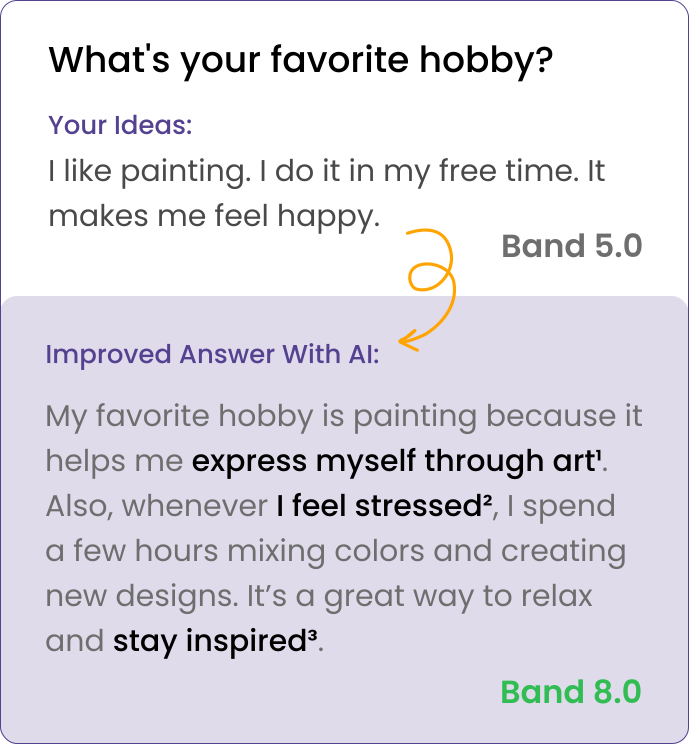
Practice IELTS Speaking answers in our free app
- Build personalized answers that match your target band.
- Turn short replies into fluent answers
- Let examiners fall in love with your answers!
Related Articles
Sample Answers
IELTS Speaking Part 1: Concentration Questions & Answers (Sep-Dec 2026)
Latest Sep-Dec 2026 IELTS Speaking Part 1 questions for Concentration. Read Band 9 sample answers, or use our AI app to turn your own ideas into perfect answers.
Sample Answers
IELTS Speaking Part 1: Jewelry Questions & Band 9 Answers (2026)
Latest Sep-Dec 2026 IELTS Speaking Part 1 questions for Jewelry. Read Band 9 sample answers or generate personal answers using our AI.
Sample Answers
IELTS Speaking Part 1: Colors Questions & Answers (Sep-Dec 2026)
Latest Sep-Dec 2026 IELTS Speaking Part 1 questions for Colors. Read Band 9 sample answers, or use our AI app to turn your own ideas into perfect answers.