IELTS Speaking Part 1: Old Buildings Questions & Band 9 Answers (2026)
Latest Sep-Dec 2026 IELTS Speaking Part 1 questions for Old Buildings. Read Band 9 sample answers or generate personal answers using our AI.
Start Practicing →Old Buildings is one of the newest subjects you need to prepare for in Sep-Dec 2026. The examiner might ask if you like visiting them, if you prefer modern architecture, or why they are important to a city. To score Band 9, avoid saying "They are very old." Instead, use natural, conversational phrases like steeped in history, architectural heritage, or run-down.
Latest Sep-Dec 2026: Old Buildings Questions & Sample Answers
1. Have you ever seen some old buildings in the city where you live?
Yes, my hometown actually has a beautifully preserved historic district downtown. I often walk past these nineteenth-century brick houses on my way to the grocery store. They really add a lot of character and charm to the neighborhood.
2. Do you think we should preserve old buildings?
Absolutely. They are a crucial part of our architectural heritage and give a city its unique identity. If we just demolish everything to build identical glass towers, we completely lose our connection to the past.
3. Do you prefer living in an old building or a modern one?
I definitely prefer a modern home. While old houses are charming from the outside, they are often incredibly drafty and lack decent insulation. I'd much rather have reliable plumbing and energy-efficient heating.
4. Are there any famous old buildings in your country?
Yes, we have quite a few medieval castles and ancient temples that are famous worldwide. They are completely steeped in history and draw millions of tourists every single year, which is a massive boost for the local economy.
5. Have you ever visited a famous old building?
I have! Last year during my travel vacation, I visited the Colosseum in Rome. Standing inside such an awe-inspiring structure really makes you appreciate the incredible engineering skills they had back then.
6. What do people usually do when visiting old buildings?
Most people just wander around taking endless photos for their social media pages. But those who are genuinely interested usually hire a guide or read the informational plaques to really understand the historical significance of the place.
7. Do you like looking at old buildings?
I do, especially when I am exploring a new city. I find the intricate stonework and unique designs much more visually interesting than the plain, cookie-cutter skyscrapers you see everywhere today.
8. Why do some people like to visit historical buildings?
I think it gives people a tangible link to the past. It's one thing to read about an event in a book, but walking through the actual halls where history happened creates a powerful sense of nostalgia and wonder.
9. Is it important to learn about the history of old buildings?
Yes, I think it provides valuable context about how our society evolved. Understanding the architectural styles and the materials they used gives you great insight into the culture and the daily lives of our ancestors.
10. Did you learn about historical buildings at school?
We touched on it briefly during history class, but it wasn't a major focus of our study curriculum. Mostly, we just memorized the dates they were built rather than learning about the architecture itself.
11. Do old buildings affect the appearance of a city?
They completely define it. Cities like Paris or Kyoto are famous specifically because their historic charm has been heavily protected from over-development. It makes the urban landscape feel much more vibrant and textured.
12. What is the oldest building you have ever seen?
Probably the Pantheon in Italy. It is almost two thousand years old, and the fact that its massive concrete dome is still perfectly intact is just mind-blowing. It has truly stood the test of time.
13. Would you like to work in an old building?
I wouldn't mind it, as long as it has been properly renovated on the inside. Having a modern work space with high-speed internet and good air conditioning is essential for me, even if the exterior of the building is centuries old.
14. Are old buildings harder to maintain than new ones?
Oh, without a doubt. They require constant, specialized upkeep to prevent the foundations from crumbling or the roofs from leaking. It's a very labor-intensive and expensive process to keep them safe for the public.
15. Do you think old buildings will be replaced in the future?
Sadly, I think many of the ordinary, run-down ones will eventually be knocked down to make way for new apartments. However, the truly iconic landmarks will always be protected by the government.
Key Vocabulary for IELTS Topic: Old Buildings
Architectural heritage: The historic buildings and structures that are important to a culture or society.
Awe-inspiring: Giving a feeling of great respect, admiration, and amazement.
Cookie-cutter: Having the exact same appearance or design as many others; lacking originality.
Demolish: To completely destroy or tear down a building.
Drafty: Having cold air blowing through, usually because of poorly sealed windows or doors.
Historic charm: The pleasant, attractive quality of something that is old and traditional.
Historical significance: The importance of a place, person, or event in history.
Labor-intensive: Requiring a large amount of physical work or effort to complete.
Run-down: In very bad condition because of age or lack of care.
Sense of nostalgia: A sentimental longing or affection for the past.
Steeped in history: Having a very rich, deep, and noticeable historical background.
Stood the test of time: To remain popular, strong, or intact after a very long period.
Tangible link: A real, physical connection that you can see or touch.
Upkeep: The process of keeping a building or machine in good condition through regular repairs.
Visually interesting: Attractive and engaging to look at because of unique details or design.
Create Your Own Band 9 Answers
IELTS Speaking Lab helps you turn your real ideas into Band 9 answers.
Select your topic/question - Old Buildings/Do you think we should preserve old buildings?
Input your rough idea - "Absolutely, they are important."
Get a personalized Band 9 answer instantly, with the perfect vocabulary for your story.
Not happy with these answers?
Change the core idea, band level difficulty, length and get a full glossary in our free app!
Start Practicing →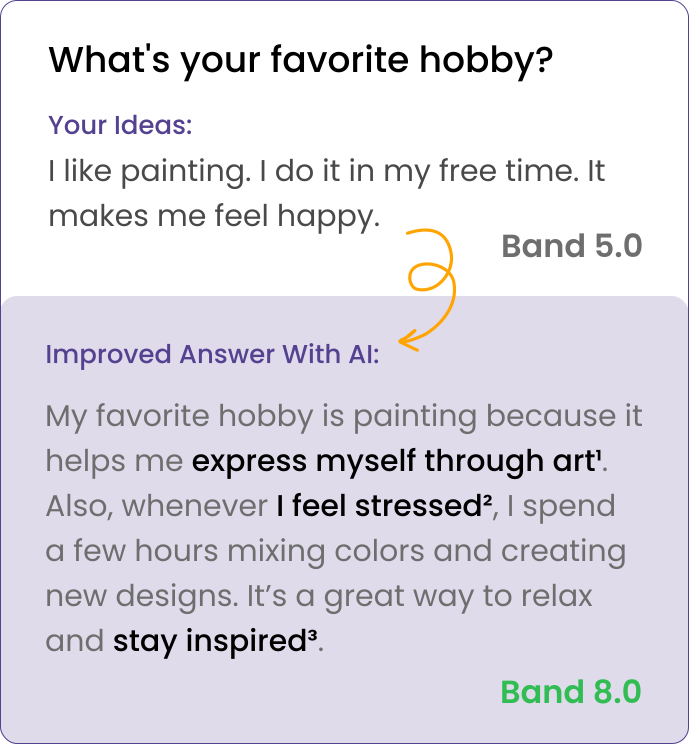
Practice IELTS Speaking answers in our free app
- Build personalized answers that match your target band.
- Turn short replies into fluent answers
- Let examiners fall in love with your answers!
Related Articles
Sample Answers
IELTS Speaking Part 1: Concentration Questions & Answers (Sep-Dec 2026)
Latest Sep-Dec 2026 IELTS Speaking Part 1 questions for Concentration. Read Band 9 sample answers, or use our AI app to turn your own ideas into perfect answers.
Sample Answers
IELTS Speaking Part 1: Jewelry Questions & Band 9 Answers (2026)
Latest Sep-Dec 2026 IELTS Speaking Part 1 questions for Jewelry. Read Band 9 sample answers or generate personal answers using our AI.
Sample Answers
IELTS Speaking Part 1: Colors Questions & Answers (Sep-Dec 2026)
Latest Sep-Dec 2026 IELTS Speaking Part 1 questions for Colors. Read Band 9 sample answers, or use our AI app to turn your own ideas into perfect answers.