Describe a Photograph: Part 2 Cue Card (2026)
Use our AI to get a personalized Band 9 answer and vocabulary for the IELTS Speaking Part 2 Cue Card "Describe a photograph".
Start Practicing →The "Describe a photograph" Cue Card can be a challenging topic in the Objects category. The key to hitting a Band 7+ is to avoid simply listing colors and people. Examiners want you to create a vivid description, share the memory behind it, and explain its emotional impact, rather than just delivering a dry list of visual facts.
How to Use This Sample Answer
Below is a tailored sample answer describing a family beach picnic. If this specific scenario matches your personal memories, it is an excellent resource for your exam preparation.
Here is how you use this page:
Read this sample answer to understand the logical structure of a Band 7+ response.
Use the IELTS Speaking Lab App to instantly generate your own personal answer to this Cue Card, tailored to your own cherished photographs.
Part 2 Cue Card and Sample Answer
Describe a photograph. You should say:
What the photograph shows
When and where it was taken
Who took it
And explain why you like it or what it reminds you of.
Band 9 Sample Answer
Introduce: I want to describe a deeply cherished photograph that holds immense sentimental value for me. It is a candid snapshot taken on a deserted beach about twenty years ago, and it currently sits in a beautiful wooden frame on my living room bookshelf.
Describe: Visually, the image features my Mom, my Dad, and myself as a young boy. We are sitting on a faded woolen blanket on the sand, sharing some simple homemade food from a picnic basket. The weather that day was absolutely pristine—the sky was an endless, clear blue, and a perfectly calm sea stretches out to the horizon behind us. There isn’t another soul in sight, which gives the picture a wonderful sense of tranquility.
Explain: The story behind this photo is actually quite spontaneous. We didn't even take it ourselves; a friendly passerby saw us laughing and offered to capture the moment. My parents worked incredibly hard and we rarely had the budget to travel back then, so this rare weekend trip away from the city was a massive treat. We weren't posing stiffly; we were just completely living in the moment.
Add impact: Ultimately, I treasure this physical print because it represents a beautiful, bygone era of my childhood. Looking at it fills me with a warm sense of nostalgia and serves as a permanent, physical reminder of my tight-knit family before life got busy and complicated.
This answer uses the IDEA Strategy (Introduce, Describe, Explain, Add impact).
Part 3 Questions and Sample Answers
After you finish your Cue Card, the examiner will ask you deeper questions related to photography and memories.
1. Do you think people take too many photographs these days?
Absolutely. The transition to smartphone cameras has created a culture of quantity over quality. Because taking a picture is free and instant, people constantly snap away without thinking. We are often so busy trying to document an event for social media that we fail to actually experience it, which I believe completely ruins the authenticity of the moment.
2. Is it better to rely on memory or keep a lot of photographs?
I believe a balance is crucial. Human memory is inherently fallible; details fade and become distorted as we age. A physical photograph acts as a tangible anchor, helping to instantly bring back the emotions and context of a specific day. However, if you experience your entire life through a camera lens, your brain never properly encodes the memory in the first place.
3. Has digital media changed the profession of photography?
It has completely democratized it, but it has also devalued it. Today, anyone can apply a digital filter and curate a picture-perfect aesthetic. This creates intense competition for professional photographers. However, true artistic brilliance—understanding complex lighting, composition, and storytelling—still requires immense skill that an amateur with a smartphone simply cannot replicate.
4. Why do some people hate having their picture taken?
I think it usually stems from deep-seated insecurities. We live in an era dominated by unrealistic beauty standards and heavily edited online personas. Many people are terrified of being captured from a bad angle or in an unflattering light because they fear that the image will be judged or scrutinized by others.
Key Vocabulary for IELTS Cue Card: Describe a Photograph
Here is the complete glossary of the vocabulary used in the answers above, plus extra high-level collocations relevant to memory and visuals.
Artistic brilliance: (Noun Phrase) Exceptional skill and creativity in an artistic field.
Bygone era: (Noun Phrase) A period of time in the past that no longer exists.
Candid snapshot: (Noun Phrase) An informal, unposed, and authentic photograph taken without the subject trying to look perfect.
Deep-seated insecurities: (Noun Phrase) Strong, underlying feelings of self-doubt or lack of confidence.
Inherently fallible: (Adjective Phrase) Naturally prone to making mistakes or being inaccurate.
Living in the moment: (Idiom) Fully engaged in and enjoying the present time without worrying about the future or past.
Nostalgia: (Noun) A sentimental longing or wistful affection for the past.
Picture-perfect aesthetic: (Noun Phrase) A visual style that looks flawlessly beautiful, often in an artificial or highly curated way.
Pristine: (Adjective) In its original condition; unspoiled and clean.
Quantity over quality: (Phrase) Prioritizing the sheer number of things produced rather than how good they actually are.
Sentimental value: (Noun Phrase) The importance of an object derived from personal or emotional associations rather than material worth.
Snap away: (Phrasal Verb) To take many photographs quickly and casually.
Spontaneous: (Adjective) Performed or occurring as a result of a sudden inner impulse or inclination and without premeditation.
Tangible anchor: (Noun Phrase) A physical object that helps ground a person to a memory, feeling, or reality.
Tight-knit: (Adjective) Closely bound together by strong relationships and common interests (often used for families or communities).
Tranquility: (Noun) The quality or state of being calm and peaceful.
Unrealistic beauty standards: (Noun Phrase) Expectations of physical attractiveness that are impossible for normal people to achieve.
Create Your Own Band 9 Answers
The sample answer above is perfect—if you want to describe a family beach picnic. But your real exam answer needs to be authentic so that you can easily speak about it for two minutes without freezing.
What if your most cherished photo is your graduation portrait? Or a dramatic landscape you captured yourself?
IELTS Speaking Lab helps you turn your real memories into Band 9 answers.
Select your cue card - Describe a photograph.
Input your rough idea (e.g., "My high school graduation picture with my best friend").
Get your personalized Band 9 answer instantly, with the perfect vocabulary built in.
Not happy with these answers?
Change the core idea, band level difficulty, length and get a full glossary in our free app!
Start Practicing →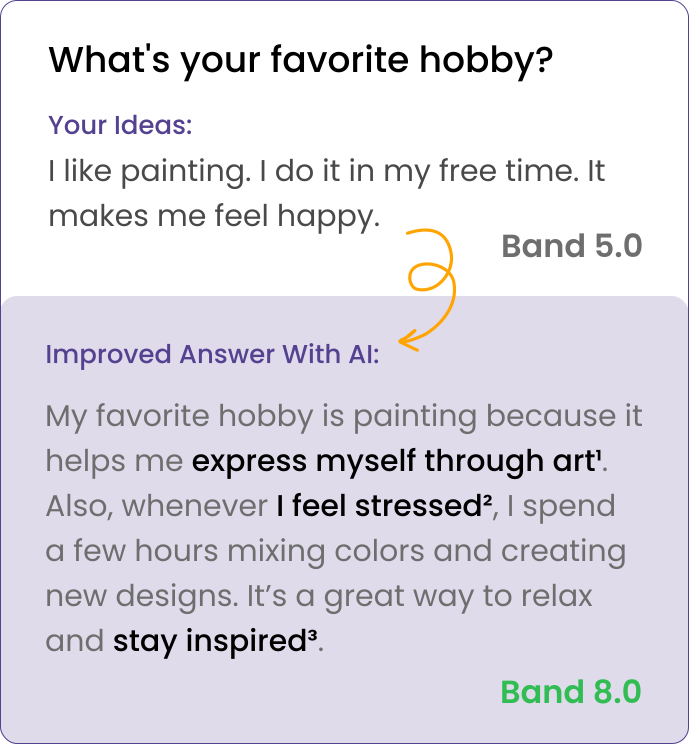
Practice IELTS Speaking answers in our free app
- Build personalized answers that match your target band.
- Turn short replies into fluent answers
- Let examiners fall in love with your answers!
Related Articles
Sample Answers
IELTS Speaking Part 1: Concentration Questions & Answers (Sep-Dec 2026)
Latest Sep-Dec 2026 IELTS Speaking Part 1 questions for Concentration. Read Band 9 sample answers, or use our AI app to turn your own ideas into perfect answers.
Sample Answers
IELTS Speaking Part 1: Jewelry Questions & Band 9 Answers (2026)
Latest Sep-Dec 2026 IELTS Speaking Part 1 questions for Jewelry. Read Band 9 sample answers or generate personal answers using our AI.
Sample Answers
IELTS Speaking Part 1: Colors Questions & Answers (Sep-Dec 2026)
Latest Sep-Dec 2026 IELTS Speaking Part 1 questions for Colors. Read Band 9 sample answers, or use our AI app to turn your own ideas into perfect answers.