IELTS Speaking Part 1: Science Questions & Band 9 Answers (2026)
Latest Sep-Dec 2026 IELTS Speaking Part 1 questions for Science. Read Band 9 sample answers or generate personal answers using our AI.
Start Practicing →Expect to see Science in your Sep-Dec 2026 IELTS speaking exam. The examiner might ask if you enjoyed science at school, what discoveries interest you, or how science impacts your life. To score Band 9, avoid saying "Science is useful." Instead, use natural, conversational phrases like underpins, hands-on exhibit, or breakthrough.
Latest Sep-Dec 2026: Science Questions & Sample Answers
1. Do you like science?
Yeah, I do find it intriguing, especially biology and how the human body works. That said, I'm definitely more interested in practical everyday applications rather than memorizing dry, complex formulas.
2. Did you study science at school?
Yes, it was a compulsory part of our study curriculum right up until high school. We had to take general science classes covering biology, chemistry, and basic physics every single week.
3. Which science subject did you like most?
Biology was always my favorite by a mile. I loved learning about living ecosystems because it felt directly relevant to the real world, unlike abstract, math-heavy physics.
4. Is science important in daily life?
Undoubtedly, it underpins almost everything we rely on in modern society. From the clean tap water we drink to the advanced technology in our smartphones, science shapes our daily existence.
5. Do you watch science documentaries?
I do, quite frequently. I love watching nature series or documentaries exploring outer space & stars because they present complex concepts in a visually stunning and accessible way.
6. Have you visited a science museum?
Yes, I actually went to an interactive science center a couple of years ago with some friends. It was great fun because they had lots of hands-on exhibits where you could test out physics principles yourself.
7. Did you do experiments at school?
We did, though they were pretty basic and tightly controlled by the teacher. I distinctly remember dissecting a flower and doing simple chemical reactions that changed colors, which felt like a neat magic trick back then.
8. What is the most useful scientific invention?
In my opinion, it has to be antibiotics. They completely revolutionized modern medicine and saved millions of lives, turning once fatal infections into manageable, run-of-the-mill illnesses.
9. Do you read science news?
I occasionally skim articles on tech blogs or mainstream news sites, especially if there's a major breakthrough in artificial intelligence or green energy. It helps me stay informed without getting bogged down in dense jargon.
10. Is science popular in your country?
Yes, STEM fields are held in high regard here. Many parents actively encourage their children to pursue careers in science and engineering because it usually guarantees stable, well-paying work.
11. Do you want to learn more about science?
I’d love to, especially through casual reading or popular science podcasts. I don't have time for formal courses, but picking up interesting scientific trivia during my commute is mentally stimulating.
12. Can everyone learn science easily?
Not necessarily, because it often requires a strong foundation in math and sharp analytical thinking. While anyone can grasp the basic ideas, delving into advanced theories can be genuinely intimidating for a lot of people.
13. How has science changed our lives?
It has completely transformed our daily routine by making life infinitely more convenient. We can cure deadly illnesses and communicate instantly across the globe, all thanks to constant scientific innovation.
14. Did you want to be a scientist as a child?
Briefly, yes. I had a phase where I was obsessed with mixing liquids together and thought being a chemist in a white lab coat looked like the coolest job in the world, though that ambition faded away pretty fast.
15. Can science solve climate change?
I think it provides the essential tools, like green energy tech and carbon capture systems. However, scientific solutions only work if governments and corporations actually have the political will to roll them out globally.
Key Vocabulary for IELTS Topic: Science
Accessible: Easy to understand or approach.
Breakthrough: An important, sudden scientific discovery.
Compulsory: Required by law or a rule.
Dissecting: Cutting open to study internal parts.
Ecosystem: A biological community interacting with its environment.
Faded away: Slowly disappeared or lost strength.
Hands-on exhibit: Interactive museum display you can touch.
Held in high regard: Respected and admired greatly.
Innovation: A new method, idea, or product.
Intimidating: Frightening or discouraging because of difficulty.
Intriguing: Arousing curiosity or interest; fascinating.
Political will: Determination by leaders to take action.
Run-of-the-mill: Ordinary, standard, or unexceptional.
Stimulating: Encouraging new ideas and energetic interest.
Underpins: Forms the basic foundation of something.
Create Your Own Band 9 Answers
IELTS Speaking Lab helps you turn your real ideas into Band 9 answers.
Select your topic/Question - Science / Do you like science?
Input your rough idea - "Yes, I was always interested in astronomy."
Get a personalized Band 9 answer instantly, with the perfect vocabulary for your story.
Not happy with these answers?
Change the core idea, band level difficulty, length and get a full glossary in our free app!
Start Practicing →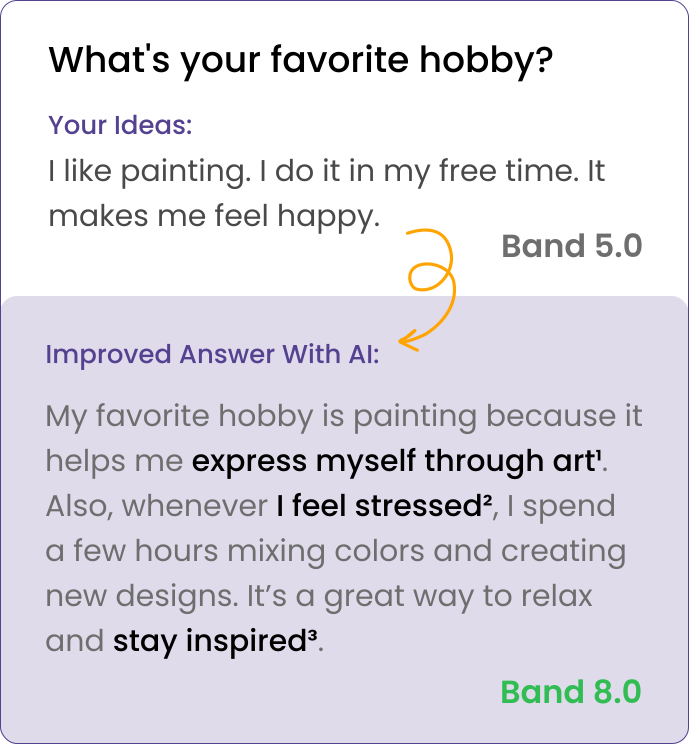
Practice IELTS Speaking answers in our free app
- Build personalized answers that match your target band.
- Turn short replies into fluent answers
- Let examiners fall in love with your answers!
Related Articles
Sample Answers
IELTS Speaking Part 1: Concentration Questions & Answers (Sep-Dec 2026)
Latest Sep-Dec 2026 IELTS Speaking Part 1 questions for Concentration. Read Band 9 sample answers, or use our AI app to turn your own ideas into perfect answers.
Sample Answers
IELTS Speaking Part 1: Jewelry Questions & Band 9 Answers (2026)
Latest Sep-Dec 2026 IELTS Speaking Part 1 questions for Jewelry. Read Band 9 sample answers or generate personal answers using our AI.
Sample Answers
IELTS Speaking Part 1: Colors Questions & Answers (Sep-Dec 2026)
Latest Sep-Dec 2026 IELTS Speaking Part 1 questions for Colors. Read Band 9 sample answers, or use our AI app to turn your own ideas into perfect answers.