Describe a City You Have Visited: Part 2 Cue Card (2026)
Use our AI to get a personalized Band 9 answer and vocabulary for the IELTS Speaking Part 2 Cue Card "Describe a city you have visited".
Start Practicing →The "Describe a city" Cue Card is a staple in the Places category. When tackling this topic, many students make the mistake of just listing famous tourist attractions like a guidebook. To achieve a Band 7 or higher, examiners want to hear about the palpable energy of the location, the sensory details of the streets, and your personal reaction to the urban environment.
How to Use This Sample Answer
Below is a high-scoring sample answer describing a trip to the fast-paced metropolis of Bangkok. If you have visited Southeast Asia, you can heavily borrow from this vocabulary.
Here is the game plan:
Read this sample answer to understand the logical structure of a Band 7+ response.
Use the IELTS Speaking Lab App to instantly generate your own personal answer to this Cue Card, tailored to a city you actually know well, whether that is Paris, Tokyo, or your own country's capital.
Part 2 Cue Card "Describe a city you have visited"
Describe a city you have visited. You should say:
Where the city is
Why you went there
What you did there
And explain how you felt about this city.
Band 9 Sample Answer
Introduce: I want to talk about an unforgettable trip I took to Bangkok, the capital of Thailand. I went there for a two-week holiday a couple of years ago, and from the second I stepped out of the airport, it was an absolute sensory overload.
Describe: The city itself is a fascinating study in contrasts. On one street, you have these massive, ultra-modern shopping malls, and right around the corner, you'll find ancient, golden-roofed temples tucked away in quiet alleys. The weather is famously hot and humid, which is why the city truly comes alive at night. The streets are packed with neon lights, zooming tuk-tuks, and this incredible, palpable energy.
Explain: I mainly went there for cultural immersion, but also because the city is a renowned culinary haven. During the day, I spent hours wandering around the Grand Palace, just admiring the intricate architecture. But my favorite part was the evenings. I would get lost in the bustling night markets, trying out all the fiery, authentic street food from local vendors.
Add impact: Ultimately, this travel experience left a massive impression on me. Despite the chronic traffic congestion and the sheer volume of people, the locals exuded this incredible warmth and genuine hospitality. It was an eye-opening adventure that really broadened my horizons, and I would honestly go back in a heartbeat.
This answer uses the IDEA Strategy (Introduce, Describe, Explain, Add impact).
Part 3 Questions and Sample Answers
After you finish your Cue Card, the examiner will ask you deeper questions related to urbanization and city living.
1. Why do some people prefer living in cities rather than rural areas?
The primary draw is the abundance of economic opportunities. Cities are hubs for major corporations, meaning there is better career mobility and higher earning potential. Furthermore, urban areas offer a vibrant social scene—you have immediate access to diverse restaurants, concerts, and advanced public transit, which you just don't get in the countryside.
2. What are the main disadvantages of living in a large metropolis?
The biggest drawback is undoubtedly the exorbitant cost of living, particularly regarding real estate. It is pricing young professionals out of the housing market entirely. Additionally, the rapid pace of urban sprawl leads to severe downsides like constant noise pollution and chronic traffic congestion, which can really wear you down and cause daily stress.
3. How can cities be made more environmentally friendly?
Municipal governments need to prioritize sustainable urban planning. This means heavily investing in green public transport to reduce the reliance on private cars. Furthermore, creating more pedestrianized zones and planting urban forests can drastically improve air quality and lower the city's overall carbon footprint.
4. Do you think historical buildings should be preserved in modern cities?
Absolutely. While modern development is necessary, tearing down historical structures destroys a city's unique identity. These buildings represent vital architectural heritage and serve as a tangible link to the past. Instead of demolishing them, developers should focus on adaptive reuse—modernizing the interiors while preserving the historic facades.
Key Vocabulary for IELTS Cue Card: Describe a City
Here is the complete glossary of the vocabulary used in the answers above, plus extra high-level collocations relevant to cities, travel, and urbanization.
Architectural heritage: Historic buildings, monuments, and structures that have cultural or historical significance to a society.
Chronic traffic congestion: Long-lasting, severe, and continuous overcrowding of roads with vehicles.
Culinary haven: A place that is famous for offering exceptionally good and diverse food.
Cultural immersion: The act of deeply engaging with and experiencing a foreign culture, rather than just observing it as a tourist.
Economic opportunities: Chances to find employment, start businesses, and improve one's financial situation.
Exorbitant cost of living: Unreasonably high expenses required to maintain a standard of living (housing, food, taxes).
Genuine hospitality: Sincere, warm, and friendly treatment of guests or strangers.
Golden-roofed temples: Places of worship characterized by roofs covered in gold or gold-colored materials, typical in Southeast Asia.
Intricate architecture: Building design that is highly detailed, complex, and carefully crafted.
Palpable energy: An atmosphere or feeling of excitement in a place that is so intense it almost feels physical.
Pedestrianized zones: Areas of a city or town reserved strictly for people walking, where vehicles are banned.
Sensory overload: A situation where one's senses (sight, hearing, smell) are overwhelmed by a massive amount of stimuli.
Study in contrasts: Something that exhibits very striking or obvious differences when looked at closely.
Sustainable urban planning: Designing cities in a way that minimizes environmental impact and promotes long-term ecological balance.
Tangible link to the past: A physical, touchable object or building that connects modern people to history.
Unforgettable trip: A journey or vacation that is so memorable it will never be forgotten.
Urban sprawl: The uncontrolled and rapid expansion of urban areas into the surrounding countryside.
Vibrant social scene: An active, lively, and exciting environment for nightlife, entertainment, and socializing.
Create Your Own Band 9 Answers
The sample above is an excellent model if you have actually traveled to Bangkok. But your exam answer must be authentic to your own life so you can speak fluently and confidently without memorizing a fake script.
What if the most interesting city you visited was London? Or a quiet coastal town in your home country?
IELTS Speaking Lab helps you turn your actual travel memories into Band 9 answers.
Select your cue card - Describe a city you have visited.
Input your rough idea (e.g., "I went to New York for a business trip and saw Times Square").
Get your personalized Band 9 answer instantly, with the perfect vocabulary built right in.
Not happy with these answers?
Change the core idea, band level difficulty, length and get a full glossary in our free app!
Start Practicing →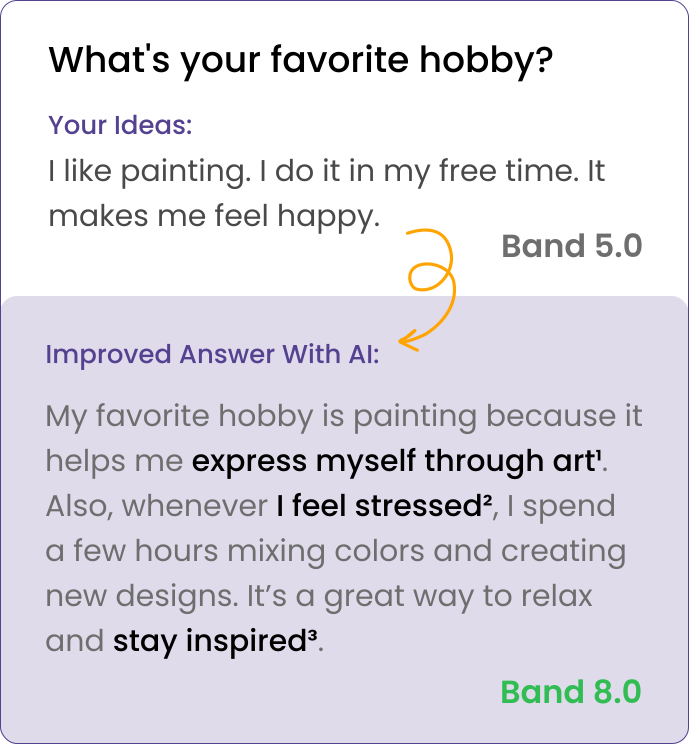
Practice IELTS Speaking answers in our free app
- Build personalized answers that match your target band.
- Turn short replies into fluent answers
- Let examiners fall in love with your answers!
Related Articles
Sample Answers
IELTS Speaking Part 1: Concentration Questions & Answers (Sep-Dec 2026)
Latest Sep-Dec 2026 IELTS Speaking Part 1 questions for Concentration. Read Band 9 sample answers, or use our AI app to turn your own ideas into perfect answers.
Sample Answers
IELTS Speaking Part 1: Jewelry Questions & Band 9 Answers (2026)
Latest Sep-Dec 2026 IELTS Speaking Part 1 questions for Jewelry. Read Band 9 sample answers or generate personal answers using our AI.
Sample Answers
IELTS Speaking Part 1: Colors Questions & Answers (Sep-Dec 2026)
Latest Sep-Dec 2026 IELTS Speaking Part 1 questions for Colors. Read Band 9 sample answers, or use our AI app to turn your own ideas into perfect answers.