IELTS Speaking Part 1: Typing Questions & Band 9 Answers (2026)
Stop memorizing generic answers. Use our AI tools to get personalized Band 9 answers and vocabulary to talk about keyboards, handwriting, and digital communication.
Start Practicing →Typing is a very common topic in 2026. The examiner might ask if you type quickly, how you learned, or if you still use handwriting. To score Band 9, avoid saying "I type very fast." Instead, use words like muscle memory, touch-typing, illegible, or carpal tunnel syndrome to describe your experience.
How to Use These Sample Answers
Below are the latest 2026 questions for "Typing."
Important: These answers are for a person who types very fast and uses a computer all day. They prefer typing because their handwriting is terrible, but they sometimes get tired wrists from using a keyboard too much.
But if you type very slowly using only two fingers, or if you love writing beautiful letters with a pen, these answers are probably not for you.
So, here is the plan:
Read these samples to understand the Band 9 structure.
Use the IELTS Speaking Lab App to get personalized answers. It gives you perfect vocabulary that fits your real life.
Part 1: Questions & Model Answers about Typing
1. Do you type fast?
Yes, I would say I am quite a proficient typist. Because I rely heavily on technology for both my professional and personal life, I have developed excellent muscle memory over the years. I can comfortably type around eighty words per minute without making too many mistakes.
2. How did you learn to type?
I mostly learned through trial and error when I was a teenager. I spent hours chatting online with my friends after school, which naturally forced me to increase my speed to keep up with the conversation. Eventually, finding the keys just became second nature to me.
3. Do you prefer typing or handwriting?
I overwhelmingly prefer typing. To be completely honest, my cursive handwriting is almost completely illegible, even to myself. Typing is vastly more efficient and allows me to organize and edit my thoughts much faster on a digital screen.
4. When do you need to type?
I literally need to type every single day. Whether it is drafting long emails for my colleagues or completing lengthy research essays for my study assignments, a keyboard is my primary tool. I would be completely lost and unproductive without it.
5. Is typing an important skill?
It is absolutely crucial in today's digital age. Being able to type quickly and accurately is a fundamental prerequisite for almost any modern office job. Without this skill, you are at a severe disadvantage in the competitive corporate workplace.
6. Can you type without looking at the keyboard?
Yes, I have successfully mastered touch-typing. I never need to glance down at my hands while I am working. This allows me to look directly at the monitor, which significantly improves my overall productivity and reading focus.
7. Do you ever use handwriting anymore?
Very rarely, to be honest. The only time I physically pick up a pen is to sign official, legal documents or perhaps to scribble a quick, superficial reminder on a sticky note. Absolutely everything else in my life is completely digitized now.
8. What are the disadvantages of typing for a long time?
The biggest drawback is definitely the physical toll it takes on your body. Typing for eight hours straight can easily lead to carpal tunnel syndrome or other forms of repetitive strain injury if you do not invest in a proper ergonomic keyboard setup.
9. Do you use voice-to-text instead of typing?
Occasionally, especially when I am navigating the internet on my smartphone while walking outside. However, for drafting formal messages, voice recognition still lacks the necessary precision and frequently misinterprets my pronunciation or punctuation.
10. Is it easier to type on a phone or a computer?
A physical computer keyboard is infinitely superior. The tactile feedback from real, mechanical keys makes a huge difference in accuracy. Typing on a flat glass phone screen usually results in an annoying number of typographical errors and requires constant autocorrect.
11. Do you think handwriting will disappear in the future?
I don't think it will vanish entirely, but its role will definitely diminish. Handwriting will likely become more of a niche artistic hobby, much like traditional calligraphy, rather than a practical, daily necessity for communication.
12. Do children need to learn handwriting if they can type?
Yes, I think they still should. Even though they will likely spend their teenage years typing on social media platforms, physically holding a pen is still highly beneficial for a young child's early cognitive development and fine motor skills.
Key Vocabulary for IELTS Topic: Typing
Here is the complete glossary of every bolded word and phrase used in the answers above.
Carpal tunnel syndrome: A medical condition causing numbness, tingling, or weakness in the hand, often caused by repetitive typing.
Cognitive development: How children think, explore, and figure things out.
Crucial: Of great importance; essential.
Efficient: Achieving maximum productivity with minimum wasted effort or expense.
Ergonomic: Designed for efficiency and comfort in the working environment.
Illegible: Not clear enough to be read.
Muscle memory: The ability to reproduce a particular movement without conscious thought, acquired as a result of frequent repetition.
Niche: Denoting products, services, or interests that appeal to a small, specialized section of the population.
Precision: The quality, condition, or fact of being exact and accurate.
Prerequisite: A thing that is required as a prior condition for something else to happen or exist.
Productivity: The effectiveness of productive effort, especially in industry or work.
Repetitive strain injury: A condition where pain and other symptoms occur in an area of the body that has done repetitive tasks.
Superficial: Existing or occurring at or on the surface; lacking depth.
Tactile: Of or connected with the sense of touch.
Touch-typing: Typing without looking at the keys.
Typographical errors: Mistakes made in the typed or printed text (commonly called "typos").
Create Your Own Band 9 Answers
The answers above are perfect—if you are a person who types very fast and uses a computer all day. But what if you type very slowly? Or what if you love writing beautiful letters with a pen?
Your answers need to be true so that you can easily recall them during a stressful exam.
IELTS Speaking Lab helps you turn your real ideas into Band 9 answers.
Select your topic - Typing.
Input your rough idea (e.g., "I type very slowly using only two fingers on my laptop").
Get personalized Band 9 answers instantly, with the perfect vocabulary for your story.
Not happy with these answers?
Change the core idea, band level difficulty, length and get a full glossary in our free app!
Start Practicing →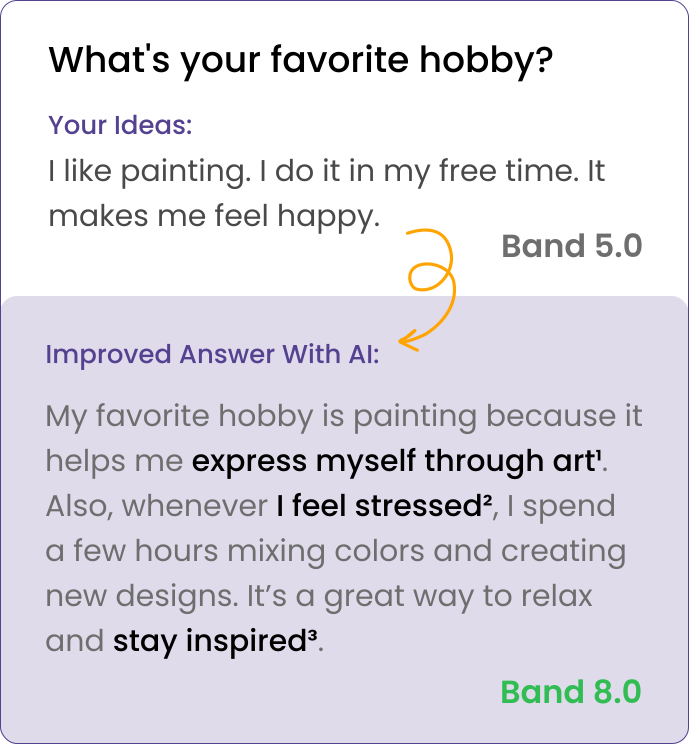
Practice IELTS Speaking answers in our free app
- Build personalized answers that match your target band.
- Turn short replies into fluent answers
- Let examiners fall in love with your answers!
Related Articles
Sample Answers
IELTS Speaking Part 1: Concentration Questions & Answers (Sep-Dec 2026)
Latest Sep-Dec 2026 IELTS Speaking Part 1 questions for Concentration. Read Band 9 sample answers, or use our AI app to turn your own ideas into perfect answers.
Sample Answers
IELTS Speaking Part 1: Jewelry Questions & Band 9 Answers (2026)
Latest Sep-Dec 2026 IELTS Speaking Part 1 questions for Jewelry. Read Band 9 sample answers or generate personal answers using our AI.
Sample Answers
IELTS Speaking Part 1: Colors Questions & Answers (Sep-Dec 2026)
Latest Sep-Dec 2026 IELTS Speaking Part 1 questions for Colors. Read Band 9 sample answers, or use our AI app to turn your own ideas into perfect answers.