IELTS Speaking Part 2 Strategies: Cue Cards Made Easy
Learn the 3 simple strategies for IELTS Speaking Part 2. Instantly organize your thoughts, speak for 2 minutes, and score Band 7+.
Start Practicing →Part 2 of the IELTS Speaking test is very different from Part 1.
This time, the examiner gives you a Cue Card and asks you to talk for one to two minutes. You also get one minute to prepare. Many students find this part stressful because it’s not easy to keep speaking for that long without a clear plan.
That’s why we use three simple strategies — AAAE, IDEA, and DALE.
Each one matches a different type of cue card and helps you stay fluent, logical, and confident — even when the topic is new.
Let’s look at how they work.
1. AAAE – Answer · Add detail · Anecdote · Explain
Best for: Past experiences or “Describe a time…” questions.
Typical cue cards:
The AAAE Structure:
A - Answer: Set the scene (Who, What, Where, When).
A - Add detail: Describe the struggle, the action, or the challenge.
A - Anecdote: Tell a specific "micro-moment" or small story (this brings it to life).
E - Explain: How you felt about it or what the result was.
Example AAAE Answer:
Cue Card: Describe a time you helped someone.
(You should say who you helped, why they needed help, how you helped them, and explain how you felt about it)
Answer: I want to talk about a time I helped my neighbor move into her new apartment. It was a memorable experience because I felt really useful.
Add detail: She had a lot of heavy boxes and no one else to help her, so I offered to give her a hand. We carried furniture up several flights of stairs—it was a tough challenge, but we managed to get the job done.
Anecdote: At one point, we almost dropped her sofa but ended up laughing and lifting it together. After we finished, she made me tea.
Explain: I was very pleased to be helpful and had a sense of achievement knowing that my actions really made a difference. I also felt myself part of the building community for the first time.
Why it works: The AAAE pattern keeps your story organized, natural, and full of emotion — perfect for Band 7 or higher answers.
2. IDEA – Introduce · Describe · Explain · Add impact
Best for: People, Objects, Books, or Places (Present Tense / General).
Typical cue cards:
The IDEA Structure:
I - Introduce: Give a direct answer to the prompt.
D - Describe: Give physical details, facts, or context.
E - Explain: Why do you like it? Why is it special?
A - Add impact: How does it affect you personally? Or a summary thought.
Example IDEA Answer:
Cue Card: Describe a gift you received. (You should say what the gift was, who gave it to you, what it looks like, and explain why it is important to you)
Introduce: I’d like to talk about a gift that is incredibly special to me: a silver MacBook Air. I received it from my parents for my 18th birthday, just before I started university.
Describe: It is a masterpiece of design—incredibly sleek, lightweight, and thin, which makes it perfect for carrying around campus in my backpack. It features a high-resolution Retina display and a long-lasting battery.
Explain: The main reason I value this gift is its utility. It has become the central hub of my student life; I use it for everything from writing research papers to video calling my family back home.
Add impact: It has made me much more productive and organized. I treat it with great care because I know how much my parents saved up to buy it, so it serves as a daily reminder of their support.
Why it works: The IDEA strategy helps you build longer, structured answers — starting with an introduction, giving key details, and finishing with your personal feeling or reflection.
3. DALE – Describe · Add detail · Link to self · Example
Best for: Dreams, Future plans, or Imaginary topics.
Typical cue cards:
The DALE Structure:
D - Describe: What is the thing you want/imagine?
A - Add detail: How would you do it? What are the specific plans?
L - Link to self: Why does this fit your personality or hobbies?
E - Example: Visualize a specific moment in the future.
Example DALE Answer:
Cue Card: Describe a skill you want to learn in the future.
(You should say what the skill is, how you would like to learn it, why you want to learn it, and explain how it could be useful)
Describe: The skill I’d really like to learn is video editing. I’ve always been fascinated by how short clips can tell powerful stories and make ordinary moments look creative.
Add detail: I want to start by watching online tutorials and practicing with free software. Later, I could take a short course to learn how to add visual effects and make videos look professional.
Link to self: I’ve always enjoyed photography, so video editing feels like a natural next step for me. It would help me express ideas more visually and maybe even start a creative project.
Example: For instance, I imagine editing a travel video from my next holiday—adding music and captions—and feeling proud of creating something meaningful.
Why it works: DALE works especially well for questions about hopes, plans, or imagination. It helps you stay clear, organized, and personal, which is exactly what the examiner wants to hear.
Final Summary
The next time you face a cue card, choose the right structure for it.
Past Event (Describe a time you...) ---> AAAE
Person, Object, Place (A gift, a book, a holiday, etc.) ---> IDEA
Future/Dream (Skill you want to learn, dream job, etc.) ---> DALE
Generate your own answers using these strategies
Reading sample answers is helpful, but you shouldn't memorize them.
If you want to master these strategies using your own life details, use IELTS Speaking Lab.
It turns your rough ideas into perfect answers for your targeted band and length.
Select your cue card: e.g., "Describe a skill you want to learn"
Input your rough idea: e.g., "I want to learn coding because..."
Instantly get personalized Band 7+ answers with perfect vocabulary for your story.
Not happy with these answers?
Change the core idea, band level difficulty, length and get a full glossary in our free app!
Start Practicing →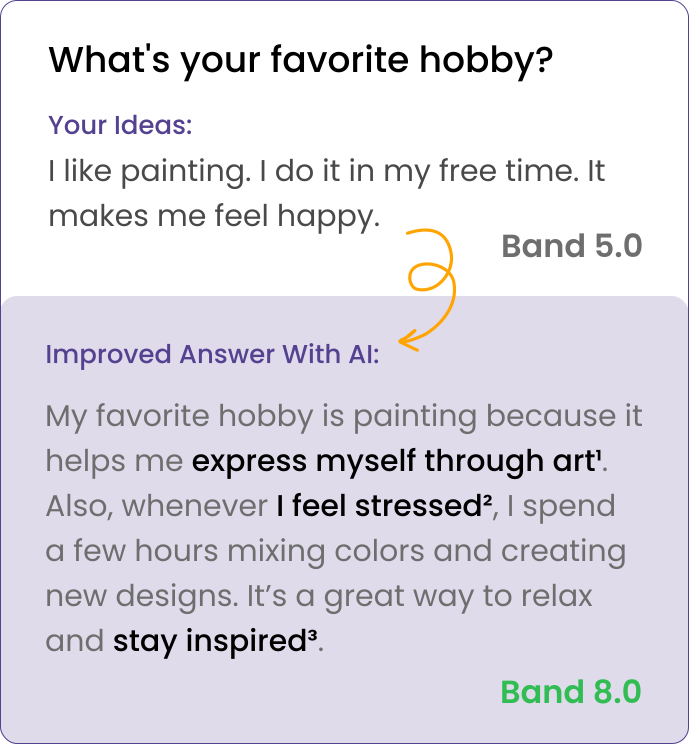
Practice IELTS Speaking answers in our free app
- Build personalized answers that match your target band.
- Turn short replies into fluent answers
- Let examiners fall in love with your answers!
Related Articles
Sample Answers
IELTS Speaking Part 1: Concentration Questions & Answers (Sep-Dec 2026)
Latest Sep-Dec 2026 IELTS Speaking Part 1 questions for Concentration. Read Band 9 sample answers, or use our AI app to turn your own ideas into perfect answers.
Sample Answers
IELTS Speaking Part 1: Jewelry Questions & Band 9 Answers (2026)
Latest Sep-Dec 2026 IELTS Speaking Part 1 questions for Jewelry. Read Band 9 sample answers or generate personal answers using our AI.
Sample Answers
IELTS Speaking Part 1: Colors Questions & Answers (Sep-Dec 2026)
Latest Sep-Dec 2026 IELTS Speaking Part 1 questions for Colors. Read Band 9 sample answers, or use our AI app to turn your own ideas into perfect answers.