A Time When You Lost Your Way: Part 2 Cue Card (2026)
Use our AI to get a personalized Band 9 answer and vocabulary for the IELTS Speaking Part 2 Cue Card "Describe an occasion when you lost your way".
Start Practicing →One of the most relevant IELTS Speaking Part 2 Cue Cards in 2026 is still "Describe a time when you lost your way." The examiner wants to hear a narrative about a time you were confused about your location, explaining how it happened and how you resolved the situation. To score highly, you should use expressive vocabulary like disoriented, wander aimlessly, and feeling a sense of panic.
How to Use This Sample Answer
Below is a sample answer for a tourist who got lost in a foreign city. If this is your case, perfect. But what if you were driving in a new area and your GPS died? Or maybe you got lost while hiking in a forest?
So here is the plan:
Read this sample answer to understand what a Band 7+ answer looks like.
Use the IELTS Speaking Lab App to instantly generate your own personal answer to this Cue Card with perfect vocabulary that describes your real story and matches your target Band.
Part 2 Cue Card and Sample Answer
Describe an occasion when you lost your way. You should say:
Where you were and what happened
How you got lost
How you found your way again
And explain how you felt about it.
Band 9 Sample Answer
(Answer) I want to talk about a time I got hopelessly lost in the narrow streets of Venice, Italy, about three years ago. It was during a summer holidays trip, and I had decided to explore the city alone for the afternoon.
(Add detail) I had been relying entirely on my smartphone map to navigate the complex maze of streets and canals. However, halfway through the afternoon, my phone battery suddenly died. I realized I had no idea where I was or which direction my hotel was in. I became completely disoriented because every corner looked exactly the same, just old buildings and water.
(Anecdote) I spent about an hour just wandering aimlessly, trying to find a major landmark like St. Mark's Square, but I just kept going in circles. I started to feel a rising sense of panic because it was getting dark and the streets were emptying out. Eventually, I swallowed my pride and walked into a small bakery. The owner didn't speak English, but I used hand gestures and showed her the name of my hotel written on a piece of paper. She smiled and pointed me in the right direction, drawing a simple map on a napkin.
(Explain) At the time, I felt incredibly vulnerable and a bit foolish for relying so much on technology. It was a stressful hour, but once I found my way back, I felt a huge sense of relief and accomplishment that I navigated it the old-fashioned way.
This answer uses the AAAE Strategy (Answer, Add detail, Anecdote, Explain).
Part 3 Questions and Sample Answers
After you finish your Cue Card, the examiner will ask you deeper questions related to navigation and spatial awareness.
1. Why do some people get lost more easily than others?
I believe it often comes down to a person's natural spatial awareness. Some individuals have an innate sense of direction and can easily create mental maps of their surroundings, while others struggle to orient themselves even in familiar places. For example, one of my friends can get lost inside a large shopping mall, whereas I rarely need a map once I've visited a place once.
2. How has technology changed the way we navigate?
It has completely revolutionized navigation, but it’s a double-edged sword. On the positive side, GPS apps like Google Maps make travel incredibly convenient and efficient; we rarely need to plan routes beforehand. On the negative side, it has led to an over-reliance on devices. Many people have lost the basic skill of reading a physical map or navigating by landmarks because they just blindly follow audio instructions.
3. What should people do if they get lost in a remote area, like a forest?
The most crucial thing is to keep a cool head and not panic. Panicking often leads to poor decisions, like running, which only makes the situation worse. Experts usually advise people to stay put if they are truly lost in a dangerous environment. Staying in one place conserves energy and makes it much easier for rescue teams to locate them compared to someone who is constantly moving.
4. Do you think traditional map-reading skills are still important today?
Yes, absolutely. While digital maps are fantastic, technology is fallible; batteries die, and signals get lost, especially in rural areas where you might lose your transport connection. In those situations, being able to read a traditional topographic map and use a compass is a lifesaving skill. Relying 100% on electronics leaves you vulnerable if they fail.
Key Vocabulary for IELTS Cue Card: Lost Your Way
Here is the complete glossary of every bolded word and phrase used in the answers above, plus extra high-level vocabulary for this topic.
A sense of panic: A sudden feeling of intense fear or anxiety.
Back of beyond: A very remote place, far from any towns or cities.
Bearings: Your position relative to your surroundings (e.g., "I lost my bearings").
Disoriented: Confused about where you are or which direction you should go.
Find your feet: To become familiar with a new situation or place.
Go astray: To become lost or go in the wrong direction.
Hand gestures: Movements of the hands or arms to express an idea or feeling.
Hopelessly lost: Completely lost, with no idea where you are.
In the middle of nowhere: A place that is far away from other houses, towns, or people.
Innate sense of direction: A natural ability to know where you are and where things are.
Keep a cool head: To remain calm in a difficult situation.
Lifesaving skill: A skill that can save a person's life in a dangerous situation.
Major landmark: A large and very recognizable building or feature that helps you know where you are.
Maze of streets: A confusing network of many streets.
Mental maps: A picture in your mind of a place and how to get around it.
Navigating by landmarks: Finding your way by looking for famous buildings or natural features.
Off course: Not following the intended route.
Over-reliance: Depending too much on something or someone.
Plan routes beforehand: To decide which way you will go before you start your journey.
Relief: The feeling of happiness that occurs when something unpleasant stops.
Revolutionized navigation: Changed the way we find our way completely.
Spatial awareness: The ability to be aware of oneself in space and to understand the relationship between objects in an area.
Stay put: To remain in the same place where you are.
Surroundings: The place and things that are around you.
Veered off path: Changed direction suddenly and went the wrong way.
Vulnerable: Able to be easily hurt, influenced, or attacked.
Wander aimlessly: To walk around without any clear purpose or direction.
Create Your Own Band 9 Answers
The answer above is perfect—if you are a tourist who got lost in a big city. But what if you were lost in the countryside during a hike? Or what if you took the wrong exit on a highway? Your answers need to be true so that you can easily recall them during a stressful exam.
IELTS Speaking Lab helps you turn your real ideas into Band 9 answers.
Select your cue card - Describe an occasion when you lost your way.
Input your rough idea (e.g., "I was hiking in the mountains and fog came down, so I couldn't see the path").
Get personalized Band 9 answer instantly, with the perfect vocabulary for your story.
Not happy with these answers?
Change the core idea, band level difficulty, length and get a full glossary in our free app!
Start Practicing →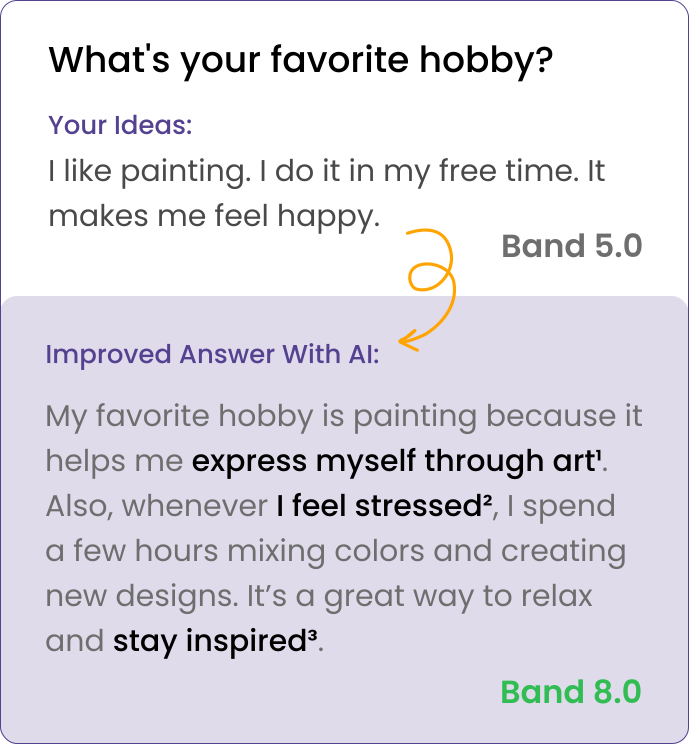
Practice IELTS Speaking answers in our free app
- Build personalized answers that match your target band.
- Turn short replies into fluent answers
- Let examiners fall in love with your answers!
Related Articles
Sample Answers
IELTS Speaking Part 1: Concentration Questions & Answers (Sep-Dec 2026)
Latest Sep-Dec 2026 IELTS Speaking Part 1 questions for Concentration. Read Band 9 sample answers, or use our AI app to turn your own ideas into perfect answers.
Sample Answers
IELTS Speaking Part 1: Jewelry Questions & Band 9 Answers (2026)
Latest Sep-Dec 2026 IELTS Speaking Part 1 questions for Jewelry. Read Band 9 sample answers or generate personal answers using our AI.
Sample Answers
IELTS Speaking Part 1: Colors Questions & Answers (Sep-Dec 2026)
Latest Sep-Dec 2026 IELTS Speaking Part 1 questions for Colors. Read Band 9 sample answers, or use our AI app to turn your own ideas into perfect answers.