Describe a Place You Often Visit: Part 2 Cue Card (2026)
Use our AI to get a personalized Band 9 answer and vocabulary for the IELTS Speaking Part 2 Cue Card "Describe a place you often visit".
Start Practicing →The "Describe a place you often visit" Cue Card is a common 2026 topic that tests your ability to describe a location (atmosphere, visual details) and explain a habit (frequency, reasons). To get Band 7+, you need to avoid generic descriptions like "it is nice" and instead use sensory vocabulary like bustling atmosphere, architectural heritage, and urban oasis.
How to Use This Sample Answer
Below is a sample answer for a student who visits a local public stadium. If this is your story, perfect. But what if you often visit a local library? Or maybe you go to a quiet coffee shop near your office?
So here is the plan:
Read this sample answer to understand the structure of a Band 7+ answer.
Use the IELTS Speaking Lab App to instantly generate your own personal answer to this Cue Card with perfect vocabulary that describes your favorite place.
Part 2 Cue Card and Sample Answer
Describe a place you often visit. You should say:
Where this place is
How often you go there
What you do there
And explain why you like to visit this place.
Band 9 Sample Answer
Introduce: I would like to talk about a place I visit almost every day: the Minyuan Stadium. It is a historic public landmark located in the heart of the Wudadao district, which is famous for its old colonial buildings. It feels like a mini European travel destination right in the city center. The best part is that it is only a stone's throw away from my apartment, so visiting it has become a daily ritual.
Describe: It is not your typical stadium. It was recently renovated into a massive sunken plaza. While it retains the original oval shape with a professional rubber jogging track, the center is a lush grassy lawn where people picnic. It is surrounded by stunning European-style architecture with red brick walls and white columns. The atmosphere is always vibrant; you see seniors doing Tai Chi in the morning and young people playing sport in the evening.
Explain: I usually go there in the late afternoon after I finish my study session. My main purpose is to prioritize my health and blow off steam. I usually put on my headphones, listen to some energetic music, and run a few laps on the track. It is the only time of day when I can disconnect from the digital world.
Add impact: I love this place because it serves as an urban oasis amidst the concrete jungle. In a busy city, it is rare to find such an open, breathable space. It gives me a profound sense of belonging to my community, and it is the perfect spot to recharge my batteries after a long day.
This answer uses the IDEA Strategy (Introduce, Describe, Explain, Add impact).
Part 3 Questions and Sample Answers
After you finish your Cue Card, the examiner will ask you deeper questions related to public spaces and leisure.
1. Is it important for cities to have public parks and squares?
Absolutely. Public spaces are the "lungs" of a city. They provide a necessary escape from the noise and pollution of urban life. Without places like parks or community squares, people would feel suffocated in their apartments. Furthermore, they are essential for public health, providing a free space for people to exercise and interact, which strengthens the community spirit.
2. Do young people and old people go to the same places for leisure?
Generally, no. There is a bit of a divide. Older people tend to prefer quiet, accessible places like parks or tea houses where they can chat or exercise gently. Young people, on the other hand, usually gravitate towards places related to sport complexes, cinemas, or trendy cafes. However, landmarks like the one I described often attract both generations, acting as a melting pot.
3. Has the way people spend their free time changed in recent years?
Yes, significantly. In the past, leisure was very active and outdoor-oriented—people played sports or visited neighbors. Nowadays, leisure has become more passive and digital. Many people spend their free time scrolling on their phones or planning virtual travel. While this is convenient, I think we are losing the physical connection to our environment.
4. Should entry to public parks be free?
Yes, I believe so. Public spaces should be accessible to everyone, regardless of their income. If you charge an entrance fee, you effectively exclude the working class, who arguably need these spaces the most to relax. These facilities are usually built with tax money, so the public has already paid for them.
Key Vocabulary for IELTS Cue Card: A Place You Visit
Here is the complete glossary of the vocabulary used in the answers above.
Architectural heritage: (Noun) The history and style of the buildings in an area.
Blow off steam: (Idiom) To do or say something that helps you to get rid of strong feelings or energy.
Bustle of the city: (Phrase) The busy and noisy activity of a city.
Colonial buildings: (Noun) Buildings built during a period of colonization, often having a specific foreign style.
Community spirit: (Noun) A feeling of belonging and cooperation among people living in the same area.
Concrete jungle: (Noun) A city area with a high density of modern buildings and few green spaces.
Daily ritual: (Noun) An activity that you do every day, often in the same way.
European-style: (Adj) Designed in a way that looks like buildings in Europe.
Historic public landmark: (Noun) An old and important building or place that is open to the public.
Melting pot: (Noun) A place where different people, styles, or cultures come together.
Recharge my batteries: (Idiom) To rest and relax in order to regain energy and strength.
Rubber jogging track: (Noun) A soft path specifically designed for running to protect knees.
Sense of belonging: (Phrase) Feeling like you are an accepted member of a group or community.
Stone's throw away: (Idiom) A very short distance.
Sunken plaza: (Noun) A public square that is built lower than the street level.
Tai Chi: (Noun) A Chinese martial art and form of stylized, meditative exercise.
Urban oasis: (Noun) A pleasant or peaceful area in the middle of a busy city.
Vibrant: (Adj) Full of energy and life.
Create Your Own Band 9 Answers
The answer above is perfect—if you visit a local public stadium in the evenings. But what if you visit a riverside park? Or a historic temple?
Your answers need to be true so that you can easily recall them during a stressful exam.
IELTS Speaking Lab helps you turn your real ideas into Band 9 answers.
Select your cue card - Describe a place you often visit.
Input your rough idea (e.g., "I go to the central library every weekend to study").
Get personalized Band 9 answer instantly, with the perfect vocabulary for your story.
Not happy with these answers?
Change the core idea, band level difficulty, length and get a full glossary in our free app!
Start Practicing →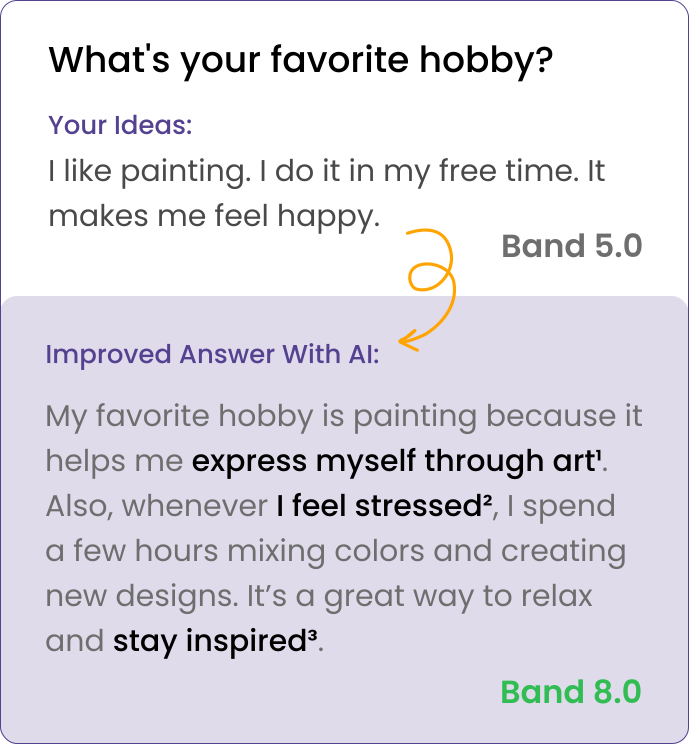
Practice IELTS Speaking answers in our free app
- Build personalized answers that match your target band.
- Turn short replies into fluent answers
- Let examiners fall in love with your answers!
Related Articles
Sample Answers
IELTS Speaking Part 1: Concentration Questions & Answers (Sep-Dec 2026)
Latest Sep-Dec 2026 IELTS Speaking Part 1 questions for Concentration. Read Band 9 sample answers, or use our AI app to turn your own ideas into perfect answers.
Sample Answers
IELTS Speaking Part 1: Jewelry Questions & Band 9 Answers (2026)
Latest Sep-Dec 2026 IELTS Speaking Part 1 questions for Jewelry. Read Band 9 sample answers or generate personal answers using our AI.
Sample Answers
IELTS Speaking Part 1: Colors Questions & Answers (Sep-Dec 2026)
Latest Sep-Dec 2026 IELTS Speaking Part 1 questions for Colors. Read Band 9 sample answers, or use our AI app to turn your own ideas into perfect answers.