Website You Use Often: Part 2 Cue Card (2026)
Use our AI to get a personalized Band 9 answer and vocabulary for the IELTS Speaking Part 2 Cue Card "Describe a website you use often".
Start Practicing →One of the most common IELTS Speaking Part 2 Cue Cards in 2026 is "Describe a website you use often." The examiner wants to hear about your internet habits, focusing on how you use the site and why it is important to your daily life. To get Band 7+, you should use technology-related vocabulary such as user-friendly interface, wealth of information, and repository of knowledge.
How to Use This Sample Answer
Below is a sample answer for a student who uses YouTube for learning and entertainment. If this is your case, perfect. But what if you use Wikipedia for your research? Or maybe you use LinkedIn to look for jobs?
So here is the plan:
Read this sample answer to understand what a Band 7+ answer looks like.
Use the IELTS Speaking Lab App to instantly generate your own personal answer to this Cue Card with perfect vocabulary that describes your real story and matches your target Band.
Part 2 Cue Card and Sample Answer
Describe a website you use often. You should say:
What it is
How often you use it
What you use it for
And explain why you use it so often.
Band 9 Sample Answer
(Introduce) I would like to talk about YouTube, which is arguably the most popular video-sharing website in the world. It is the homepage on my browser, and honestly, I probably spend more time on it than I should.
(Describe) I access it daily, usually in the evenings after I finish my study or work. The site has an incredibly user-friendly interface that suggests videos based on my viewing history. It hosts a massive variety of content, ranging from short funny clips to full-length documentaries and educational tutorials.
(Explain) I use it for two main purposes: education and relaxation. When I need to learn a new skill, like cooking or coding, YouTube is my go-to repository of knowledge. There are countless content creators who explain complex topics simply. On the other hand, when I just want to unwind, I often binge-watch travel vlogs or music videos related to my hobbies.
(Add impact) The main reason I use it so often is the algorithm. It is dangerously good at predicting exactly what I want to watch next, which keeps me glued to the screen. It has completely replaced traditional TV for me because it puts a wealth of information and entertainment right at my fingertips.
This answer uses the IDEA Strategy (Introduce, Describe, Explain, Add impact).
Part 3 Questions and Sample Answers
After you finish your Cue Card, the examiner will ask you deeper questions related to the internet and online habits.
1. What are the positive and negative effects of social media websites? Social media is definitely a double-edged sword. On the positive side, it allows us to stay connected with friends and share our lives instantly. However, the downside is that it can lead to cyberbullying and feelings of inadequacy when people compare their real lives to the "perfect" lives they see online. For example, many young people suffer from anxiety because of the pressure to maintain a certain digital footprint.
2. Do you think libraries will disappear in the future because of the internet? I don't think they will disappear completely, but their role will certainly evolve. While the internet offers instant access to information, libraries provide a quiet, focused environment for reading that a website cannot replicate. They are becoming community hubs rather than just places to borrow books. However, for quick research, the internet has undeniably made physical encyclopedias obsolete.
3. How has the internet changed the way people buy things? It has revolutionized shopping by making it incredibly convenient. With just a few clicks, consumers can compare prices, read reviews, and have products delivered to their doorsteps. This has hurt traditional "brick and mortar" shops, but it has opened up a global marketplace for consumers. For instance, I can easily buy clothes from a brand in another country without leaving my house.
4. Should parents limit the time their children spend online? Yes, absolutely. The internet is full of distractions and inappropriate content. Without supervision, children can easily stumble upon harmful material or become addicted to online games, which affects their family time and schoolwork. Parents need to set strict boundaries to ensure their children develop a healthy relationship with technology.
Key Vocabulary for IELTS Cue Card: Website
Here is the complete glossary of every bolded word and phrase used in the answers above, plus extra high-level vocabulary for this topic.
Algorithm: A set of rules used by a computer to solve problems or calculate things (often used to decide what content to show you).
At my fingertips: Readily available; easy to reach or access.
Binge-watch: To watch many episodes of a TV series or many videos one after another.
Boundaries: Limits or rules about what is acceptable.
Brick and mortar: Traditional businesses that have a physical building (shops), rather than online ones.
Content creator: Someone who creates entertaining or educational material to be expressed through any medium or channel.
Cyberbullying: The use of electronic communication to bully a person, typically by sending messages of an intimidating or threatening nature.
Digital footprint: The information about a particular person that exists on the internet as a result of their online activity.
Double-edged sword: A situation or thing that has both positive and negative effects.
Downside: The negative aspect of something.
Educational tutorials: Instructional videos that teach you how to do something.
Evolve: To change or develop gradually.
Feelings of inadequacy: Feeling that you are not good enough compared to others.
Glued to the screen: Looking at a screen (phone/TV/computer) for a very long time without stopping.
Homepage on my browser: The first page that opens when you start your internet browser.
Information overload: A state of being overwhelmed by the amount of information one has to process.
Intuitive design: A design that is easy to understand and use without instructions.
Obsolete: No longer produced or used; out of date.
Phishing: The fraudulent practice of sending emails purporting to be from reputable companies to induce individuals to reveal personal information.
Quiet, focused environment: A place that is silent and helps you concentrate on work or study.
Repository of knowledge: A place where a large amount of knowledge or information is stored.
Suffer from anxiety: To have a medical condition where you feel extremely worried or nervous.
Tech-savvy: Knowing a lot about modern technology, especially computers.
Undeniably: Clearly true; impossible to deny.
User-friendly interface: A system (like a website or app) that is easy for people to understand and use.
Video-sharing website: A website where users can upload and watch videos.
Viewing history: A record or list of the videos you have watched in the past.
Virtual reality: A computer-generated simulation of a three-dimensional image or environment.
Wealth of information: A very large amount of useful information.
Create Your Own Band 9 Answers
The answer above is perfect—if you are a student who uses YouTube for learning. But what if you use Wikipedia for research? Or what if you use LinkedIn for your career?
Your answers need to be true so that you can easily recall them during a stressful exam.
IELTS Speaking Lab helps you turn your real ideas into Band 9 answers.
Select your cue card - Describe a website you use often.
Input your rough idea (e.g., "I use Wikipedia to research topics for my university essays").
Get personalized Band 9 answer instantly, with the perfect vocabulary for your story.
Not happy with these answers?
Change the core idea, band level difficulty, length and get a full glossary in our free app!
Start Practicing →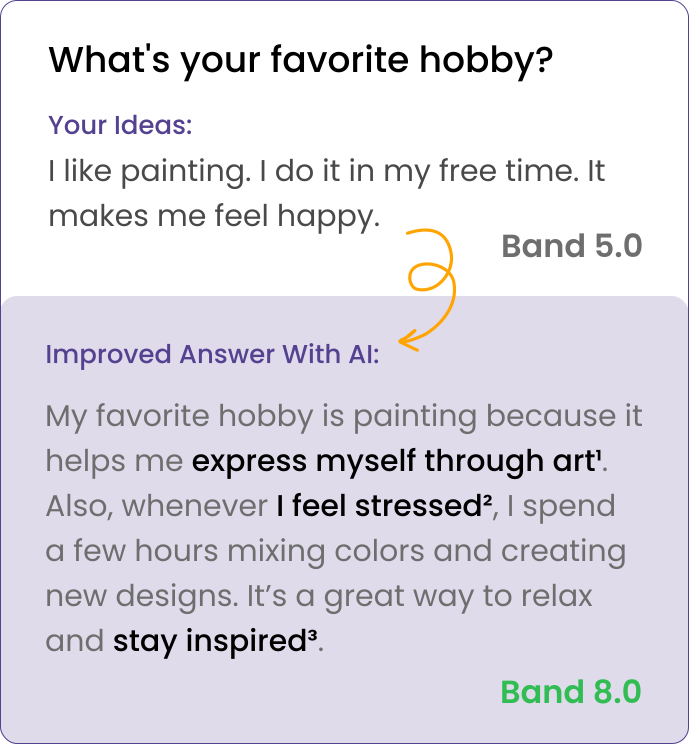
Practice IELTS Speaking answers in our free app
- Build personalized answers that match your target band.
- Turn short replies into fluent answers
- Let examiners fall in love with your answers!
Related Articles
Sample Answers
IELTS Speaking Part 1: Concentration Questions & Answers (Sep-Dec 2026)
Latest Sep-Dec 2026 IELTS Speaking Part 1 questions for Concentration. Read Band 9 sample answers, or use our AI app to turn your own ideas into perfect answers.
Sample Answers
IELTS Speaking Part 1: Jewelry Questions & Band 9 Answers (2026)
Latest Sep-Dec 2026 IELTS Speaking Part 1 questions for Jewelry. Read Band 9 sample answers or generate personal answers using our AI.
Sample Answers
IELTS Speaking Part 1: Colors Questions & Answers (Sep-Dec 2026)
Latest Sep-Dec 2026 IELTS Speaking Part 1 questions for Colors. Read Band 9 sample answers, or use our AI app to turn your own ideas into perfect answers.