Describe a Famous Person You Want To Meet: Part 2 Cue Card
Use our AI to get a personalized Band 9 answer and vocabulary for the IELTS Speaking Part 2 Cue Card "Describe a famous person you would like to meet".
Start Practicing →The "Describe a famous person you would like to meet" is a popular 2026 Cue Card in the IELTS Speaking test. It tests your ability to describe a person's achievements, personality, and your hypothetical interaction with them. To achieve Band 7+, you must go beyond listing their biography and explain the personal significance of the meeting using vocabulary like household name, source of inspiration, and pick someone's brain.
How to Use This Sample Answer
Below is a sample answer for a student who wants to meet the author J.K. Rowling. If this matches your choice, great. But what if you want to meet Elon Musk? Or a famous athlete like Lionel Messi?
So here is the plan:
Read this sample answer to understand the structure of a Band 7+ answer.
Use the IELTS Speaking Lab App to instantly generate your own personal answer to this Cue Card with perfect vocabulary that describes your specific idol.
Part 2 Cue Card and Sample Answer
Describe a famous person you would like to meet. You should say:
Who this person is
What this person is famous for
What you would talk about with this person
And explain why you would like to meet them.
Band 9 Sample Answer
Introduce: I would like to talk about a person who is not only a household name but also a literary phenomenon: J.K. Rowling, the British author behind the Harry Potter series. I have been an avid reader of her books since I was a child, and her work has defined my generation.
Describe: She is famous for creating the "Wizarding World," which is arguably the most successful franchise in modern history. However, she is also known for her incredible rags-to-riches story. Before she became a multi-millionaire, she was a single mother living on state benefits, writing her manuscript in cafes while her baby slept. This resilience and perseverance make her arguably just as impressive as her writing.
Explain: If I had the chance to meet her, perhaps over a coffee in Edinburgh, I would love to pick her brain about her early life. I want to ask how she maintained her creative drive when she was facing so much rejection from publishers. Furthermore, I would be desperate to ask about her future endeavors. I would ask if she plans to expand the Harry Potter universe further or if she intends to leave the franchise as a finished masterpiece.
Add impact: I want to meet her because she is my ultimate role model. She taught me that failure is not fatal and that imagination can change the world. Meeting the woman who sparked my love for reading and hobbies like creative writing would be a surreal experience—I think I would be totally star-struck.
This answer uses the IDEA Strategy (Introduce, Describe, Explain, Add impact).
Part 3 Questions and Sample Answers
After you finish your Cue Card, the examiner will ask you deeper questions related to fame and celebrity culture.
1. Do you think famous people have a right to privacy?
Absolutely. While they chose a public career, they did not agree to have their personal life examined under a microscope. The paparazzi often cross the line, turning their daily existence into a media circus. Everyone, regardless of their status, deserves a sanctuary where they are safe from the prying eyes of the public and the press.
2. Why do some people want to become famous?
I think for many, it is about validation and the desire for immortality—they want to be remembered after they are gone. For others, specifically in the age of social media, it is about the glamour and wealth associated with being an influencer. However, many underestimate the price of fame, such as the loss of anonymity and the pressure to maintain a perfect image.
3. How do celebrities influence public opinion?
They have massive sway over their fanbase. If a famous actor endorses a political candidate or a charity, millions of people will follow suit simply because they trust that person. This can be positive, such as raising awareness for daily routine changes to help the climate, but it can be dangerous if the celebrity spreads misinformation.
4. Are famous people good role models for children?
It varies significantly. Some celebrities use their platform to promote education, family values, and philanthropy, making them excellent role models. Others, however, promote materialism, unrealistic beauty standards, or toxic behavior. Parents need to guide children to distinguish between a celebrity's talent and their character.
Key Vocabulary for IELTS Cue Card: A Famous Person
Here is the complete glossary of the vocabulary used in the answers above, plus extra high-level words relevant to this topic.
Avid reader: (Phrase) Someone who reads a lot and with great enthusiasm.
Creative drive: (Phrase) The inner motivation to create something new or artistic.
Future endeavors: (Phrase) Plans or projects that a person intends to do in the future.
Glamour: (Noun) An attractive or exciting quality that makes certain people or things seem appealing.
Household name: (Noun) A person or thing that is well known by the public.
Immortality: (Noun) The ability to live forever; in this context, being remembered forever.
Influencer: (Noun) A person with the ability to influence potential buyers of a product or service by promoting or recommending the items on social media.
Literary phenomenon: (Phrase) A writer or book that is incredibly successful and popular.
Masterpiece: (Noun) A work of outstanding artistry, skill, or workmanship.
Media circus: (Idiom) A news event where the media coverage is perceived to be excessive or sensationalized.
Misinformation: (Noun) False or inaccurate information.
Multi-millionaire: (Noun) A person with assets worth several million dollars/pounds.
Perseverance: (Noun) Persistence in doing something despite difficulty or delay in achieving success.
Personal life: (Phrase) The part of a person's life that is not public or related to their job.
Pick someone's brain: (Idiom) To talk to someone in order to get helpful information or advice.
Price of fame: (Phrase) The negative consequences that come with being famous (e.g., lack of privacy).
Prying eyes: (Phrase) People watching you when you want to be alone.
Rags-to-riches: (Adj) Used to describe a person's rise from a state of extreme poverty to one of great wealth.
Resilience: (Noun) The capacity to recover quickly from difficulties; toughness.
Role model: (Noun) A person looked to by others as an example to be imitated.
Sanctuary: (Noun) A place of refuge or safety.
Star-struck: (Adj) Feeling great interest in or admiration for a famous person.
Surreal experience: (Phrase) An experience that feels like a dream; too strange or wonderful to be real.
Sway: (Noun) Power or influence over someone.
Create Your Own Band 9 Answers
The answer above is perfect—if you want to meet J.K. Rowling. But what if you want to meet Cristiano Ronaldo? Or Barack Obama? Your answers need to be true so that you can easily recall them during a stressful exam.
IELTS Speaking Lab helps you turn your real ideas into Band 9 answers.
Select your cue card - Describe a famous person you would like to meet.
Input your rough idea (e.g., "I want to meet Taylor Swift because I love her songwriting").
Get personalized Band 9 answer instantly, with the perfect vocabulary for your story.
Not happy with these answers?
Change the core idea, band level difficulty, length and get a full glossary in our free app!
Start Practicing →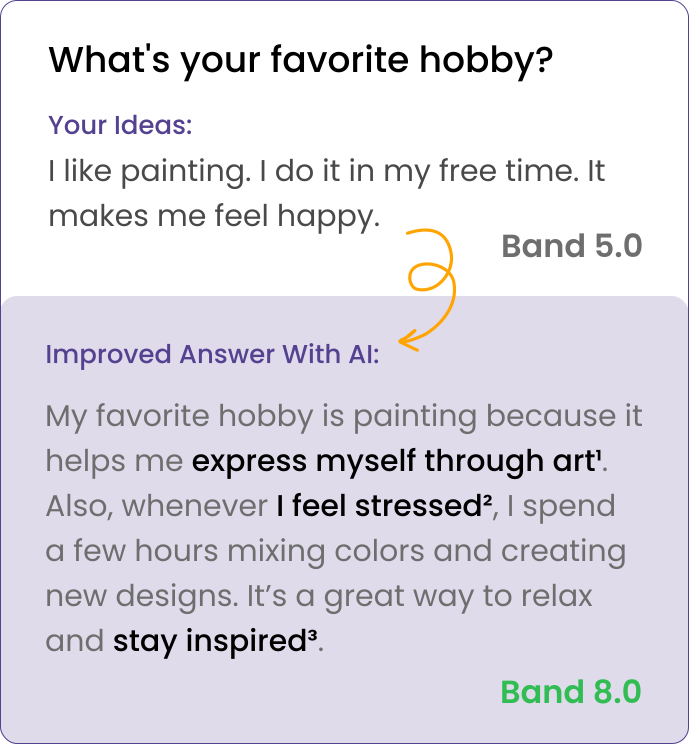
Practice IELTS Speaking answers in our free app
- Build personalized answers that match your target band.
- Turn short replies into fluent answers
- Let examiners fall in love with your answers!
Related Articles
Sample Answers
IELTS Speaking Part 1: Concentration Questions & Answers (Sep-Dec 2026)
Latest Sep-Dec 2026 IELTS Speaking Part 1 questions for Concentration. Read Band 9 sample answers, or use our AI app to turn your own ideas into perfect answers.
Sample Answers
IELTS Speaking Part 1: Jewelry Questions & Band 9 Answers (2026)
Latest Sep-Dec 2026 IELTS Speaking Part 1 questions for Jewelry. Read Band 9 sample answers or generate personal answers using our AI.
Sample Answers
IELTS Speaking Part 1: Colors Questions & Answers (Sep-Dec 2026)
Latest Sep-Dec 2026 IELTS Speaking Part 1 questions for Colors. Read Band 9 sample answers, or use our AI app to turn your own ideas into perfect answers.