IELTS Speaking Part 1: Art Questions & Band 9 Answers (2026)
Use our AI tools to get personalized Band 9 answers and vocabulary to talk about paintings, creativity, and museums.
Start Practicing →Art can be a difficult topic if you are not creative. The examiner might ask about your favorite artist, visiting galleries, or drawing lessons. To score Band 9, avoid saying "I am bad at drawing." Instead, use words like aptitude, abstract, subjective, or aesthetic to describe your views.
How to Use These Sample Answers
Below are the latest 2026 questions for "Art."
Important: These answers are for a person who does not know much about art and finds it a bit boring. They are practical and scientific, not creative. They prefer realistic photos to strange paintings. But if you are a professional painter or you love visiting museums every weekend, these answers are probably not for you.
So, here is the plan:
Read these samples to understand the Band 9 structure.
Use the IELTS Speaking Lab App to get personalized answers. It gives you perfect vocabulary that fits your real life—whether you are a master artist or just stick figures.
IELTS Speaking Part 1: Questions & Model Answers about Art
1. Do you like art?
To be honest, not particularly. I have always been more of a science and numbers person, so I lack the artistic flair that others have. While I can appreciate the skill involved in creating a masterpiece, I don't really have a deep passion for the fine arts.
2. Do you often visit art galleries?
Very rarely. I find wandering around a quiet gallery looking at paintings to be quite tedious. I prefer more active hobbies or visiting history museums where I can learn facts rather than interpreting abstract concepts.
3. Did you learn art at school?
Yes, it was a compulsory subject in primary school. I remember struggling with it because I had absolutely no natural aptitude for drawing. My sketches always looked messy compared to my classmates', so I dropped the subject as soon as I could.
4. What kind of art do you like?
If I had to choose, I prefer realism. I like paintings that actually look like the object or person they are supposed to represent. I find contemporary art a bit confusing because it is so subjective; the meaning is often ambiguous and open to interpretation.
5. Do you have any paintings in your home?
I have a few generic prints and posters on the walls just for decoration, to make the apartment look less bare. But I don't own any original oil paintings or valuable pieces. My taste in interior design is quite minimalist and functional.
6. Is art popular in your country?
Yes, definitely. We have a rich cultural heritage, and many people in my hometown take great pride in our traditional crafts and folklore. There are many exhibitions and cultural festivals throughout the year that draw huge crowds.
7. Do you think art classes are necessary for children?
I think they are beneficial, yes. Even if a child isn't talented, like me, art helps develop creativity and fine motor skills. It allows children to express themselves in a way that academic subjects like math or science do not.
8. Would you like to learn to paint?
No, I don't think I would have the patience for it. Painting requires a steady hand and a good eye for perspective and color, neither of which I possess. I think I would find the process more frustrating than therapeutic.
9. Who is your favorite artist?
Since I don't follow the art world, I can only name the famous ones like Leonardo da Vinci or Van Gogh. I suppose I admire Van Gogh because his style is so unique and recognizable, even to a layperson like me.
10. Do you think photography is a form of art?
Absolutely. In fact, I appreciate photography more than painting because it captures reality. A skilled photographer needs to understand composition, lighting, and timing. It takes a lot of skill to capture a candid moment perfectly.
11. Why do some people buy very expensive art?
I think for the ultra-wealthy, it is often just a status symbol or an investment. Owning a rare piece by a renowned artist is a way to show off their wealth. For others, it might be a genuine emotional connection to the aesthetic of the piece.
12. Do you prefer traditional art or digital art?
I think digital art is fascinating. It seems more relevant to the modern world. With the rise of the internet and technology, digital artists can create incredible visuals for movies and video games, which is the kind of art I consume most often.
13. Have you ever visited a famous museum?
Yes, I visited the Louvre once on a holiday. While it was impressive to see the sheer scale of the collection, I found the crowds overwhelming. Standing in line for hours just to get a glimpse of the Mona Lisa was a bit of an anti-climax for me.
14. Do you think the government should pay for art?
That is a tricky question. While public art can beautify a city, I tend to think that government funds should be prioritized for essential services like healthcare or education. However, I understand that funding the arts is important for preserving our cultural identity.
15. Is painting a good hobby?
For the right person, yes. I can see how mixing colors and creating something from scratch could be very relaxing and a good way to relieve stress from work. But for me, I prefer reading or watching movies to unwind.
Key Vocabulary for IELTS Topic: Art
Here is the complete glossary of every bolded word and phrase used in the answers above.
Abstract concepts: Ideas that are not physical or concrete.
Aesthetic: Concerned with beauty or the appreciation of beauty.
Ambiguous: Open to more than one interpretation; unclear.
Anti-climax: A disappointing end to something impressive.
Aptitude: A natural ability to do something.
Artistic flair: A natural talent or style for art.
Candid moment: A photo taken informally, without posing.
Compulsory subject: A subject you must study at school.
Composition: The artistic arrangement of the parts of a picture.
Contemporary art: Art produced in the modern time.
Creativity: The use of the imagination or original ideas.
Cultural festivals: Celebrations of traditions and culture.
Cultural identity: The identity or feeling of belonging to a group.
Digital art: Art created using computers or digital technology.
Fine arts: Visual art created primarily for beauty (painting, sculpture).
Fine motor skills: Coordination of small muscles (hands/fingers).
Folklore: Traditional beliefs and stories of a community.
Interior design: The art of decorating the inside of a room.
Layperson: A person without professional knowledge in a subject.
Masterpiece: A work of outstanding artistry or skill.
Minimalist: A style using simple elements and little decoration.
Natural aptitude: A natural ability to do something well.
Oil paintings: Paintings made using pigments mixed with oil.
Overwhelming: Very intense; too much to handle.
Perspective: Drawing objects to give the impression of height, depth, and width.
Public art: Art placed in public spaces for everyone to see.
Realism: Representing things accurately, true to life.
Relaxing: Reducing tension or anxiety.
Status symbol: A possession that indicates high social status or wealth.
Subjective: Based on or influenced by personal feelings or opinions.
Tedious: Too long, slow, or dull; tiresome.
Therapeutic: Helping to relax or heal the mind.
Create Your Own Band 9 Answers
The answers above are perfect—if you are a practical person who doesn't like art. But what if you are a professional artist? Or what if you love visiting museums?
Your answers need to be true so that you can easily recall them during a stressful exam.
IELTS Speaking Lab helps you turn your real ideas into Band 9 answers.
Select your topic - Art.
Input your rough idea (e.g., "I love sketching because it helps me forget my problems").
Get personalized Band 9 answers instantly, with the perfect vocabulary for your story.
Not happy with these answers?
Change the core idea, band level difficulty, length and get a full glossary in our free app!
Start Practicing →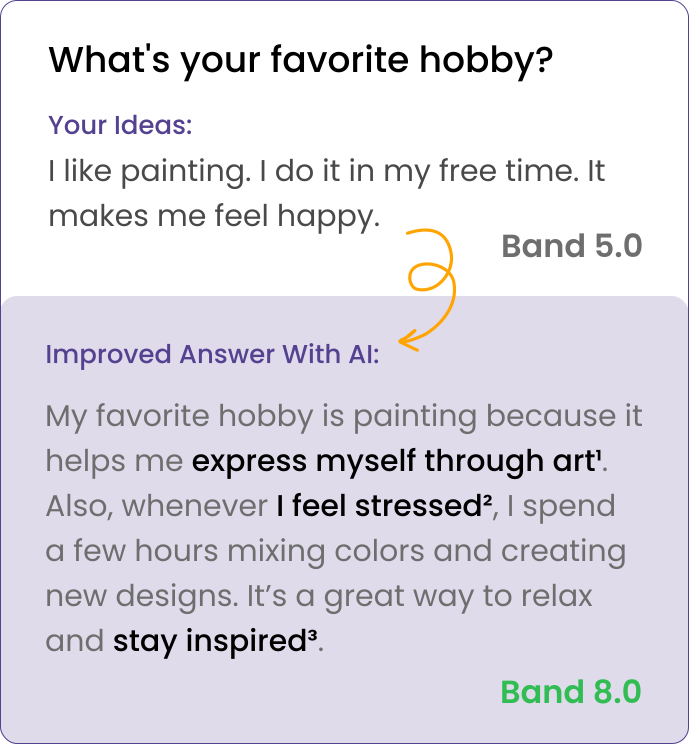
Practice IELTS Speaking answers in our free app
- Build personalized answers that match your target band.
- Turn short replies into fluent answers
- Let examiners fall in love with your answers!
Related Articles
Sample Answers
IELTS Speaking Part 1: Concentration Questions & Answers (Sep-Dec 2026)
Latest Sep-Dec 2026 IELTS Speaking Part 1 questions for Concentration. Read Band 9 sample answers, or use our AI app to turn your own ideas into perfect answers.
Sample Answers
IELTS Speaking Part 1: Jewelry Questions & Band 9 Answers (2026)
Latest Sep-Dec 2026 IELTS Speaking Part 1 questions for Jewelry. Read Band 9 sample answers or generate personal answers using our AI.
Sample Answers
IELTS Speaking Part 1: Colors Questions & Answers (Sep-Dec 2026)
Latest Sep-Dec 2026 IELTS Speaking Part 1 questions for Colors. Read Band 9 sample answers, or use our AI app to turn your own ideas into perfect answers.