IELTS Speaking Part 1: Internet Questions & Band 9 Answers (2026)
Latest Sep-Dec 2026 IELTS Speaking Part 1 questions for Internet. Read Band 9 sample answers or generate personal answers using our AI.
Start Practicing →Prepare to talk about Internet if your IELTS test falls in late 2026. The examiner will likely ask how often you use it, what you use it for, and if you think it is safe. To score Band 9, avoid saying "I use the internet every day." Instead, use words like double-edged sword, doomscrolling, digital detox, or information overload to describe your relationship with the web.
Latest Sep-Dec 2026: Internet Questions & Model Answers
1. How often do you use the internet?
Inevitably, I use it every single day. It has become an indispensable tool for modern life. However, I am very conscious of my usage and try not to fall into the trap of mindless scrolling for hours on end.
2. What do you mainly use the internet for?
Primarily for work and communication. I use email and project management tools constantly. Outside of professional reasons, I use it to manage my finances, but I try to avoid using it for mind-numbing entertainment.
3. Do you prefer using a computer or a phone?
I definitely prefer a computer. I view my laptop as a productive piece of technology, whereas my smartphone feels like a distraction device. I find it easier to focus on a larger screen, and typing on a keyboard is much more efficient.
4. Do you use social media?
I have a love-hate relationship with it. I have accounts to stay in touch with friends, but I limit my time on them. I find that social media often presents a curated reality that can make you feel inadequate if you consume too much of it.
5. How do you get online?
I have high-speed fiber-optic broadband at home. On the go, especially when I travel, I rely on my 5G mobile data to check maps, although I often turn it off to save battery and preserve my mental peace.
6. Do you think the internet is safe?
Not entirely. It is a breeding ground for scams. You have to be hyper-vigilant about cybersecurity, phishing emails, and identity theft. I always use two-factor authentication to protect my accounts.
7. Did you use the internet much when you were a child?
Not really. I am part of the generation that remembers life before the internet was ubiquitous. We had a slow dial-up connection that blocked the phone line, so my usage was strictly limited to homework and brief research.
8. Is the internet good for learning?
Yes, it is a fantastic resource for study. You have the world's knowledge at your fingertips. However, you need to possess strong critical thinking skills to distinguish between credible sources and fake news or misinformation.
9. Do you shop online?
I do, simply for the convenience. It saves me from the hassle of going to physical stores. However, I am careful not to get sucked into consumerism by targeted ads that track my browsing history.
10. What would you do if the internet stopped working?
Honestly, I would probably feel relieved. It would be a forced digital detox. I would finally have time to play sport outside or go for a run without the constant urge to check my notifications.
11. Do you think people spend too much time online?
Absolutely. It has created a sedentary lifestyle for many people. We are glued to our screens, which ruins our posture and our eyesight. I think we are facing an epidemic of screen addiction.
12. How has the internet changed the way we communicate?
It has made communication instant but superficial. We send endless texts and emojis, but we rarely have deep, meaningful conversations anymore. I prioritize face-to-face interaction whenever possible to maintain real human connection.
13. Do you play games online?
No, I consider that a massive time sink. I know many people find it relaxing, but I prefer listening to soothing music to unwind. I find video games too immersive and addictive; once you start, it is hard to stop.
14. Are you worried about privacy online?
Yes, very. The amount of data harvesting that tech companies do is alarming. It feels like we have traded our privacy for convenience. I try to minimize my digital footprint by using privacy-focused browsers.
15. Do you use the internet for entertainment?
Occasionally, I will stream movies or documentaries. However, I am wary of binge-watching entire series. Streaming platforms are designed to keep you hooked, which can wreak havoc on your sleep patterns.
16. What is the most annoying thing about the internet?
The toxicity in comment sections. People feel bold enough to be rude and aggressive because of the anonymity the internet provides. It creates a very hostile environment that I try to avoid.
17. Do you search for health advice online?
I try not to because it usually leads to cyberchondria—where you google a headache and convince yourself you have a terminal illness. I think it is dangerous to rely on Dr. Google instead of seeing a professional.
18. Do you think the internet helps you work better?
It is a double-edged sword. On one hand, it allows for remote collaboration and research. On the other hand, it offers infinite distractions. Staying focused requires immense self-discipline.
19. Will the internet change in the future?
I suspect it will become even more integrated into our lives with AI and the Metaverse. While this technological advancement is impressive, I fear it will further detach us from the physical world.
20. What is your favorite website?
I don't have one specific favorite, but I appreciate minimalist news aggregators that present facts without sensationalism. I value utility and simplicity over flashy design.
Key Vocabulary for IELTS Topic: Internet
Anonymity: The state of remaining unknown (no one knows who you are).
Binge-watching: Watching many episodes of a TV series in one sitting.
Breeding ground: A place where something bad can develop easily (e.g., scams).
Browsing history: A record of the web pages you have visited.
Consumerism: The preoccupation of society with the acquisition of consumer goods.
Critical thinking skills: The ability to analyze facts to form a judgment.
Curated reality: A version of life shown on social media that looks perfect but isn't real.
Cyberchondria: Anxiety about your health caused by searching for symptoms online.
Cybersecurity: Protection of computer systems and networks from attack.
Data harvesting: The process of collecting data from users (often without them knowing).
Dial-up connection: An old, slow internet connection using telephone lines.
Digital detox: A period of time during which a person refrains from using electronic devices.
Digital footprint: The trail of data you leave behind when using the internet.
Distraction device: A name for a phone because it stops you from working.
Doomscrolling: Spending a lot of time scrolling through bad news on a phone.
Double-edged sword: Something that has both good and bad consequences.
Dr. Google: A slang term for using the internet to diagnose medical problems.
Efficient: Achieving maximum productivity with minimum wasted effort.
Fake news: False or misleading information presented as news.
Fiber-optic: A type of cable that transmits data at high speeds using light.
Human connection: A bond between people (usually face-to-face).
Identity theft: The fraudulent acquisition and use of a person's private identifying information.
Immersive: Seeming to surround the audience, player, or user so that they feel completely involved.
Indispensable: Absolutely necessary.
Information overload: Exposure to too much information or data.
Love-hate relationship: Strong feelings about something that are a mix of good and bad.
Mental peace: A state of calm and tranquility in the mind.
Metaverse: A virtual-reality space in which users can interact with a computer-generated environment.
Mind-numbing: Extremely boring or dull.
Mindless scrolling: Looking through social media without thinking or stopping.
Minimalist: Simple and plain; using the fewest elements possible.
Physical world: The real world (offline).
Screen addiction: The inability to stop looking at screens/phones.
Sedentary lifestyle: A way of life with little or no physical activity.
Self-discipline: The ability to control one's feelings and overcome one's weaknesses.
Simplicity: The quality or condition of being easy to understand or do.
Sleep patterns: The schedule of when you sleep and wake up.
Superficial: Existing only on the surface; not deep or meaningful.
Time sink: An activity that consumes a significant amount of time, often wastefully.
Toxicity: Very harmful or unpleasant behavior.
Two-factor authentication: A security process where you provide two different authentication factors to verify yourself.
Ubiquitous: Found everywhere.
Create Your Own Band 9 Answers
IELTS Speaking Lab helps you turn your real ideas into Band 9 answers.
Select your topic/question - Internet/Do you prefer using a computer or a phone?
Input your rough idea - "It depends on the task, but I use a phone more often."
Get a personalized Band 9 answer instantly, with the perfect vocabulary for your story.
Not happy with these answers?
Change the core idea, band level difficulty, length and get a full glossary in our free app!
Start Practicing →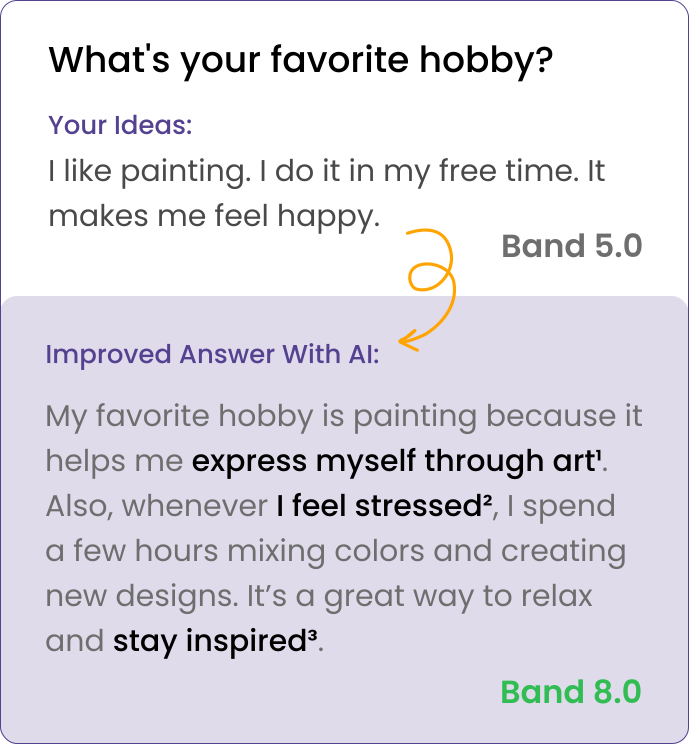
Practice IELTS Speaking answers in our free app
- Build personalized answers that match your target band.
- Turn short replies into fluent answers
- Let examiners fall in love with your answers!
Related Articles
Sample Answers
IELTS Speaking Part 1: Concentration Questions & Answers (Sep-Dec 2026)
Latest Sep-Dec 2026 IELTS Speaking Part 1 questions for Concentration. Read Band 9 sample answers, or use our AI app to turn your own ideas into perfect answers.
Sample Answers
IELTS Speaking Part 1: Jewelry Questions & Band 9 Answers (2026)
Latest Sep-Dec 2026 IELTS Speaking Part 1 questions for Jewelry. Read Band 9 sample answers or generate personal answers using our AI.
Sample Answers
IELTS Speaking Part 1: Colors Questions & Answers (Sep-Dec 2026)
Latest Sep-Dec 2026 IELTS Speaking Part 1 questions for Colors. Read Band 9 sample answers, or use our AI app to turn your own ideas into perfect answers.