IELTS Speaking Part 1: Gifts Questions & Band 9 Answers (2026)
Use our AI tools to get personalized Band 9 answers and vocabulary to talk about presents, birthdays, and generosity.
Start Practicing →Gifts is a frequent topic. The examiner might ask about the last gift you gave, or if you are good at choosing presents. To score Band 9, avoid saying "I gave a nice book." Instead, use words like sentimental value, gesture, token of appreciation, or generic to describe your habits.
How to Use These Sample Answers
Below are the latest 2026 questions for "Gifts."
Important: These answers are for a person who likes giving gifts that are useful. They hate clutter and unnecessary plastic. They believe that a small, thoughtful gift is better than a big, expensive one.
But if you buy expensive luxury brands just to show off how much money you have, or if you don't care what the other person likes, these answers are probably not for you.
So, here is the plan:
Read these samples to understand the Band 9 structure.
Use the IELTS Speaking Lab App to get personalized answers. It gives you perfect vocabulary that fits your real life.
IELTS Speaking Part 1 Questions & Model Answers about Gifts
1. Do you like giving gifts?
Yes, very much. I find it incredibly rewarding to see the smile on someone's face when they open a present. I view it as a token of appreciation for the people I care about. It is a nice way to strengthen the bond with friends and family.
2. Do you prefer giving or receiving gifts?
I definitely prefer giving. While receiving something is nice, the feeling of finding the perfect gift for someone is much more satisfying. I love the anticipation of waiting for their reaction. Sometimes, receiving gifts can feel awkward if I don't know how to react or if the gift is not to my personal taste.
3. When was the last time you gave a gift?
It was actually last weekend. It was my mother's birthday, so I bought her a high-quality blender because she loves making healthy smoothies. It was a practical gift, but it also showed that I pay attention to her daily routine. She was thrilled with it.
4. Is it difficult to choose a gift?
Sometimes, yes. The pressure to find something unique can be quite stressful. I try to avoid buying generic items like chocolates or flowers. I prefer to put a lot of thought into it to ensure the gift has some personal significance to the recipient.
5. Do you think expensive gifts are better?
Not at all. I am a strong believer that "it’s the thought that counts." A handmade card or a framed photograph often has far more sentimental value than a luxury watch. An expensive gift can sometimes feel like a status symbol rather than a genuine act of kindness.
6. Have you ever received a gift you didn't like?
Yes, unfortunately. A few years ago, a distant relative gave me a decorative porcelain doll. It was completely useless and just collected dust on my shelf. It was a white elephant gift. I felt bad, but I eventually had to donate it to a charity shop.
7. Do you give money as a gift?
Occasionally, especially for weddings or teenagers. Giving cash is very practical because it gives the recipient the freedom to buy what they actually need. However, I do feel it lacks a personal touch, so I usually try to accompany it with a handwritten letter to make it feel less cold.
8. Do you wrap gifts yourself?
No, I am terrible at it! My wrapping always looks messy and the tape gets everywhere. I usually rely on gift bags or I pay for the gift-wrapping service at the shopping mall. I think a well-presented gift makes the receiving experience much more special.
9. Do you send gifts to people who live far away?
Yes, thanks to the internet, it is very easy now. I often order books or gadgets online and have them shipped directly to my friends' addresses. It is a convenient way to show I am thinking of them, even if we are separated by distance.
10. What kind of gifts do you like to receive?
I prefer practical gifts. I dislike clutter, so I appreciate things I can actually use, like kitchen gadgets or consumables like nice coffee. Alternatively, I love experiential gifts, like tickets to a concert or a voucher for a massage, because they create memories rather than taking up space.
11. Do you give gifts to your neighbors?
Not usually. In my hometown, people tend to keep to themselves. However, if a new neighbor moves in, I might bring over a small housewarming gift, like a plant or some baked goods, just as a welcoming gesture.
12. What do you give to children?
I try to avoid plastic toys that break easily. Instead, I look for educational toys or books that can help them learn. I think it is important to give children gifts that stimulate their imagination rather than just providing momentary entertainment.
13. Do you bring a gift when visiting someone?
Yes, it is a common social etiquette in my culture. I would never arrive empty-handed. I usually bring a bottle of wine or a box of chocolates for the host. It is a small sign of gratitude for their hospitality.
14. Do you think gift-giving traditions are changing?
Yes, I think people are becoming more conscious of the environment. There is a shift away from buying mass-produced plastic items towards more sustainable options. Many people now agree to do "Secret Santa" with a spending limit to reduce waste during the holidays.
15. Do you ever re-gift something?
I have done it once or twice, but only if I am certain the new recipient will truly love the item. There is a stigma attached to re-gifting, but I think it is better than letting a perfectly good item go to waste. You just have to be careful not to give it back to the person who gave it to you!
Key Vocabulary for IELTS Topic: Gifts
Here is the complete glossary of every bolded word and phrase used in the answers above.
Daily routine: The usual things you do every day (eating, sleeping, working).
Educational toys: Toys designed to help children learn.
Experiential gifts: Gifts that are an experience (travel, spa, concert) rather than an object.
Generic: Common, lacking imagination; not specific to a person.
Gesture: An action performed to convey one's feelings or intentions.
Gift-wrapping service: A paid service where someone wraps your presents professionally.
Gratitude: The quality of being thankful; readiness to show appreciation.
Mass-produced: Made in large quantities by an automated mechanical process.
Perfect gift: A present that is exactly right for the person receiving it.
Personal significance: Having a special meaning to a specific person.
Personal taste: An individual's preference for what they like or dislike.
Personal touch: An element that makes something feel special and individual.
Practical gifts: Items that are useful and serve a purpose.
Re-gifting: Giving a gift you received to someone else.
Sentimental value: The value of an object based on personal memories, not money.
Status symbol: A possession that indicates a person's wealth or high social status.
Sustainable: Able to be maintained at a certain rate or level; good for the environment.
Token of appreciation: A small gift given to say "thank you."
White elephant: A possession that is useless or troublesome, especially one that is expensive to maintain or difficult to dispose of.
Create Your Own Band 9 Answers
The answers above are perfect—if you are a person who likes useful gifts. But what if you love buying expensive things? Or what if you love making handmade gifts?
Your answers need to be true so that you can easily recall them during a stressful exam.
IELTS Speaking Lab helps you turn your real ideas into Band 9 answers.
Select your topic - Gifts.
Input your rough idea (e.g., "I love buying expensive watches for my friends because I want them to look cool").
Get personalized Band 9 answers instantly, with the perfect vocabulary for your story.
Not happy with these answers?
Change the core idea, band level difficulty, length and get a full glossary in our free app!
Start Practicing →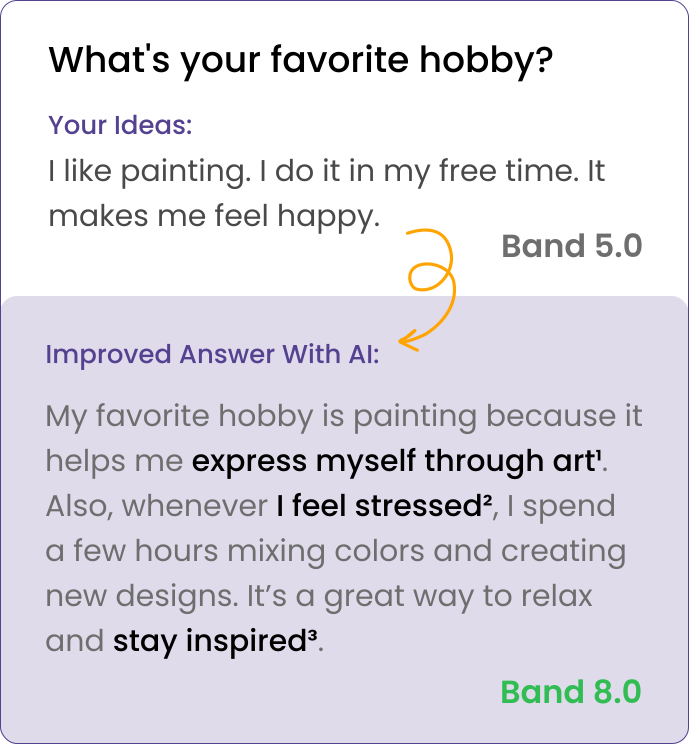
Practice IELTS Speaking answers in our free app
- Build personalized answers that match your target band.
- Turn short replies into fluent answers
- Let examiners fall in love with your answers!
Related Articles
Sample Answers
IELTS Speaking Part 1: Concentration Questions & Answers (Sep-Dec 2026)
Latest Sep-Dec 2026 IELTS Speaking Part 1 questions for Concentration. Read Band 9 sample answers, or use our AI app to turn your own ideas into perfect answers.
Sample Answers
IELTS Speaking Part 1: Jewelry Questions & Band 9 Answers (2026)
Latest Sep-Dec 2026 IELTS Speaking Part 1 questions for Jewelry. Read Band 9 sample answers or generate personal answers using our AI.
Sample Answers
IELTS Speaking Part 1: Colors Questions & Answers (Sep-Dec 2026)
Latest Sep-Dec 2026 IELTS Speaking Part 1 questions for Colors. Read Band 9 sample answers, or use our AI app to turn your own ideas into perfect answers.