IELTS Speaking Part 1: Rules Questions & Band 9 Answers (2026)
Stop memorizing generic answers. Use our AI tools to get personalized Band 9 answers and vocabulary to talk about regulations, school rules, and law enforcement.
Start Practicing →Rules is a common topic in the IELTS exam. The examiner might ask about the rules you had to follow at school, or your opinion on strict laws. To score Band 9, avoid saying "Rules are good." Instead, use words like regulations, conformity, deterrent, or authoritarian to express your views.
How to Use These Sample Answers
Below are the latest 2026 questions for "Rules."
Important: These answers are for a person who believes in strict discipline and order. They think rules are essential for society to function and they usually follow regulations without complaining.
But if you are a rebel who hates authority, or if you think that rules are made to be broken, these answers are probably not for you.
So, here is the plan:
Read these samples to understand the Band 9 structure.
Use the IELTS Speaking Lab App to get personalized answers. It gives you perfect vocabulary that fits your real life.
Part 1: Questions & Model Answers about Rules
1. Are there any rules you have to follow at work/school?
Yes, my work environment is highly structured. We have strict regulations regarding data security and client confidentiality. It is absolutely mandatory to follow protocol to avoid compromising sensitive information.
2. Did you have to follow many rules when you were a child?
Certainly. My parents were quite strict and instilled a strong sense of discipline in me. I had a rigid curfew and specific chores to complete. While it felt authoritarian at the time, I now appreciate the structure it provided.
3. Do you think it is important to have rules in society?
Without a shadow of a doubt. Rules are the foundation of a civilized society. Without them, we would descend into complete anarchy. They act as a necessary deterrent against anti-social behavior and protect vulnerable people.
4. What are some of the rules in your hometown?
My hometown recently implemented strict bylaws regarding noise pollution. For example, construction work is strictly prohibited after 8 PM. It is a very sensible rule that ensures a peaceful living environment for all residents.
5. Are there any rules you disagree with?
I generally respect authority, but I find some bureaucratic rules overly restrictive. For instance, the complex zoning laws in my city often stifle small business development. Some regulations need to be updated to reflect modern realities rather than enforcing outdated conformity.
6. Do people generally obey rules in your country?
For the most part, yes. The majority of citizens are law-abiding and respect the system. However, minor infractions like jaywalking or speeding are quite common, perhaps because the penalties are not severe enough to discourage them.
7. How should children be taught about rules?
I believe in leading by example. Parents and teachers need to consistently enforce boundaries and explain the rationale behind them. If children understand that rules are for their safety, they are more likely to internalize them rather than feeling coerced.
8. What happens when people break the rules?
There must be consequences. Depending on the severity of the infraction, it could range from a simple warning or a fine, to imprisonment. A justice system must be impartial and ensure that no one is above the law.
9. Do you think rules stifle creativity?
Not necessarily. In a study environment, having a clear framework actually gives you a secure space to be creative. Total freedom can sometimes lead to chaos. True innovation often comes from learning how to operate brilliantly within established parameters.
10. How is technology changing how rules are enforced?
Technology has made enforcement much more efficient. For example, speed cameras and facial recognition software make it incredibly difficult to evade the law. While this increases safety, it also raises valid concerns about mass surveillance and privacy.
11. Should rules be the same for everyone?
In principle, yes. The law should be applied equally without prejudice. However, I believe judges must also have the discretion to consider mitigating circumstances. A rigid, zero-tolerance policy can sometimes lead to profound injustice.
12. Are there strict rules about the environment in your country?
Yes, there is growing legislation to protect the environment. We have strict guidelines on waste disposal and heavy fines for illegal dumping. These rules are crucial to ensure sustainable development for future generations.
Key Vocabulary for IELTS Topic: Rules
Here is the complete glossary of every bolded word and phrase used in the answers above.
Anarchy: A state of disorder due to absence or nonrecognition of authority.
Authoritarian: Favoring or enforcing strict obedience to authority.
Bylaws: Rules made by a local authority to regulate its own affairs.
Coerced: Persuaded (an unwilling person) to do something by using force or threats.
Conformity: Compliance with standards, rules, or laws.
Consequences: Results or effects, typically unwelcome or unpleasant ones.
Deterrent: A thing that discourages or is intended to discourage someone from doing something.
Discipline: The practice of training people to obey rules or a code of behavior.
Impartial: Treating all rivals or disputants equally; fair and just.
Law-abiding: Obedient to the laws of society.
Legislation: Laws, considered collectively.
Mandatory: Required by law or rules; compulsory.
Mitigating circumstances: Factors that lessen the severity or culpability of a criminal act.
Parameters: Limits or boundaries which define the scope of a particular process or activity.
Penalties: Punishments imposed for breaking a law, rule, or contract.
Regulations: Rules or directives made and maintained by an authority.
Restrictive: Imposing limitations or conditions on someone's activities or freedom.
Surveillance: Close observation, especially of a suspected spy or criminal.
Create Your Own Band 9 Answers
The answers above are perfect—if you are a person who believes in strict discipline and order. But what if you are a rebel who hates rules? Or what if you think that rules are made to be broken?
Your answers need to be true so that you can easily recall them during a stressful exam.
IELTS Speaking Lab helps you turn your real ideas into Band 9 answers.
Select your topic - Rules.
Input your rough idea (e.g., "I hate rules because I think people should be free to do what they want").
Get personalized Band 9 answers instantly, with the perfect vocabulary for your story.
Not happy with these answers?
Change the core idea, band level difficulty, length and get a full glossary in our free app!
Start Practicing →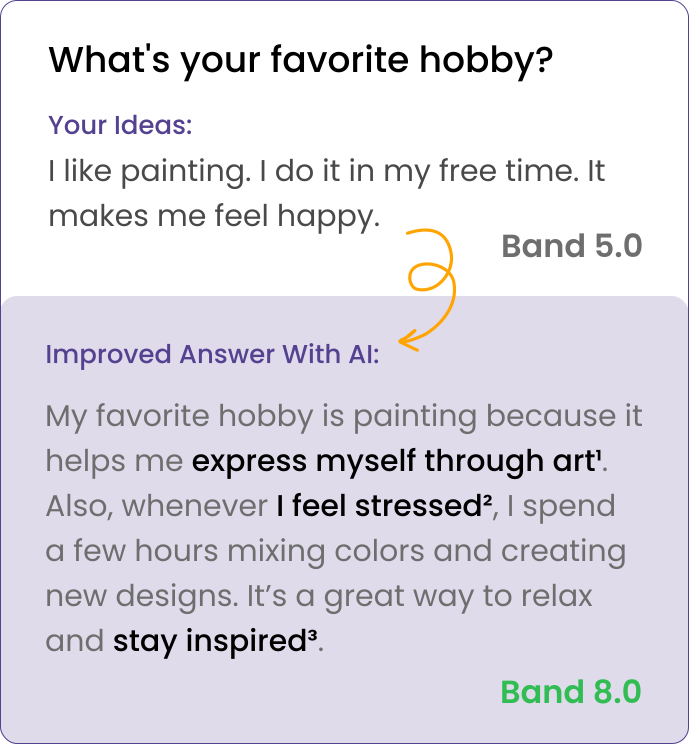
Practice IELTS Speaking answers in our free app
- Build personalized answers that match your target band.
- Turn short replies into fluent answers
- Let examiners fall in love with your answers!
Related Articles
Sample Answers
IELTS Speaking Part 1: Concentration Questions & Answers (Sep-Dec 2026)
Latest Sep-Dec 2026 IELTS Speaking Part 1 questions for Concentration. Read Band 9 sample answers, or use our AI app to turn your own ideas into perfect answers.
Sample Answers
IELTS Speaking Part 1: Jewelry Questions & Band 9 Answers (2026)
Latest Sep-Dec 2026 IELTS Speaking Part 1 questions for Jewelry. Read Band 9 sample answers or generate personal answers using our AI.
Sample Answers
IELTS Speaking Part 1: Colors Questions & Answers (Sep-Dec 2026)
Latest Sep-Dec 2026 IELTS Speaking Part 1 questions for Colors. Read Band 9 sample answers, or use our AI app to turn your own ideas into perfect answers.