IELTS Speaking Part 1: Sleep Questions & Answers (May-Aug 2026)
Get personalized Band 9 answers using our AI. Find the latest May-Aug 2026 IELTS Part 1 questions and vocabulary for sleep, habits, and morning routines.
Start Practicing →Sleep is a new topic in the May-Aug 2026 IELTS test. The examiner might ask how many hours you sleep, if you take naps, or what you do when you can't fall asleep. To score Band 9, avoid saying "I sleep very well." Instead, use natural, conversational phrases like out like a light, toss and turn, or catch up on my sleep.
How to Use These Sample Answers
Below are the latest May-Aug 2026 questions for "Sleep."
Important: These answers are for a person who works hard during the week, tries to keep a healthy sleep schedule, but sometimes stays up late on weekends.
But if you work night shifts and sleep during the day, or if you can fall asleep instantly anywhere and anytime, these answers are probably not for you.
So, here is the plan:
Read these sample answers to understand the Band 9 structure.
Use the IELTS Speaking Lab App to get personalized answers. It gives you perfect vocabulary that fits your real life.
Part 1: Questions & Sample Answers about Sleep
1. How many hours do you usually sleep at night?
I usually aim for about seven to eight hours. It really depends on my daily routine, but I find that if I get less than seven, I feel pretty sluggish the next day.
2. Do you ever take naps during the day?
Rarely. I find that if I take a power nap in the afternoon, it completely ruins my sleep drive for the night. I'd rather just push through the fatigue.
3. Do you think sleep is important?
Absolutely. It is the foundation of good health. If you don't rest properly, your immune system drops and your mood is just completely thrown off balance.
4. What do you do if you can't fall asleep?
If I toss and turn for more than twenty minutes, I usually get up and read a physical book. Scrolling through social media just keeps my brain too stimulated.
5. Do you go to bed at the same time every day?
Mostly, yes. I try to stick to a consistent schedule during the week because of my work commitments. But on Friday nights, I definitely stay up a bit later.
6. Is it easy for you to wake up in the morning?
Not at all. I am definitely not an early bird. I usually have to set two or three alarms just to drag myself out of bed.
7. Did you sleep more when you were younger?
Oh, for sure. When I was a teenager, I could easily sleep in for ten or twelve hours straight. Now, my internal clock naturally wakes me up much earlier.
8. What helps you get a good night's sleep?
I think staying active makes a huge difference. If I play some sport or go for a run, I am usually out like a light as soon as my head hits the pillow.
9. Do you like to read before bed?
Yes, it's my favorite way to wind down. Reading a few chapters helps me detach from the stress of the day and really relaxes my mind.
10. How do you feel when you don't get enough sleep?
I get incredibly irritable and find it very hard to focus. Even simple tasks during my study sessions feel overwhelming if I am sleep-deprived.
11. Do you prefer to sleep in a completely dark room?
Yes, I need it to be pitch black. I even use blackout curtains to block the streetlights, otherwise, my sleep quality is terrible.
12. Have your sleep habits changed recently?
A little bit. I've been actively trying to reduce my screen time before bed, which has honestly helped me drift off much faster than before.
13. Do you sleep in on weekends?
I try not to overdo it, but I definitely use my days off to catch up on my sleep. I might stay in bed an extra hour or two just to recover from the week.
14. Do you use an alarm clock?
Yes, I rely heavily on my phone's alarm. I wish I could wake up naturally, but I just can't trust myself to get up on time without that jarring noise.
15. Are you a light or heavy sleeper?
I am a very heavy sleeper. Once I finally fall asleep, I am completely out, and it takes a lot of noise to actually wake me up.
Key Vocabulary for IELTS Topic: Sleep
Catch up on my sleep: To get extra rest to make up for hours missed previously.
Consistent schedule: A routine that stays the same every day.
Drag myself out of bed: To force oneself to get up when feeling very tired.
Early bird: A person who naturally wakes up early and feels energetic in the morning.
Heavy sleeper: A person who is not easily awakened by noise.
Internal clock: The body's natural rhythm that regulates sleep and wakefulness.
Irritable: Easily annoyed or made angry.
Jarring noise: A loud, unpleasant, or shocking sound.
Out like a light: To fall asleep very quickly and deeply.
Pitch black: Completely dark, with absolutely no light.
Power nap: A short sleep taken during the day to quickly restore energy.
Push through the fatigue: To keep going or working even when feeling exhausted.
Screen time: The amount of time spent looking at digital devices like phones or computers.
Sleep in: To intentionally sleep later than usual in the morning.
Sleep quality: How well and deeply a person rests during the night.
Sleep-deprived: Suffering from a severe lack of adequate rest.
Sluggish: Moving or reacting slower than normal due to tiredness.
Thrown off balance: Feeling confused, unsteady, or not in your normal state.
Toss and turn: To move around restlessly in bed because you cannot sleep.
Wind down: To relax and calm down after a period of activity or stress.
Create Your Own Band 9 Answers
The sample answers above are perfect—if you are a person who works hard during the week, tries to keep a healthy sleep schedule, but sometimes stays up late on weekends.
But what if you work night shifts and sleep during the day?
Or what if you can fall asleep instantly anywhere and anytime?
Your answers need to be true so that you can easily recall them during a stressful exam.
IELTS Speaking Lab helps you turn your real ideas into Band 9 sample answers.
Select your topic - Sleep.
Input your rough idea (e.g., "I work night shifts and sleep during the day").
Get personalized Band 9 answers instantly, with the perfect vocabulary for your story.
Not happy with these answers?
Change the core idea, band level difficulty, length and get a full glossary in our free app!
Start Practicing →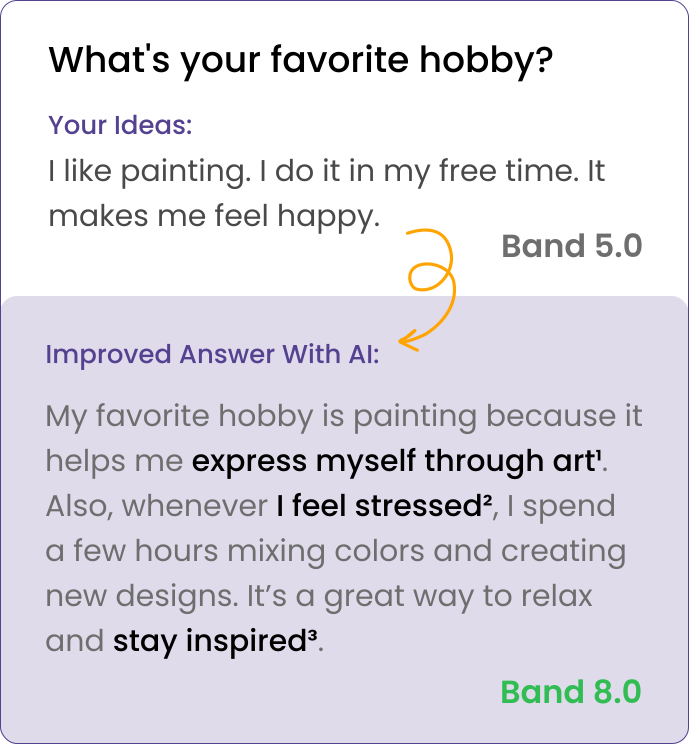
Practice IELTS Speaking answers in our free app
- Build personalized answers that match your target band.
- Turn short replies into fluent answers
- Let examiners fall in love with your answers!
Related Articles
Sample Answers
IELTS Speaking Part 1: Concentration Questions & Answers (Sep-Dec 2026)
Latest Sep-Dec 2026 IELTS Speaking Part 1 questions for Concentration. Read Band 9 sample answers, or use our AI app to turn your own ideas into perfect answers.
Sample Answers
IELTS Speaking Part 1: Jewelry Questions & Band 9 Answers (2026)
Latest Sep-Dec 2026 IELTS Speaking Part 1 questions for Jewelry. Read Band 9 sample answers or generate personal answers using our AI.
Sample Answers
IELTS Speaking Part 1: Colors Questions & Answers (Sep-Dec 2026)
Latest Sep-Dec 2026 IELTS Speaking Part 1 questions for Colors. Read Band 9 sample answers, or use our AI app to turn your own ideas into perfect answers.