Describe An App You Use A Lot: Part 2 Cue Card (2026)
Use our AI to get a personalized Band 9 answer and vocabulary for the IELTS Speaking Part 2 Cue Card "Describe an app you use a lot"
Start Practicing →The "Describe an app you use a lot" Cue Card is a highly frequent topic in 2026, especially given our daily reliance on smartphones. To achieve a Band 7 or higher, avoid simply listing the buttons you click. Instead, focus on how the app improves your daily routine using vocabulary like user-friendly, gamification, and intuitive design.
How to Use This Sample Answer
Below is a sample answer for a language learner who uses an English learning app. If this is your case, perfect. But what if you rely on a budgeting app to track your finances? Or maybe you use a fitness tracker to stay healthy?
So here is the plan:
Read this sample answer to understand what a Band 7+ answer looks like.
Use the IELTS Speaking Lab App to instantly generate your own personal answer to this Cue Card with perfect vocabulary that describes your real story and matches your target Band.
Part 2 Cue Card and Sample Answer
Describe an app on your phone that you use a lot. You should say:
What the app is
How you learned about it
What you use it for
And explain why you use it so often.
Band 9 Sample Answer
Introduce: I would like to talk about an application that has become an indispensable part of my daily routine: an English language learning app called Duolingo. It is essentially a pocket-sized tutor that makes learning a new language accessible and engaging.
Describe: I originally stumbled upon it a few years ago through an ad on social media. The app is structured around bite-sized lessons that cover vocabulary, grammar, and listening skills. What makes it stand out is its gamification; you earn points, maintain a daily streak, and unlock new levels as you progress. It utilizes spaced repetition to ensure you actually remember the words long-term.
Explain: I use this app religiously every single morning during my commute. Instead of mindlessly scrolling through the internet, I dedicate fifteen minutes to a quick study session. I appreciate its intuitive design, which makes navigation seamless even for someone who isn't particularly tech-savvy.
Add impact: Ultimately, this app has completely transformed my approach to self-improvement. It provides a sense of micro-achievement that keeps me motivated. Thanks to this piece of technology, I've noticed a tangible improvement in my English fluency, proving that consistency is far more important than cramming.
This answer uses the IDEA Strategy (Introduce, Describe, Explain, Add impact).
Part 3 Questions and Sample Answers
After you finish your Cue Card, the examiner will ask you deeper questions related to technology and daily habits.
1. Do you think people rely too much on apps today?
Yes, I believe there is a growing over-reliance on digital tools. While apps for banking or work offer incredible convenience, many people use them as a crutch. For instance, people rely on navigation apps so much that they lose their natural sense of direction. We need to strike a balance to avoid becoming completely dependent on our devices.
2. What kinds of apps are most popular among young people?
Unsurprisingly, entertainment and communication platforms dominate. Young people are drawn to short-form video apps because they provide instant gratification. Additionally, messaging apps are essential for maintaining their social circles and keeping in touch with their family and peers. Educational apps are also gaining traction, though they still lag behind entertainment.
3. How has technology changed the way we learn?
The shift has been profound. In the past, learning was confined to a physical classroom and a textbook. Now, education has been democratized. Anyone with a smartphone can access high-quality courses from the comfort of their home. However, this also requires a high degree of self-discipline, as the digital world is full of distractions.
4. Will artificial intelligence eventually replace human teachers?
I highly doubt it. While AI can certainly automate grading or provide personalized quizzes, it lacks the capacity for genuine empathy. A great teacher does more than just transmit information; they inspire, mentor, and adapt to a student's emotional needs. AI can act as a powerful supplementary tool, but the human element in education is irreplaceable.
Key Vocabulary for IELTS Cue Card: An App
Here is the complete glossary of the vocabulary used in the answers above, plus extra high-level words relevant to this topic.
Accessible: (Adjective) Easy to approach, reach, enter, speak with, or use.
Algorithm: (Noun) A process or set of rules to be followed in calculations or other problem-solving operations, especially by a computer.
Bite-sized: (Adjective) Small and easily manageable pieces of information or tasks.
Democratized: (Verb) Made accessible to everyone; allowing everyone to participate.
Digital detox: (Noun) A period of time during which a person refrains from using electronic devices.
Gamification: (Noun) The application of typical elements of game playing (e.g. point scoring, competition) to other areas of activity to encourage engagement.
Indispensable: (Adjective) Absolutely necessary; essential.
Instant gratification: (Phrase) The desire to experience pleasure or fulfillment without delay or deferment.
Intuitive design: (Phrase) A product architecture that is easy to use and understand without explicit instructions.
Micro-achievement: (Noun) A small, quick success that gives a sense of progress.
Over-reliance: (Noun) Excessive dependence on someone or something.
Religiously: (Adverb) With consistent and strict regularity.
Seamless: (Adjective) Smooth and continuous, with no apparent gaps or spaces between one part and the next.
Spaced repetition: (Phrase) A learning technique that incorporates increasing intervals of time between subsequent review of previously learned material.
Subscription model: (Noun) A business model where a customer must pay a recurring price at regular intervals for access to a product.
Supplementary tool: (Phrase) An additional item or program used to enhance or complete something else.
Tangible: (Adjective) Perceptible by touch; having physical substance or real, measurable results.
User interface (UI): (Noun) The means by which the user and a computer system interact, in particular the use of input devices and software.
User-friendly: (Adjective) Easy to learn, use, understand, or deal with.
Create Your Own Band 9 Answers
The answer above is perfect—if you are a language learner who uses an English learning app. But what if you rely on a budgeting app to track your finances? Or what if you use a fitness tracker to stay healthy?
Your answers need to be true so that you can easily recall them during a stressful exam.
IELTS Speaking Lab helps you turn your real ideas into Band 9 answers.
Select your cue card - Describe an app on your phone that you use a lot.
Input your rough idea (e.g., "I use a meditation app to help me sleep").
Get personalized Band 9 answer instantly, with the perfect vocabulary for your story.
Not happy with these answers?
Change the core idea, band level difficulty, length and get a full glossary in our free app!
Start Practicing →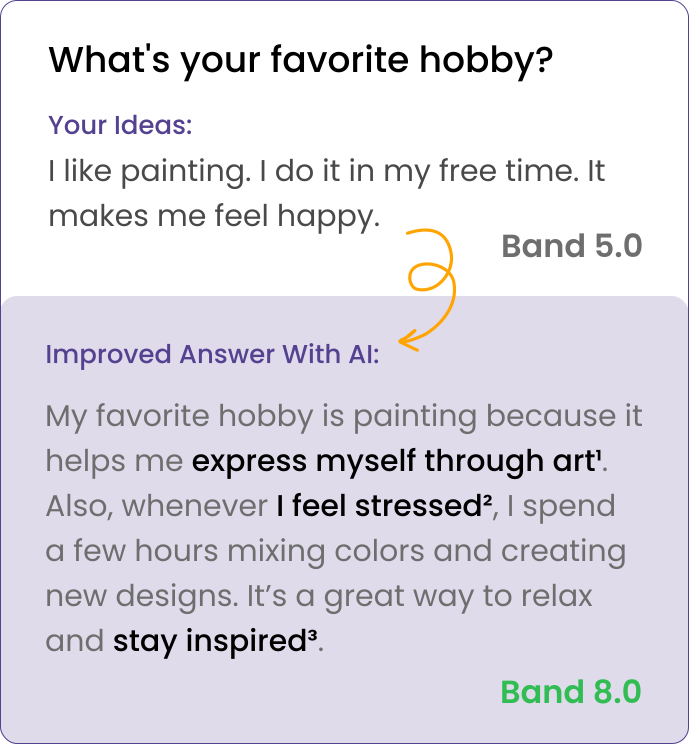
Practice IELTS Speaking answers in our free app
- Build personalized answers that match your target band.
- Turn short replies into fluent answers
- Let examiners fall in love with your answers!
Related Articles
Sample Answers
IELTS Speaking Part 1: Concentration Questions & Answers (Sep-Dec 2026)
Latest Sep-Dec 2026 IELTS Speaking Part 1 questions for Concentration. Read Band 9 sample answers, or use our AI app to turn your own ideas into perfect answers.
Sample Answers
IELTS Speaking Part 1: Jewelry Questions & Band 9 Answers (2026)
Latest Sep-Dec 2026 IELTS Speaking Part 1 questions for Jewelry. Read Band 9 sample answers or generate personal answers using our AI.
Sample Answers
IELTS Speaking Part 1: Colors Questions & Answers (Sep-Dec 2026)
Latest Sep-Dec 2026 IELTS Speaking Part 1 questions for Colors. Read Band 9 sample answers, or use our AI app to turn your own ideas into perfect answers.