Describe a Family Member You Are Close To: Part 2 Cue Card (2026)
Use our AI to get a personalized Band 9 answer and vocabulary for the IELTS Speaking Part 2 Cue Card "Describe a family member you are close to".
Start Practicing →The "Describe a family member you are close to" Cue Card is one of the most common 2026 topics in the IELTS Speaking test. It tests your ability to describe personality, appearance, and relationships. To achieve Band 7+, you must go beyond simple descriptors like "kind" or "friendly" and use idioms and natural collocations like confidante, bonding experience, and through thick and thin.
How to Use This Sample Answer
Below is a sample answer for a student who is close to their cousin. If this matches your story, great. But what if you are closer to your grandmother? Or your older brother?
So here is the plan:
Read this sample answer to understand the structure of a Band 7+ answer.
Use the IELTS Speaking Lab App to instantly generate your own personal answer to this Cue Card with perfect vocabulary that describes your specific family member.
Part 2 Cue Card and Sample Answer
Describe a family member you are close to. You should say:
Who this person is
What they look like
What you do together
And explain why you are close to this person.
Band 9 Sample Answer
Introduce: I would like to talk about my cousin, Layla. She is technically my maternal cousin, but because we grew up living on the same street, I have always considered her to be more of a sister than a distant relative. She is just two years older than me, which meant we went through all the same life stages together.
Describe: In terms of appearance, Layla has a striking resemblance to my mother's side of the family. She has curly dark hair and a warm, radiant smile that immediately puts people at ease. Personality-wise, she is incredibly gregarious and extroverted, whereas I tend to be a bit more reserved. People often say we are like chalk and cheese, but I think that is exactly why we get along so well; she pulls me out of my shell.
Explain: We spend a lot of time together on weekends. We usually go to a local cafe to catch up on gossip, or we go shopping for clothes. However, our favorite thing to do is travel. Last year, we went on a road trip across the country, which was a massive bonding experience for us. We share a very specific sense of humor, so we spend most of our time laughing at inside jokes that no one else understands.
Add impact: The main reason I am so close to her is that she has been my confidante through difficult times. Whether I was struggling with study stress or relationship issues, Layla has always been a shoulder to cry on. She supports me through thick and thin, and knowing I have her unconditional support gives me a lot of confidence in life.
This answer uses the IDEA Strategy (Introduce, Describe, Explain, Add impact).
Part 3 Questions and Sample Answers
After you finish your Cue Card, the examiner will ask you deeper questions related to family and relationships.
1. Is it better to have a large family or a small family?
It really depends on the individual's preference. A large family provides a massive support network and a vibrant social life; you are never lonely because there is always a cousin or aunt around. However, large families can be chaotic. A small family often allows for deeper connections and less financial strain on the parents. Ultimately, the biological bond is strong in both, but in a large family, you have a wider safety net if something goes wrong.
2. How has the role of elderly people in the family changed?
In the past, grandparents were the patriarchs or matriarchs of the household, commanding immense respect and often living with their children. Today, with the rise of nuclear families, elderly people often live alone or in retirement homes. While they are still loved, their authority and daily involvement in raising grandchildren have diminished in many modern societies.
3. Are friends more important than family?
I believe they serve different but equally important roles. You cannot choose your family, but they provide a foundational safety net that is hard to break. Friends, on the other hand, are the family you choose. They often share your specific interests and passions, like hobbies or career goals, which allows for a different kind of intellectual or emotional connection.
4. What causes conflicts between family members?
I think the biggest cause is the generation gap. Parents and children often have vastly different values regarding lifestyle, career choices, and marriage. For example, parents might value stability and tradition, while children value freedom and self-expression. Lack of communication and financial disputes are also major triggers for family arguments, as money issues can easily destroy trust.
Key Vocabulary for IELTS Cue Card: A Family Member
Here is the complete glossary of the vocabulary used in the answers above, plus extra high-level words relevant to this topic.
Biological bond: (Phrase) The genetic connection or blood relationship between family members.
Bonding experience: (Phrase) An activity or event that brings people closer together emotionally.
Chalk and cheese: (Idiom) Used to describe two people who are completely different from each other.
Confidante: (Noun) A person with whom one shares a secret or private matter, trusting them not to repeat it to others.
Financial disputes: (Phrase) Arguments or disagreements concerning money or property.
Generation gap: (Noun) A difference of attitudes between people of different generations, leading to a lack of understanding.
Gregarious: (Adj) Fond of company; sociable.
Inside jokes: (Phrase) Jokes that are shared by a small group of people and not understood by others.
Maternal cousin: (Phrase) A cousin from your mother's side of the family.
Matriarch: (Noun) A woman who is the head of a family or tribe.
Nuclear family: (Noun) A couple and their dependent children, regarded as a basic social unit.
Patriarch: (Noun) The male head of a family or tribe.
Radiant smile: (Phrase) A smile that looks very happy and bright.
Safety net: (Phrase) A safeguard against possible hardship or adversity (like family support during tough times).
Shoulder to cry on: (Idiom) Someone who is willing to listen to your problems and give you sympathy.
Specific sense of humor: (Phrase) A particular way of finding things funny that is shared between people.
Striking resemblance: (Phrase) Looking very similar to someone else.
Thick and thin: (Idiom) Under all circumstances, no matter how difficult.
Unconditional support: (Phrase) Support that is given without any conditions or requirements.
Value freedom: (Phrase) To consider independence and personal liberty as highly important.
Create Your Own Band 9 Answers
The answer above is perfect—if you are close to your cousin. But what if you want to talk about your father? Or your aunt? Your answers need to be true so that you can easily recall them during a stressful exam.
IELTS Speaking Lab helps you turn your real ideas into Band 9 answers.
Select your cue card - Describe a family member you are close to.
Input your rough idea (e.g., "I am close to my grandpa because he taught me how to fish").
Get personalized Band 9 answer instantly, with the perfect vocabulary for your story.
Not happy with these answers?
Change the core idea, band level difficulty, length and get a full glossary in our free app!
Start Practicing →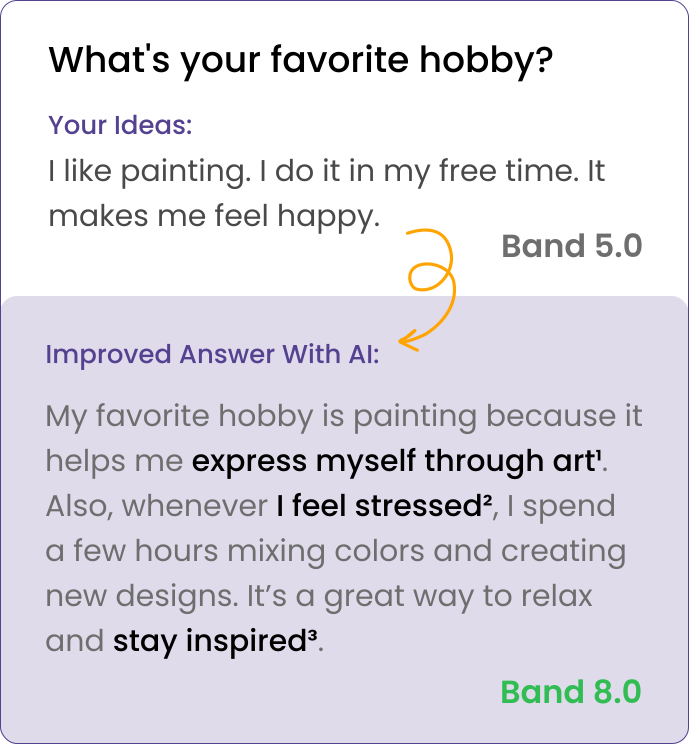
Practice IELTS Speaking answers in our free app
- Build personalized answers that match your target band.
- Turn short replies into fluent answers
- Let examiners fall in love with your answers!
Related Articles
Sample Answers
IELTS Speaking Part 1: Concentration Questions & Answers (Sep-Dec 2026)
Latest Sep-Dec 2026 IELTS Speaking Part 1 questions for Concentration. Read Band 9 sample answers, or use our AI app to turn your own ideas into perfect answers.
Sample Answers
IELTS Speaking Part 1: Jewelry Questions & Band 9 Answers (2026)
Latest Sep-Dec 2026 IELTS Speaking Part 1 questions for Jewelry. Read Band 9 sample answers or generate personal answers using our AI.
Sample Answers
IELTS Speaking Part 1: Colors Questions & Answers (Sep-Dec 2026)
Latest Sep-Dec 2026 IELTS Speaking Part 1 questions for Colors. Read Band 9 sample answers, or use our AI app to turn your own ideas into perfect answers.