Describe a Long Journey You Had: Part 2 Cue Card (2026)
Use our AI to get a personalized Band 9 answer and vocabulary for the IELTS Speaking Part 2 Cue Card "Describe a long journey you had".
Start Practicing →One of the most used IELTS Speaking Part 2 Cue Cards in 2026 is "Describe a long journey you had." The examiner expects you to tell a well structured story about a specific trip, explain how you traveled, and describe the effect it had on you. To get Band 7+ you need to use advanced vocabulary such as off the beaten track, scenic route, and travel bug.
How to Use This Sample Answer
Below is a sample answer for a person who likes driving who went on a road trip with friends. If this is your case, perfect. But what if you went by plane? Or maybe you took a long train ride?
So here is the plan:
Read this sample answer to understand what a Band 7+ answer looks like.
Use the IELTS Speaking Lab App to instantly generate your own personal answer to this Cue Card with perfect vocabulary that describes your real story and matches your target Band.
Part 2 Cue Card and Sample Answer
Describe a long journey you had. You should say:
Where you went
How you traveled
Why you went
And explain how you felt about it.
Band 9 Sample Answer
(Answer) I would like to talk about a memorable road trip I took two years ago to the South of France. It was a classic summer holidays trip where my friends and I decided to avoid the hustle and bustle of airports and drive all the way from London to the Mediterranean coast.
(Add detail) We packed my small car with suitcases, snacks, and a guitar, and hit the road early in the morning. We decided to take the scenic route through the countryside rather than sticking to the main highways. This allowed us to see some incredible landscapes and quiet villages that were completely off the beaten track. Although the drive took over 12 hours, the experience was much more immersive than flying.
(Anecdote) I remember one specific moment when we got lost near the Alps. Our GPS stopped working, and we ended up taking a detour through a mountain pass. At first, we were panicked, but then we stumbled upon a breathtaking view of a valley at sunset. We stopped the car, took photos, and realized that getting lost was actually the highlight of the trip. It was a true hidden gem that we never would have found if we had stuck to the plan.
(Explain) In terms of how I felt, I was physically exhausted by the time we arrived, but mentally, I felt a great sense of freedom. Being behind the wheel with my best friends gave me a chance to disconnect from my daily work stress. It definitely gave me the travel bug to explore more places by car in the future.
This answer uses the AAAE Strategy (Answer, Add detail, Anecdote, Explain).
Part 3 Questions and Sample Answers
After you finish your Cue Card, the examiner will ask you deeper questions related to travel and transport.
1. Do you prefer traveling by car or by train?
Personally, I prefer the train for long distances. While cars offer flexibility, trains allow you to relax, read, or even get some work done without the stress of navigating traffic. For instance, the high-speed trains in Japan are incredibly efficient and punctual, making the journey seamless. Therefore, for me, the convenience of rail transport usually outweighs the freedom of driving.
2. How has tourism affected popular tourist destinations?
I think mass tourism is a double-edged sword. On one hand, it brings money and boosts the economy for locals. On the other hand, it can lead to overcrowding and environmental damage. Venice is a prime example where the sheer number of visitors is damaging the environment and pricing locals out of the housing market. Governments really need to implement sustainable tourism practices to protect these heritage sites.
3. Do you think space travel will become common in the future?
That is hard to predict. Currently, the cost is astronomical, so space tourism is only available to billionaires. However, with the rapid pace of technology, it might become accessible to the upper middle class in the next 50 years. But for the average person, I think it will remain a sci-fi dream for a long time.
4. What do people need to prepare before a long journey?
Proper preparation is essential to avoid disasters. Travelers should always check their itinerary, ensure they have necessary documents like visas, and pack light to avoid hauling heavy luggage. I once forgot to check the weather forecast and packed only summer clothes for a trip that turned out to be freezing! So, a little bit of research beforehand goes a long way.
Key Vocabulary for IELTS Cue Card: Long Journey
Here is the complete glossary of every bolded word and phrase used in the answers above, plus extra high-level vocabulary for this topic.
Astronomical: Extremely high (usually referring to cost).
Boosts the economy: To make the economic situation better or more active.
Breathtaking view: An extremely beautiful view.
Commute: The journey you make every day to go to work or school.
Convenience: The quality of being useful, easy, or suitable for someone.
Detour: A different or less direct route to a place that is used to avoid a problem or to visit somewhere or do something on the way.
Double-edged sword: A situation or thing that has both positive and negative effects.
Exhausted: Very tired.
Expedition: An organized journey for a particular purpose (like research).
Flexibility: The ability to change plans easily.
Hidden gem: A nice place that is not well known.
Hit the road: To begin a journey.
Hustle and bustle: Busy and noisy activity.
Itinerary: A detailed plan or route of a journey.
Jet lag: The feeling of being tired and confused after a long plane journey across time zones.
Layover: A short stay in a place that you make while you are on a longer journey to somewhere else.
Making the journey seamless: Making the trip very smooth and without problems.
Mass tourism: Large numbers of people visiting the same place at the same time.
Motion sickness: Feeling sick because of the movement of a car, boat, or plane.
Off the beaten track: In a place where few people go, far from any main roads and towns.
Pack light: To bring very few things with you when you travel.
Pricing locals out of the housing market: When houses become too expensive for local people to afford because of tourism or other factors.
Scenic route: A road that goes through beautiful natural scenery, often longer than the direct route.
Sci-fi: Science fiction; stories about the future or space.
Sense of freedom: The feeling of being able to do what you want.
Space tourism: Traveling into space for a holiday.
Stumble upon: To find something by chance.
Sustainable tourism: Tourism that does not harm the environment or the local culture.
Travel bug: A strong desire to travel.
Voyage: A long journey, especially by ship.
Wanderlust: A strong desire to travel and explore the world.
Create Your Own Band 9 Answers
The answer above is perfect—if you are a person who likes driving who went on a road trip. But what if you went by plane? Or what if you took a long train ride?
Your answers need to be true so that you can easily recall them during a stressful exam.
IELTS Speaking Lab helps you turn your real ideas into Band 9 answers.
Select your cue card - Describe a long journey you had.
Input your rough idea (e.g., "I went to Japan by plane and the flight was 14 hours long").
Get personalized Band 9 answer instantly, with the perfect vocabulary for your story.
Not happy with these answers?
Change the core idea, band level difficulty, length and get a full glossary in our free app!
Start Practicing →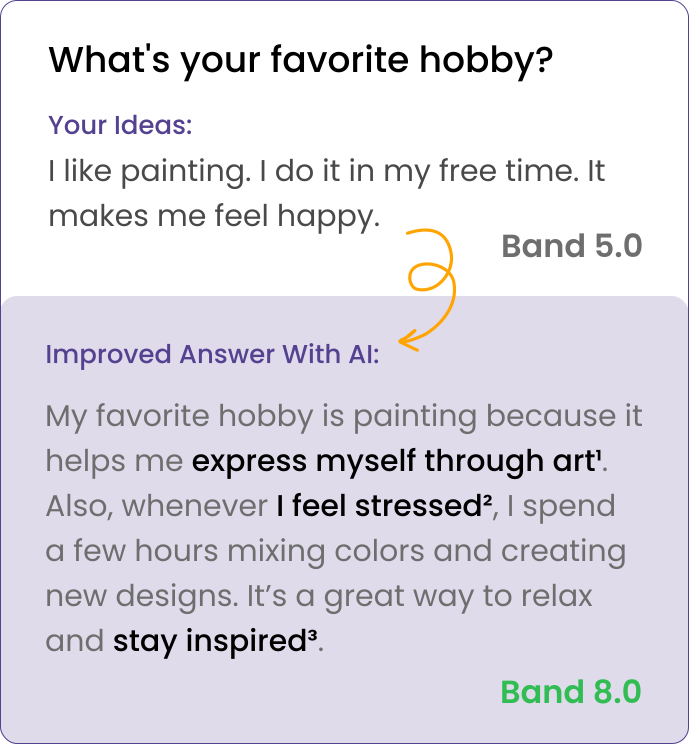
Practice IELTS Speaking answers in our free app
- Build personalized answers that match your target band.
- Turn short replies into fluent answers
- Let examiners fall in love with your answers!
Related Articles
Sample Answers
IELTS Speaking Part 1: Concentration Questions & Answers (Sep-Dec 2026)
Latest Sep-Dec 2026 IELTS Speaking Part 1 questions for Concentration. Read Band 9 sample answers, or use our AI app to turn your own ideas into perfect answers.
Sample Answers
IELTS Speaking Part 1: Jewelry Questions & Band 9 Answers (2026)
Latest Sep-Dec 2026 IELTS Speaking Part 1 questions for Jewelry. Read Band 9 sample answers or generate personal answers using our AI.
Sample Answers
IELTS Speaking Part 1: Colors Questions & Answers (Sep-Dec 2026)
Latest Sep-Dec 2026 IELTS Speaking Part 1 questions for Colors. Read Band 9 sample answers, or use our AI app to turn your own ideas into perfect answers.