IELTS Speaking Part 1 Strategies: How to Extend Answers
Learn 2 simple speaking strategies for IELTS Speaking Part 1. Instantly extend your answers, impress the examiner, and score Band 7+.
Start Practicing →IELTS Speaking Part 1 is often called the "warm-up," but that doesn't mean it's unimportant. It is your first chance to show the examiner your fluency, coherence, and vocabulary.
The biggest mistake students make in Part 1 is giving short, one-sentence answers.
Examiner: "Do you like your job?"
Student: "Yes, I do."
This is grammatically correct, but it does nothing to show your English ability.
To score a Band 7 or higher, you must extend your answers.
You don't need to memorize scripts. Instead, use these two Speaking Strategies to structure your thoughts and answers in a way that examiners love.
Speaking Strategy #1: SEER
Best for: Opinions, Habits, Likes/Dislikes, and General Questions.
SEER stands for:
S - Short Answer: Give a direct, clear answer to the question.
E - Extend: Add a reason, detail, or explanation.
E - Example: Provide a specific, concrete example to illustrate your point.
R - Reflect: Conclude with a brief feeling or opinion about it.
This strategy helps you extend your answer with examples and opinions.
Examples of SEER answers:
Q1: "What is your major?" | Topic: Study
Answer:
(S) I am currently majoring in Digital Marketing.
(E) It basically involves learning how to analyze consumer behavior and use data to create effective advertising campaigns online.
(E) For instance, right now I am working on a university project where we have to design a launch strategy for a new mobile app.
(R) I find it incredibly fascinating because it combines creativity with psychology.
Q2: "Is your hometown good for children?" | Topic: Hometown
Answer:
(S) Yes, I think it is a fantastic place to grow up.
(E) It is a very safe and green area with plenty of parks, which allows children to play outside without their parents worrying about traffic or crime.
(E) For example, there is a massive playground right in the city center where families gather every weekend for picnics.
(R) So, for a family looking for a healthy environment, it is an ideal location.
Q3: "What is your favorite season?" | Topic: Weather
Answer:
(S) I absolutely love cool, crisp autumn weather.
(E) It’s the perfect balance—not too hot and not too cold—which makes it ideal for being outdoors.
(E) I really enjoy going for long hikes in the nearby mountains when the air is fresh and the leaves are changing color.
(R) It just makes me feel much more energized compared to the humid heat of summer.
Speaking Strategy #2: A123
Best for: Preference questions ("Do you prefer X or Y?") or Frequency questions ("How often do you...?").
A123 stands for:
A - Answer: Start with a phrase like "Well, it depends..." or "To be honest, it varies..."
1 - Option 1: Describe one situation or context.
2 - Option 2: Describe a contrasting situation or context.
3 - Conclude: Provide a quick summarizing thought.
This method is perfect when the answer isn't a simple "yes" or "no." It allows you to show off complex grammar by contrasting two different situations using phrases like "It depends."
Examples of A123 answers:
Q1: "How often do you use the internet?" | Topics: Technology/Internet/Social Media
Answer:
(A) To be honest, it really depends on whether I am at work or at home.
(1) During the week, I am online constantly for about eight hours a day because my job involves a lot of research and emailing.
(2) However, on weekends, I try to disconnect and stay offline to give my eyes and my brain a rest.
(3) So, my usage fluctuates heavily based on the day of the week.
Q2: "Do you prefer paper books or ebooks?" | Topic: Reading
Answer:
(A) Well, it varies based on the situation.
(1) If I am traveling or commuting, I definitely prefer ebooks because my Kindle is light and can hold hundreds of titles.
(2) On the other hand, if I am studying or reading a classic novel, I much prefer a physical paper book so I can make notes and feel the pages.
(3) Consequently, I use both formats depending on what I am doing.
Q3: "Do you prefer trains or planes?" | Topic: Transport
Answer:
(A) It actually depends on the distance I need to travel.
(1) For short domestic trips, I love taking the train because you can see the scenery and there is no long security check.
(2) But for international travel or long distances, I will always choose a plane simply because it is much faster and more efficient.
(3) Therefore, I choose the mode of transport that saves me the most time.
Final Tip
Want to give a clear opinion or answer with examples and explanations? --> SEER
Want to talk about 2 options and/or compare them? --> A123
These two strategies help you organize your thoughts and score higher because examiners are waiting for such extended answers from Band 7+ candidates, even to the simplest questions.
Generate your own answers using these strategies
Reading sample answers is helpful, but you shouldn't memorize them.
If you want to master these strategies using your own life details, use IELTS Speaking Lab.
It turns your rough ideas into perfect Band 7+ answers for your targeted band and length.
Select your question: e.g., "What is your major?" | Topic: Study
Input your rough idea: e.g., "My major is Business Administration".
Get personalized Band 7+ answers: Instantly, with the perfect vocabulary for your story.
Not happy with these answers?
Change the core idea, band level difficulty, length and get a full glossary in our free app!
Start Practicing →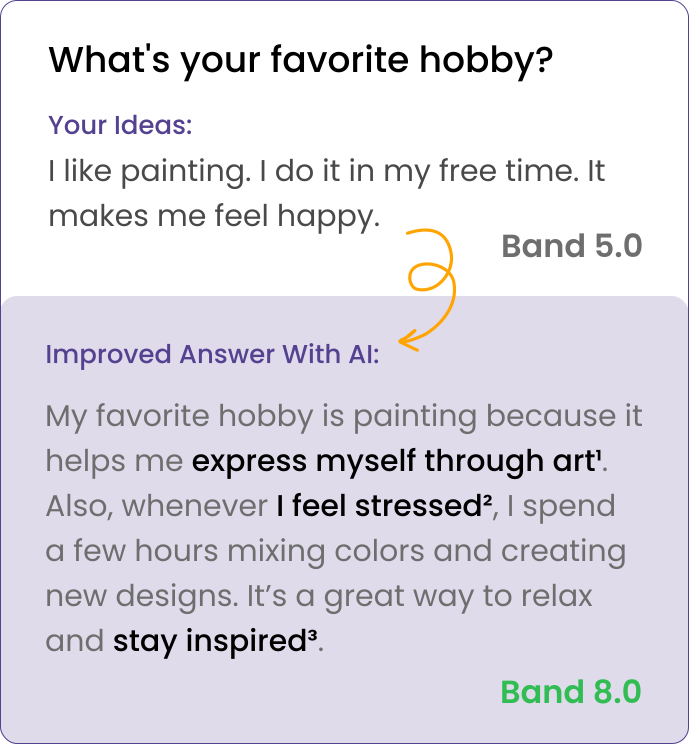
Practice IELTS Speaking answers in our free app
- Build personalized answers that match your target band.
- Turn short replies into fluent answers
- Let examiners fall in love with your answers!
Related Articles
Sample Answers
IELTS Speaking Part 1: Concentration Questions & Answers (Sep-Dec 2026)
Latest Sep-Dec 2026 IELTS Speaking Part 1 questions for Concentration. Read Band 9 sample answers, or use our AI app to turn your own ideas into perfect answers.
Sample Answers
IELTS Speaking Part 1: Jewelry Questions & Band 9 Answers (2026)
Latest Sep-Dec 2026 IELTS Speaking Part 1 questions for Jewelry. Read Band 9 sample answers or generate personal answers using our AI.
Sample Answers
IELTS Speaking Part 1: Colors Questions & Answers (Sep-Dec 2026)
Latest Sep-Dec 2026 IELTS Speaking Part 1 questions for Colors. Read Band 9 sample answers, or use our AI app to turn your own ideas into perfect answers.