Describe a Skill You Want to Learn: Part 2 Cue Card (2026)
Use our AI to get a personalized Band 9 answer and vocabulary for the IELTS Speaking Part 2 Cue Card "Describe a skill you want to learn".
Start Practicing →The "Describe a skill you want to learn" Cue Card is a popular 2026 topic that tests your ability to discuss future plans and ambitions. To achieve Band 7+, you need to go beyond simply naming the skill; you must describe the process of learning it using specific technical vocabulary like post-production, steep learning curve, color grading, and compelling narrative.
How to Use This Sample Answer
Below is a sample answer for a student or professional who wants to learn video editing. If this matches your goal, great. But what if you want to learn coding? Or playing the guitar?
So here is the plan:
Read this sample answer to understand the structure of a Band 7+ answer.
Use the IELTS Speaking Lab App to instantly generate your own personal answer to this Cue Card with perfect vocabulary that describes your specific skill.
Part 2 Cue Card and Sample Answer
Describe a skill you want to learn. You should say:
What the skill is
How you would learn it
Why you want to learn it
And explain how this skill would be useful to you.
Band 9 Sample Answer
Describe: The skill I am most eager to acquire in the near future is video editing, or more specifically, the art of post-production. In an era where technology dominates our communication, I consider this to be one of the most valuable hard skills one can possess. It involves taking raw footage and manipulating it to create a compelling narrative, rather than just a series of random clips.
Add detail: I plan to start by familiarizing myself with the interface of industry-standard software like Adobe Premiere Pro. I am aware it has a steep learning curve, so I will rely on self-paced learning via tutorials on the internet. My initial goal is to move beyond simple cuts and master the basics of sound design, color grading, and adding seamless transitions. I believe the best way to learn is through hands-on experience, so I will practice by editing short projects every weekend.
Link to self: This skill appeals to me because I have a deep passion for art and content creation, but I currently lack the technical proficiency to express it. I capture hundreds of videos, but they just sit in my gallery lacking polish. Learning to edit would heighten my digital literacy and be a huge asset for my work portfolio, as visual storytelling is becoming a prerequisite in almost every industry.
Example: For instance, I can vividly imagine creating a cinematic documentary about my family history. Being able to sync old home movies with sentimental music and add professional visual effects would turn ordinary memories into a masterpiece. That ability to evoke emotion through a screen is exactly why I want to pursue this.
This answer uses the DALE Strategy (Describe, Add detail, Link to self, Example).
Part 3 Questions and Sample Answers
After you finish your Cue Card, the examiner will ask you deeper questions related to education and skills.
1. What is the difference between the skills children learn and the skills adults learn?
Children are like sponges; they usually focus on foundational skills like language, literacy, and social interaction. Their learning is often implicit and play-based. Adults, on the other hand, tend to focus on vocational or practical skills that are directly related to their employment or study. Adult learning is usually more conscious and goal-oriented, but it can be harder due to a lack of neuroplasticity compared to kids.
2. Is it important for people to learn new skills as they get older?
Absolutely. Lifelong learning is essential for keeping the brain active and delaying cognitive decline. In a rapidly changing world, skills that were relevant ten years ago might now be obsolete. Therefore, older people need to upskill, particularly in digital areas, to remain independent and connected to society.
3. Do you think schools should focus more on artistic skills or academic skills?
I believe there should be a balance, but artistic skills are often undervalued. While academic subjects like math and science are crucial for logical reasoning, artistic subjects foster creativity and emotional intelligence. In a future where automation and AI—driven by the media and tech sectors—take over logical tasks, human creativity will be the most distinct and valuable asset.
4. Why do some people find it difficult to learn new things?
There are several factors. Firstly, the fear of failure can be paralyzing; adults often feel embarrassed to be beginners again. Secondly, it requires a significant time commitment and discipline, which is hard to manage alongside a full-time job. Finally, some people may lack the innate talent for certain skills, making the process feel discouraging.
Key Vocabulary for IELTS Cue Card: A Skill You Want to Learn
Here is the complete glossary of the vocabulary used in the answers above, plus extra high-level words relevant to this topic.
Cinematic: (Adj) Having qualities characteristic of motion pictures; visually impressive.
Cognitive decline: (Noun) The lessening of mental abilities (memory, thinking) as one ages.
Color grading: (Noun) The process of altering and enhancing the color of a video image to create a specific mood.
Compelling narrative: (Phrase) A story that is very interesting or exciting and holds your attention.
Content creation: (Noun) The contribution of information to any media, especially digital media.
Digital literacy: (Noun) The ability to find, evaluate, and compose clear information through digital platforms.
Fear of failure: (Phrase) An emotional block that prevents people from trying new things because they are afraid of making mistakes.
Hands-on experience: (Phrase) Knowledge or skill that someone gets from doing something rather than just reading about it.
Hard skills: (Noun) Teachable abilities or skill sets that are easy to quantify (e.g., coding, editing).
Innate talent: (Noun) A natural ability or skill that you are born with.
Interface: (Noun) The layout of a software application that the user interacts with.
Lifelong learning: (Noun) The practice of continuing to learn new things throughout your entire life.
Masterpiece: (Noun) A work of outstanding artistry, skill, or workmanship.
Neuroplasticity: (Noun) The ability of the brain to form and reorganize synaptic connections, especially in response to learning.
Obsolete: (Adj) No longer produced or used; out of date.
Polish: (Noun) Refinement or elegance in a finished product.
Post-production: (Noun) The work that is done on a film or recording after filming has taken place.
Prerequisite: (Noun) A thing that is required as a prior condition for something else to happen or exist.
Raw footage: (Phrase) Original, unedited film or video material.
Seamless transitions: (Phrase) Smooth changes from one scene to another without interruption.
Self-paced learning: (Phrase) A method of learning where the student controls the speed at which they learn.
Sound design: (Noun) The art of creating soundtracks for a variety of needs (filmmaking, television production, etc.).
Steep learning curve: (Idiom) A situation where you have to learn a lot in a short period of time; difficult to learn at first.
Sync: (Verb) To cause to occur at the same time or rate (synchronize).
Technical proficiency: (Phrase) A high level of skill or competence in technical matters.
Visual effects: (Noun) Imagery created or manipulated outside the context of a live-action shot (VFX).
Vocational: (Adj) Relating to an occupation or employment (practical skills for a job).
Create Your Own Band 9 Answers
The answer above is perfect—if you want to learn Video Editing. But what if you want to learn Photography? Or Public Speaking?
Your answers need to be true so that you can easily recall them during a stressful exam.
IELTS Speaking Lab helps you turn your real ideas into Band 9 answers.
Select your cue card - Describe a skill you want to learn.
Input your rough idea (e.g., "I want to learn how to play the piano because I love classical music").
Get personalized Band 9 answer instantly, with the perfect vocabulary for your story.
Not happy with these answers?
Change the core idea, band level difficulty, length and get a full glossary in our free app!
Start Practicing →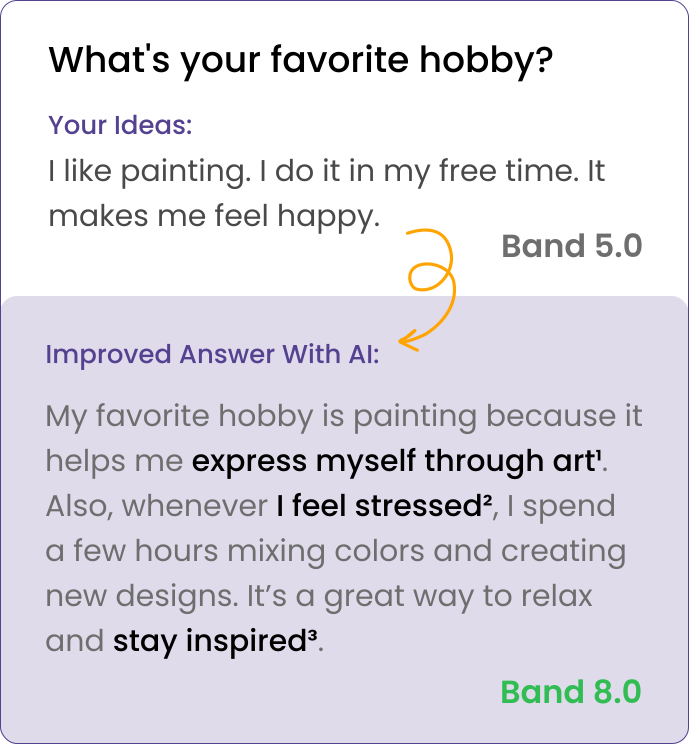
Practice IELTS Speaking answers in our free app
- Build personalized answers that match your target band.
- Turn short replies into fluent answers
- Let examiners fall in love with your answers!
Related Articles
Sample Answers
IELTS Speaking Part 1: Concentration Questions & Answers (Sep-Dec 2026)
Latest Sep-Dec 2026 IELTS Speaking Part 1 questions for Concentration. Read Band 9 sample answers, or use our AI app to turn your own ideas into perfect answers.
Sample Answers
IELTS Speaking Part 1: Jewelry Questions & Band 9 Answers (2026)
Latest Sep-Dec 2026 IELTS Speaking Part 1 questions for Jewelry. Read Band 9 sample answers or generate personal answers using our AI.
Sample Answers
IELTS Speaking Part 1: Colors Questions & Answers (Sep-Dec 2026)
Latest Sep-Dec 2026 IELTS Speaking Part 1 questions for Colors. Read Band 9 sample answers, or use our AI app to turn your own ideas into perfect answers.