Describe a Time You Gave Advice: Part 2 Cue Card (2026)
Use our AI to get a personalized Band 9 answer and vocabulary for the IELTS Speaking Part 2 Cue Card "Describe a time you gave advice".
Start Practicing →The "Describe a time you gave advice" Cue Card is still relevant in 2026 and it falls under the Past Event category. To achieve Band 7+, you need to clearly articulate the problem, the specific advice given, and the outcome. You must use specific high-level vocabulary like sedentary lifestyle, constructive criticism, and transformation to describe the situation effectively, rather than just saying "he changed his life."
How to Use This Sample Answer
Below is a sample answer for a fitness enthusiast who advised a friend on weight loss. If this matches your story, great. But what if you advised a colleague about a career move? Or a sibling about university choices?
So here is the plan:
Read this sample answer to understand the structure of a Band 7+ answer.
Use the IELTS Speaking Lab App to instantly generate your own personal answer to this Cue Card with perfect vocabulary that describes your specific situation.
Part 2 Cue Card and Sample Answer
Describe a time you gave advice to someone. You should say:
Who you gave advice to
What the advice was
Why you gave this advice
And explain how the person reacted to your advice.
Band 9 Sample Answer
Answer: I would like to talk about a time I gave some crucial advice to one of my best friends, Murat. He had been struggling with his weight for years and was feeling quite depressed about his appearance and low energy levels. Since I am quite passionate about fitness and health, he approached me for guidance on how to lose weight effectively without making himself miserable.
Add detail: My advice was centered around the concept of a calorie deficit and adopting a sustainable lifestyle change rather than a "crash diet." I told him that he needed to abandon his sedentary lifestyle and incorporate at least 30 minutes of sport or activity into his daily routine. I also introduced him to intermittent fasting, explaining that it wasn't about starving himself, but rather controlling when he ate. I emphasized that consistency was the key to success, not perfection.
Anecdote: I remember taking him grocery shopping to overhaul his pantry. We threw out all the processed food and sugary drinks and replaced them with whole foods like lean protein and vegetables. At first, he was skeptical and grumpy because he missed his snacks, but after two weeks, he called me excitedly to say he had turned a corner and actually felt more energetic.
Explain: I gave this advice because I was genuinely worried about his long-term well-being. Seeing his physical transformation was incredibly rewarding. He reacted very positively in the long run; he has now lost over 20 kilograms and has even inspired other members of his family to get healthy. It made me realize the power of honest, constructive criticism combined with support.
This answer uses the AAAE Strategy (Answer, Add detail, Anecdote, Explain).
Part 3 Questions and Sample Answers
After you finish your Cue Card, the examiner will ask you deeper questions related to advice and communication.
1. Is it better to get advice from a friend or a professional?
It depends on the gravity of the situation. For personal issues or emotional support, a friend is often better because they know your personality and can offer empathy. However, for technical matters like legal disputes, medical issues, or financial planning, it is essential to seek professional consultation. Relying on a friend for medical advice, for example, could be dangerous if they lack the necessary expertise.
2. Why do some people dislike receiving advice?
I think it often comes down to pride or ego. Unsolicited advice can sometimes feel like judgment, which puts people on the defensive. They might feel that the advice-giver is being condescending or acting superior. Furthermore, if the advice implies they need to change a comfortable habit, like their diet or work routine, they might resist it out of fear of the unknown.
3. What are the problems with advice given on the internet?
The main problem is the lack of credibility. Anyone can post advice on social media without any qualifications, leading to the spread of misinformation, especially regarding health and nutrition. Also, internet advice is usually generic; it doesn't take into account an individual's specific circumstances. What works for a fitness influencer might be harmful to an average person.
4. Should parents give advice to their children or let them make their own mistakes?
It is a delicate balance. Parents should definitely provide guidance and share their wisdom to prevent serious harm. However, they must also allow their children to make minor mistakes. Experiencing failure is a powerful learning tool that builds resilience. If parents "helicopter" and solve every problem, the child may grow up lacking critical decision-making skills.
Key Vocabulary for IELTS Cue Card: Giving Advice
Here is the complete glossary of the vocabulary used in the answers above, plus extra high-level words relevant to this topic.
Calorie deficit: (Noun) The state of burning more calories than you eat, essential for weight loss.
Condescending: (Adj) Having or showing a feeling of patronizing superiority.
Consistency: (Noun) The quality of always behaving or performing in a similar way (sticking to the plan).
Constructive criticism: (Phrase) Advice that is useful and intended to help or improve something, rather than just being negative.
Consultation: (Noun) A meeting with an expert or professional to seek advice.
Credibility: (Noun) The quality of being trusted and believed in.
Crucial advice: (Phrase) Extremely important or necessary advice.
Decision-making skills: (Phrase) The ability to choose the best course of action.
Defensive: (Adj) Very anxious to challenge or avoid criticism.
Delicate balance: (Phrase) A situation where two opposing forces need to be carefully managed.
Empathy: (Noun) The ability to understand and share the feelings of another.
Expertise: (Noun) Expert skill or knowledge in a particular field.
Fear of the unknown: (Phrase) A psychological fear of unsure or uncertain situations.
Generic: (Adj) Characteristic of a whole group or class; not specific.
Gravity of the situation: (Phrase) The seriousness or importance of a situation.
Guidance: (Noun) Advice or information aimed at resolving a problem or difficulty.
Helicopter: (Verb - slang) To hover over someone (usually a child) and control their every move.
Intermittent fasting: (Noun) An eating pattern that cycles between periods of fasting and eating.
Misinformation: (Noun) False or inaccurate information.
Overhaul: (Verb) To take apart and repair or improve something extensively.
Pride or ego: (Phrase) A sense of self-importance that prevents someone from accepting help.
Processed food: (Phrase) Food that has been altered from its natural state, often with added sugar or chemicals.
Resilience: (Noun) The capacity to recover quickly from difficulties; toughness.
Sedentary lifestyle: (Phrase) A type of lifestyle with little or no physical activity.
Sustainable: (Adj) Able to be maintained at a certain rate or level; realistic for the long term.
Transformation: (Noun) A thorough or dramatic change in form or appearance.
Turned a corner: (Idiom) To pass the critical point in a process (usually moving from bad to good).
Unsolicited advice: (Phrase) Advice that is given when it was not asked for (often considered rude).
Whole foods: (Phrase) Food that has been processed or refined as little as possible.
Create Your Own Band 9 Answers
The answer above is perfect—if you advised someone on weight loss. But what if you advised someone on saving money? Or breaking up with a partner?
Your answers need to be true so that you can easily recall them during a stressful exam.
IELTS Speaking Lab helps you turn your real ideas into Band 9 answers.
Select your cue card - Describe a time you gave advice.
Input your rough idea (e.g., "I told my brother to study engineering instead of art").
Get personalized Band 9 answer instantly, with the perfect vocabulary for your story.
Not happy with these answers?
Change the core idea, band level difficulty, length and get a full glossary in our free app!
Start Practicing →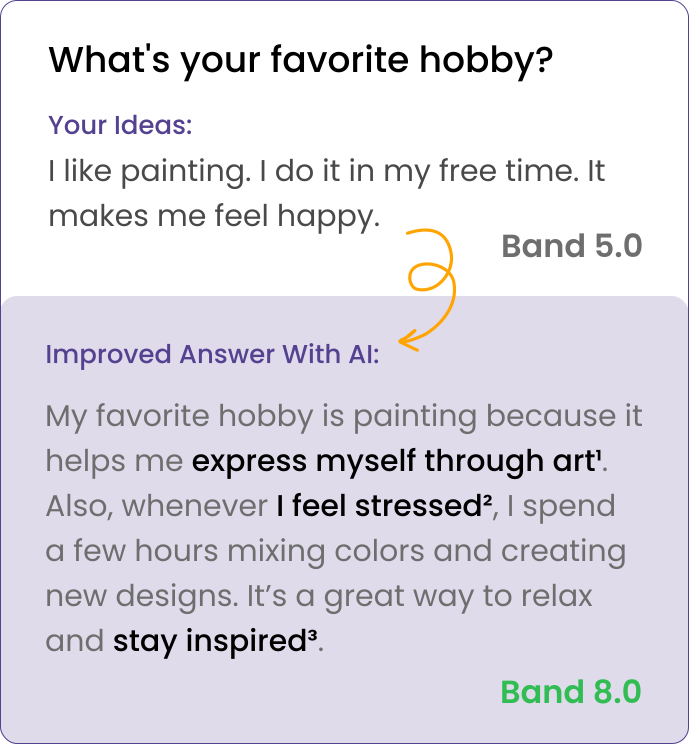
Practice IELTS Speaking answers in our free app
- Build personalized answers that match your target band.
- Turn short replies into fluent answers
- Let examiners fall in love with your answers!
Related Articles
Sample Answers
IELTS Speaking Part 1: Concentration Questions & Answers (Sep-Dec 2026)
Latest Sep-Dec 2026 IELTS Speaking Part 1 questions for Concentration. Read Band 9 sample answers, or use our AI app to turn your own ideas into perfect answers.
Sample Answers
IELTS Speaking Part 1: Jewelry Questions & Band 9 Answers (2026)
Latest Sep-Dec 2026 IELTS Speaking Part 1 questions for Jewelry. Read Band 9 sample answers or generate personal answers using our AI.
Sample Answers
IELTS Speaking Part 1: Colors Questions & Answers (Sep-Dec 2026)
Latest Sep-Dec 2026 IELTS Speaking Part 1 questions for Colors. Read Band 9 sample answers, or use our AI app to turn your own ideas into perfect answers.